


Summary
The West Asia conflict is most severely impacting the poor and low-income people in Nepal, as elsewhere. Instead of addressing the woes of these people, the new government of Nepal is evicting squatters without following due process, thus thereby exacerbating these people’s vulnerabilities.
Nepal’s new Prime Minister, Balendra Shah, and most members of his cabinet were sworn in on 27 March 2026, almost exactly a month after the United States (US)-Israel-Iran war began on 28 February 2026. Therefore, the new government inherited the fallout of the war, which became more pronounced since the formation of the new government in Nepal. While the existing and possible future impacts of the war have compounded the government’s challenges, it might also provide a respite to the Rastriya Swatantra Party (RSP). This is because the RSP, which has formed the government, has pledged several difficult-to-achieve results with the Nepali people conditional upon the situation remaining under its control. In case the party fails to fulfil its promises, what else could shield it if not the impacts of the war? Nevertheless, the government needs to be cognisant of the possible immediate impacts of the war and prioritise their redressal.
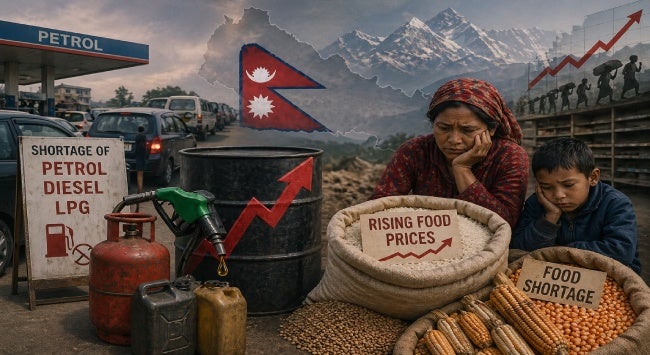
As elsewhere, Nepal has already started facing multifaceted impacts of the war. As the Nepal Customs data show, while there has been a reduction in petroleum product imports into the country, their prices have skyrocketed. The three most important petroleum products that Nepal imports are diesel, petrol and liquified petroleum gas (LPG). Diesel is mostly used to run larger passenger and cargo vehicles such as buses and trucks and heavy-duty vehicles used in construction. As a result of reduced supply and higher prices of diesel, transport operators have raised their fares. This has mainly affected people who regularly use these mass transportation services. The rise in cargo transport fares ultimately is transmitted to consumers, thus impacting the people’s purchasing capacity. Inadequate supply of diesel and other petroleum items used in construction has slowed down construction activities.
Petrol is mostly used in smaller, private transportation means, particularly motorcycles and four-wheeled vehicles. In the past few years, with a rise in Nepal’s hydropower generation and distribution, the country has seen a massive rise in the penetration of electric vehicles (EVs), also aided by favourable government policies. Therefore, the effects of a supply crunch and rising prices of petrol is somewhat cushioned in the smaller, four-wheeler segment. However, since the use of motorcycles is ubiquitous throughout the country, including for use in ride-hailing services and, hence, an income source for several individuals, supply reduction and price rise of petrol is detrimental to a significant section of the Nepali population.
Regarding LPG, which is used for cooking in households as well as hotels and restaurants, a reduction in its supply and an increase in its price has a wide-ranging impact. Nevertheless, as in the case of EVs, Nepali people, mostly living in bigger towns and cities, have also resorted to the increasing use of induction cooking stoves since experiencing India’s blockade in 2015 and with increasing availability of electricity. On the other hand, many households in rural areas still primarily use traditional biomass for cooking. The groups that are most affected by reduced supply of LPG are hotels and restaurants that cannot switch to other means, and low-income people who rely on LPG and cannot afford to keep an alternative option such as induction stoves. The downsizing or shutting down of businesses, including hotels and restaurants, will also mostly impact the relatively low-income people due to a loss in their employment.
There are reports that the disruption of international flights has significantly reduced tourist arrivals in Nepal. This is a major setback in a country where the domestic economy has been performing poorly and tourism is an important sector, including for employment. Similarly, the failure in the timely distribution of fertiliser has been a perennial problem in Nepal. The crisis in West Asia will significantly add to this woe, in terms of both the lack of adequate fertiliser and a significant rise in the price of what might be available. In addition, the El Nino is forecast to bring in less-than-usual rain this monsoon season. Therefore, there are high possibilities of losses in farmers’ incomes and an impact on the country’s food security situation.
Another major impact of the crisis must be borne by the Nepali migrant workers living in the Gulf Cooperation Council (GCC) countries. A Nepali national was killed in the United Arab Emirates by falling debris when Iran-fired missile was intercepted. A Nepali citizen working as a captain in a Dubai-based shipping company was taken into custody by Iran from the Strait of Hormuz.
There are nearly two million Nepali migrant workers in the GCC countries who contribute around 40 per cent of the total remittances that Nepal receives. So far, the crisis has not significantly impacted these workers in terms of job losses requiring them to return home. However, living in countries that are highly import-dependent for daily essentials, the low-income earners are the ones that will be affected the most because of the short supply of essentials and/or a rise in prices.
If the war prolongs and/or intensifies, it is highly possible that the migrant workers would need to be evacuated. In that case, while it will gravely impact the workers individually, it will also hugely impact Nepal’s economy that has been largely underpinned by the remittances it receives from abroad. Moreover, evacuating millions of people in a short timeframe will be a daunting challenge.
Therefore, as is the case usually during crises, the extraordinary impact of the West Asia crisis is on low-income and poor people. Addressing the challenges that are already present and preparing for potential ones should be the priority of the current government in Nepal. However, it appears that the government is focused on other tasks that could be placed as later priorities. The prime minister’s instructions to clear public spaces and unorganised settlements occupied mostly by the poor and the landless forcefully without following due process is one such misplaced priority.
. . . . .
Dr Puspa Sharma is a Senior Research Fellow at the Institute of South Asian Studies (ISAS), an autonomous research institute in the National University of Singapore (NUS). He can be contacted at puspa.sh@nus.edu.sg. The author bears full responsibility for the facts cited and opinions expressed in this paper.
Pic Credit: Chatgpt
-
 More From :
-
 Tags :
-
 Download PDF