


Summary
While New Delhi and Seoul are eager to deepen their strategic partnership, stalled economic cooperation is acting as a drag on the relationship. In comparison to India, Vietnam has been far more successful in courting South Korean investments and trade.
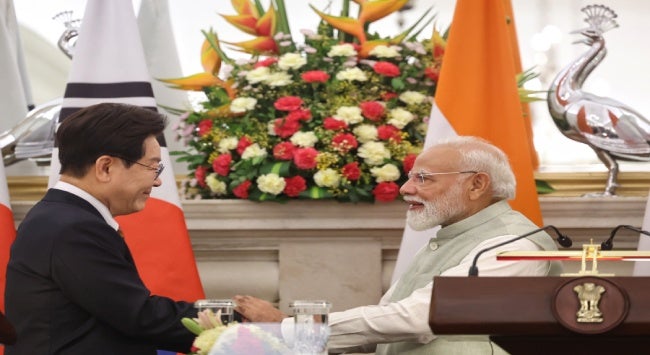
South Korean President Lee Jae Myung managed to achieve a remarkable number of substantive outcomes in his three-day visit to New Delhi last week. India and South Korea agreed on a Joint Vision for their Special Strategic Partnership, an extensive plan to cooperate on sustainability issues, and the establishment of a bilateral Industrial Cooperation Committee. The two countries signed onto each other’s signature green initiatives such as India’s International Solar Alliance and South Korea’s Global Green Growth Institute. As a geopolitical signal, South Korea joined the India-led Indo Pacific Oceans Initiative.
India and South Korea also committed to developing several significant joint ventures, including a shipyard in Southern India, a POSCO-JSW Steel project in Odisha and a Hyundai-TVS Motor partnership to produce electric three-wheelers. With an eye towards the ongoing Iran War, the two sides agreed to work together to ensure the stability of energy resource trade, since South Korea buys naphtha and other petroleum feedstocks from India and, in turn, exports petroleum products and lubricant base oils.
The success of Lee’s visit underscores the strong desire in both New Delhi and Seoul to strengthen their bilateral ties. South Korea occupies a key position in India’s ‘Act East’ policy which aims at enhancing New Delhi’s engagement with Eastern Asia. Similarly, India is central to South Korea’s New Southern Policy launched in 2017 as a way to diversify Seoul’s dependence on the great powers. However, despite maintaining a ‘Strategic Partnership’ since 2010, which was upgraded to a ‘Special Strategic Partnership’ in 2015, India-South Korea relationship remains stagnant and shallow relative to its potential.
Since the end of the Cold War, the two fundamental drivers of the relationship have been the convergence of strategic interests and the promise of economic complementarity. Strategically, the common challenge of managing China’s rise draws the two countries together. In the past, they also shared concerns over the nuclear cooperation between Pakistan and North Korea. Defence cooperation has proven to be a fertile ground, with the joint production of K9 Vajra-T Howitzer adapted from South Korean technology. The case for India-South Korea economic partnership is even stronger. South Korea’s strengths in capital and technology pair well with India’s advantages in low-cost labour and resources. The imperative of China+1, that is, the need to diversify supply chains away from China, further incentivises deeper economic cooperation between India and South Korea.
Yet India-South Korea economic relationship has been underperforming. Bilateral trade has grown sluggishly from US$20.5 billion (S$27.7 billion) in 2011 to US$27 billion (S$36.5 billion) in 2026. During Lee’s visit, the two governments promised to raise bilateral trade to US$50 billion (S$67.5 billion) by 2030. However, they have failed to reach similar targets before. In 2012, New Delhi and Seoul promised to raise bilateral trade to US$40 billion (S$54 billion) within three years but failed to get there.
South Korean investments in India have grown slowly in the last decade, making up less than one per cent of total foreign direct investment (FDI) into India. Most South Korean FDI into India is concentrated in a few ventures by large firms aimed at exploiting the domestic market rather than using India as an export platform. Small South Korean firms remain hesitant to enter the Indian market. The majority of the FDI is directed in automobile and steel sectors and strikingly low amounts is aimed at high-technology manufacturing such as electronics or machinery.
An apt comparison is Vietnam-South Korea economic partnership, which has soared in the last three decades despite several historical and geopolitical causes of friction. The two are each other’s third-largest export destinations, with bilateral trade touching nearly US$95 billion (S$128.3 billion). Ten thousand South Korean firms have invested close to US$100 billion (S$135 billion) in Vietnam as compared to 700 Korean companies that have put US$6 billion (S$8.1 billion) into India.
One reason for India-South Korea trade underperformance is that Indian market remains relatively closed to South Korea, as evident from Table 1. India offers South Korea zero tariffs on 3,316 items as opposed to 5,008 by Vietnam. India levies more than five per cent tariff on 1,427 items compared to just 107 by Vietnam.
Table 1: Number of tariff lines applied by India and Vietnam on South Korean products

Source: Calculated by the author from Country-wise Tariff Data from WITS, 2022
The 2010 India-South Korea Comprehensive Economic Partnership Agreement (CEPA) remains a source of contention because New Delhi believes it has allowed South Korea to build an enormous trade surplus. During Lee’s visit, India’s Commerce Minister Piyush Goyal called the CEPA “irrational” and “lopsided”. The two sides have been renegotiating the agreement since 2016 but are yet to reach a conclusion. Notably, South Korea also enjoys enormous trade surplus over Vietnam but Hanoi views it as a sign of tight supply chain integration.
South Korean firms have faced regulatory and political hurdles in India. The most notable case was the projected POSCO investment of US$12 billion (S$16.2 billion) in Odisha that was derailed due to local resistance to land acquisition. South Korea’s foreign ministry notes that India has subjected South Korea to more cases of import regulations than any other country. Recently, New Delhi has tried to compensate for these challenges by proposing establishment of a “Korea enclave” in India.
Despite the challenges, the interest in deepening India-South Korea relationship persists in both New Delhi and Seoul. However, Indian officials sometimes do not fully appreciate that, as is true in most East Asian countries, commercial issues are central to South Korean foreign policy thinking. India-South Korea strategic partnership cannot reach its full potential without strong foundation of economic cooperation.
. . . . .
Dr Sandeep Bhardwaj is a Research Fellow at the Institute of South Asian Studies (ISAS), an autonomous research institute at the National University of Singapore (NUS). He can be contacted at sbhardwaj@nus.edu.sg. The author bears full responsibility for the facts cited and opinions expressed in this paper.
Pic Credit: Joint Strategic Vision for India-ROK Special Strategic Partnership | Prime Minister of India
-
 More From :
-
 Tags :
-
 Download PDF