


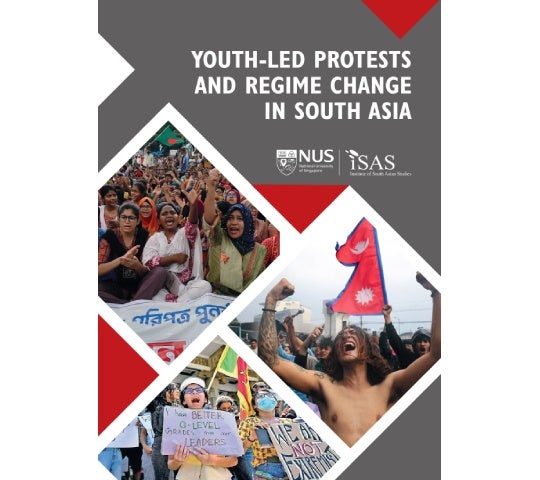
| Title: | Youth-Led Protests and Regime Change in South Asia |
| Author/s: | Rajni Gamage, Tanujja Dadlani, Kanika Kaur |
| Abstract: | The Special Report examines the changing nature of the state in South Asia, where traditional power structures are facing increasing pressure from a politically active and digitally connected generation of young citizens.
Based on discussions at the 2026 International Conference on South Asia, organised by ISAS at NUS, the report explores the wave of youth-led protests, mass uprisings and extra-electoral regime changes that have reshaped the region since 2022. The report focuses on three key dimensions: the structural drivers of dissent, including economic pressures, debt and youth disillusionment; the mechanics of mobilisation, particularly the rise of decentralised and leaderless digital networks; and the future of governance, including the challenge of turning protest movements and revolutionary momentum into lasting policy and constitutional reforms. |
| Date: | 25 September 2026 |
| Read More |
| Title: | Agency and Constraints: Small States in the New World Order – Perspectives from Nepal |
| Author/s: | Puspa Sharma, Kanika Kaur, Devyani Chaturvedi |
| Abstract: | This Special Report examines how Nepal can navigate a changing global order while preserving strategic autonomy. Drawing on an expert roundtable convened in Kathmandu on 3 June 2025 by ISAS, Nepal Economic Forum and its platform, the Himalayan Future Forum, it explores Nepal’s strategic position between India and China and the need for more flexible diplomacy as geopolitical competition intensifies.
The report highlights Nepal’s potential sources of leverage, including its diaspora, youthful population and Himalayan position, and argues that stronger institutions, diversified partnerships and proactive diplomacy can enhance its strategic agency. |
| Date: | 19 August 2026 |
| Read More |
| Title: | Politics of Post-Uprising Reform in Bangladesh and Sri Lanka: Rule of Law, Institutions and Constitutional Reforms |
| Author/s: | Rajni Gamage, Imran Ahmed, Roshni Kapur, Saeeduddin Faridi |
| Abstract: | In January 2026, ISAS and Konrad Adenauer Stiftung jointly organised a workshop that examined the recent political transitions in Sri Lanka and Bangladesh, with references to Nepal, following major democratic uprisings. Using a comparative perspective, the participants discussed the causes of these political changes and the challenges of institutional reform, democratic renewal and state-building in the post-uprising period.
The discussions, which are contained in this Special Report, also considered these developments within broader global debates on democratic resilience and governance. Participants explored the capacity of new governments to deliver reforms while navigating domestic and international challenges, highlighting the importance of strong institutions, the rule of law and effective governance in sustaining democratic transitions. |
| Date: | 16 July 2026 |
| Read More |
| Title: | AI Governance in the Indo-Pacific: Competition, Sovereignty and Strategic Adaptation |
| Author/s: | Karthik Nachiappan |
| Abstract: | Artificial intelligence (AI) governance is becoming a major policy challenge in the Indo-Pacific as AI increasingly shapes economic competitiveness, national security, digital sovereignty and workforce transformation. While the United States (US) and China dominate global AI development, the Southeast Asian countries are developing their own approaches to harness AI’s benefits while managing risks related to regulation, jobs and technological dependence.
This Special Report examines how the Southeast Asian nations are balancing opportunities from both US and Chinese AI investments without becoming overly reliant on either. It also highlights the importance of cooperation with Germany and Europe to promote shared principles that ensure AI development supports openness, human dignity and a stable international order. |
| Date: | 23 June 2026 |
| Read More |
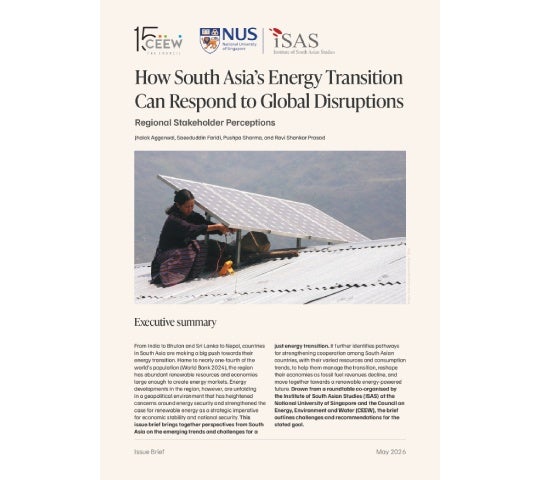
| Title: | How South Asia’s Energy Transition Can Respond to Global Disruptions: Regional Stakeholder Perceptions |
| Author/s: | Jhalak Aggarwal, Saeeduddin Faridi, Pushpa Sharma, Ravi Shankar Prasad |
| Abstract: | The South Asian countries – from India and Bhutan to Sri Lanka and Nepal – are accelerating their energy transition. Home to nearly a quarter of the world’s population, the region has vast renewable resources and growing energy markets. At the same time, geopolitical uncertainties have heightened concerns around energy security, reinforcing renewable energy as both an economic and strategic priority.
This Special Report brings together regional perspectives on the key trends and challenges shaping a just energy transition. Drawing from a roundtable co-organised by ISAS and the Council on Energy, Environment and Water, India, the report outlines pathways for greater regional cooperation to support the transition, manage declining fossil fuel revenues, and advance a shared renewable energy future. |
| Date: | 15 May 2026 |
| Read More |
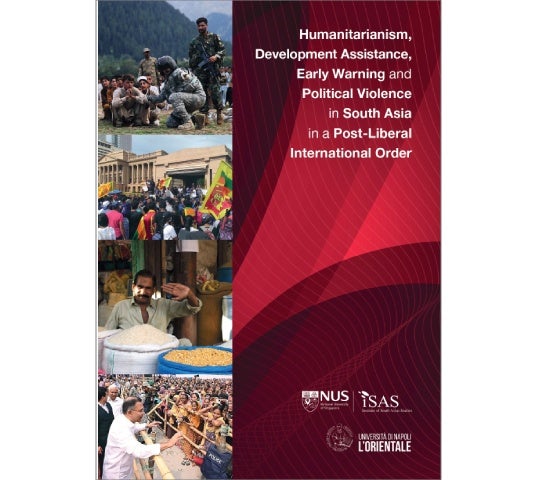
| Title: | Humanitarianism, Development Assistance, Early Warning and Political Violence in South Asia in a Post-Liberal International Order |
| Author/s: | Ruth Hanau Santini, Andrea Novellis, Rajni Gamage, Devyani Chaturvedi |
| Abstract: | ISAS, in collaboration with the University of Naples “L’Orientale”, convened an online roundtable in October 2025 on humanitarianism, development assistance, early warning and political violence in South Asia within a post-liberal international order. The participants noted the limitations of current predictive tools and called for hybrid approaches that combine qualitative and quantitative methods. They emphasised that despite technological advances, gaps in implementation persist, requiring improved transparency, data sharing and coordination, alongside a more anticipatory and cooperative global framework for effective humanitarian action.
Drawing on these discussions, this report examines how intersecting global crises – such as conflict, economic instability and climate change – are reshaping humanitarian action and early warning systems in South Asia and the broader Global South. It finds that overlapping challenges are straining the capacity of states and international institutions, particularly amid a weakening liberal international order characterised by reduced multilateral cooperation, politicisation of aid and shifting global priorities. |
| Date: | 29 April 2026 |
| Read More |
Load more