


Summary
The second phase of the West Bengal assembly election, with polling in 142 constituencies, will be held on 29 April 2026. The districts that will vote in the second phase include Kolkata and several high-profile constituencies.
The first phase of the assembly election in West Bengal on 23 April 2026 saw a record turnout of nearly 93 per cent. This was more than 10 per cent higher than the voter turnout in 2021. There are various reasons being suggested for the high turnout.
The record turnout is partly a function of the Indian Election Commission’s Special Intensive Survey (SIR), which saw as many as nine million voters – about 12 per cent of West Bengal’s 76 million voters – being deleted from the electoral rolls. So even if the voter turnout was roughly similar to the 2021 election, the percentage would have gone up by around 10 per centage points due to the smaller number of total eligible voters. However, absolute voting numbers have also gone up by 200,000 in 152 seats that went to election, which provides evidence for greater voter enthusiasm this time.
Ground reports suggest that the SIR might have had something to do too with the urgency of voters to cast their ballots. Many voters, especially Muslims, who constitute 27 per cent of the state’s population, and migrant labourers, who earn their livelihood outside the state and number over two million, believed that if they did not cast their votes in this election their names might get struck from the electoral rolls. This meant that the vast number of voters from West Bengal made their way back from different parts of the country to cast their votes.
All the districts where polling took place showed marginal increases from 2021. However, the Muslim-majority seats showed exceptionally high voting. The five assembly seats with the highest deletions, all in the Muslim-dominated Murshidabad district which has 22 constituencies, saw voting in excess of 96 per cent.
Traditionally, it was believed in India that a high turnout usually hurts the incumbent. However, studies have shown that this is not always true. Unsurprisingly, both the ruling Trinamool Congress (TMC) and the primary challenger, the Bharatiya Janata Party (BJP), have claimed victory in the first phase.
While the veracity of such claims will only be proven when the results are declared on 4 May 2026, the stage is now set for the second phase where 142 of the 294 constituencies go to poll. The districts that will vote in the second phase include Kolkata, Howrah, Nadia, North 24 Parganas, South 24 Parganas, Hooghly and Purba (East) Bardhaman. These districts are considered the TMC’s stronghold. Unlike the first phase, which consisted of constituencies where the BJP won a majority of their 77 seats in 2021, the TMC won 123 of the 143 seats going to poll in the second phase in 2021.
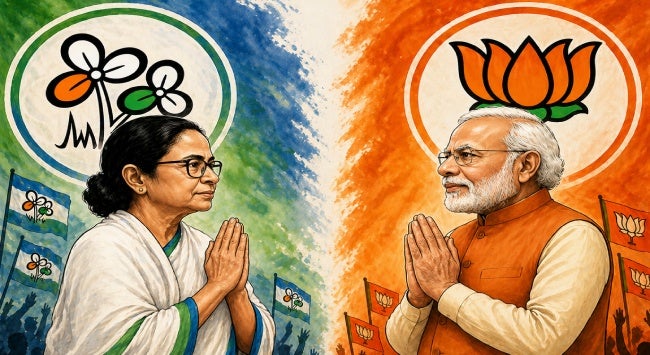
The second phase will also see some of the most high-profile contests, including in the Bhabanipur constituency in Kolkata where West Bengal Chief Minister Mamata Banerjee is pitted against the BJP’s Suvendu Adhikari, the leader of the opposition in the state legislative assembly. Adhikari had defeated Mamata by a slim margin in Nandigram in the 2021 assembly election. This time, Adhikari is contesting both the Nandigram and the Bhabanipur assembly seats. Though Mamata has won from Bhabanipur three times, the last time in a bypoll in 2021 with a margin of 58,000 votes, the constituency has lost around 51,000 voters due to the SIR. Some believe this could make the contest closer than anticipated.
The SIR has also cast a shadow over the Scheduled Caste Matua-Namasudra community, many of whom have migrated from Bangladesh and are present in large numbers in North 24 Parganas and Nadia districts. In North 24 Parganas, where the Matuas comprise 30 per cent of the population, over 300,000 Matua voters have been deleted from the rolls. The BJP, which has assiduously wooed the Matuas with promises of citizenship, won five of the 33 seats in North 24 Parganas in 2021, most of them with thin margins. If the Matuas turn away from the BJP over the SIR, it could have an impact on the party’s prospects in the second phase. To counter the impact of the SIR, on 26 April 2026, Prime Minister Narendra Modi, in an election rally in Thakurnagar – the nerve centre of the Matuas – assured them of citizenship through the Citizenship (Amendment) Act, 2019.
With elections over in the other states and West Bengal being the only one with a two-phase poll, both Modi and Home Minister Amit Shah have been camping and campaigning extensively in the state. While this reflects the intense desire of the BJP to win in West Bengal for the first time ever, it is also testimony to the weakness of the BJP’s local leadership. Party leaders like Adhikari, who defected from the TMC to the BJP in 2020 soon after corruption charges were levelled against him, do not have a statewide following. Adhikari’s rise within the BJP has also led to the sidelining of some of its long-time leaders like Dilip Ghosh, a former party president and member of parliament, who is contesting from the Kharagpur Sadar constituency.
It will only be known on 4 May 2026 whether Mamata has been able to withstand the effects of anti-incumbency and the extraordinary effort put in by the BJP and Modi to defeat her.
. . . . .
Dr Ronojoy Sen is Senior Research Fellow and Research Lead (Politics, Society and Governance) at the Institute of South Asian Studies (ISAS), an autonomous research institute at the National University of Singapore (NUS). He can be contacted at isasrs@nus.edu.sg. The author bears full responsibility for the facts cited and opinions expressed in this paper.
Pic Credit: Chatgpt
-
 More From :
-
 Tags :
-
 Download PDF