


Japan-Pakistan Economic Relations:
From Missed Opportunities to Partnership?
Imran Ahmed, Tanujja Dadlani
21 August 2026Summary
Japan and Pakistan are seeking to expand an economic relationship that has historically remained limited despite longstanding areas of complementarity. Renewed cooperation in critical minerals and technology offers an opportunity to translate these shared interests into deeper investment and commercial ties.
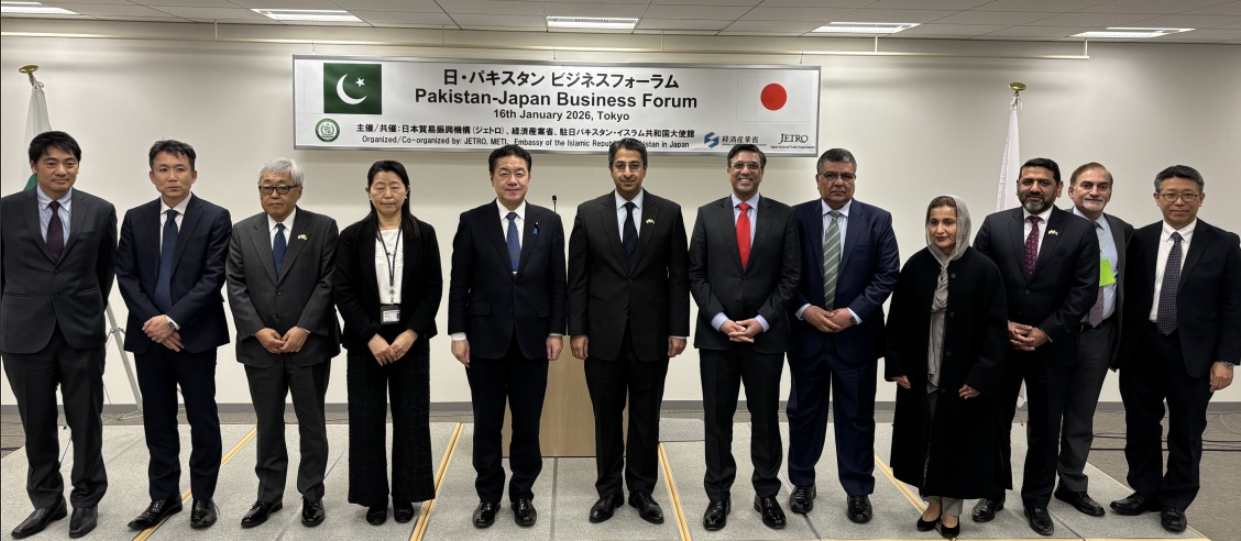
In January 2026, Japanese and Pakistani officials and business leaders met in Tokyo for the first Japan-Pakistan Government-Business Joint Dialogue, held there since 2018. The discussions pointed to renewed interest in expanding a bilateral economic relationship that has remained relatively limited. Pakistan identified minerals and mining, information technology and agricultural products as areas for greater cooperation, while Japan emphasised trade, investment and improvements to Pakistan’s business environment. The dialogue comes as concerns over economic security and supply-chain resilience are creating new incentives for closer ties. Japan’s efforts to diversify its sources of critical minerals, alongside Pakistan’s need for greater foreign investment, provide a potential basis for such engagement. The question is whether this convergence of interests can transform a historically limited relationship into a more substantive economic partnership.
Economic complementarity between Japan and Pakistan is not new. Before Pakistan’s independence, Japan had already developed significant trading links with the region through its demand for cotton. After 1947, the economic needs of the two countries created further opportunities for cooperation. Japan was rebuilding its economy after the Second World War and required raw materials, while newly independent Pakistan needed manufactured goods, machinery and support for industrial development. However, this early complementarity did not develop into a deeper industrial partnership. As Japan subsequently emerged as a major industrial economy, relations with Pakistan remained centred largely on trade and development assistance rather than sustained investment, technology transfer and industrial cooperation.
Despite decades of diplomatic relations, economic ties between Japan and Pakistan remain relatively modest. In 2023, Pakistan exported JPY33.7 billion (S$270.4 million) worth of goods to Japan, principally cotton products, textiles and chemicals, while Japanese exports to Pakistan reached JPY146.9 billion (S$1.18 billion) and included automobiles, machinery and steel. Direct commercial links are also limited, with 74 Japanese-affiliated companies operating in Pakistan and Japanese direct investment amounting to only US$5 million (S$6.36 million) in 2023-24. Japan has nevertheless remained an important development partner. By 2023, it had provided Pakistan with JPY817.48 billion (S$6.56 billion) in loans and JPY307.59 billion (S$2.47 billion) in grants. This combination of substantial development assistance but comparatively limited trade and investment illustrate the central challenge in the relationship. The renewed engagement between the two countries will, therefore, depend on whether they can move beyond the traditional donor-recipient relationship towards cooperation based on shared economic interests.
Critical minerals provide one of the clearest opportunities to change this dynamic. Japan is seeking to diversify and secure supplies of critical minerals, with State Minister of Economy, Trade and Industry Ino Toshiro describing “securing alternative sources of critical minerals” as “an urgent issue” in June 2026. The Reko Diq copper and gold project illustrates this convergence of interests. In November 2025, Japanese financial institutions were reported to be considering approximately US$300 million (S$381.4 million) in financing connected to the project as Japan sought to strengthen access to copper supplies. The significance of Reko Diq therefore extends beyond a single investment since it demonstrates how Pakistan’s resources and Japan’s capital, technology and demand for critical minerals could provide the basis for a more commercially driven relationship.
Technology and skilled labour offer another avenue for deeper cooperation. The Pakistan Economic Survey 2025-26 describes the information technology and telecommunications sector as “one of the most dynamic and strategically pillar of Pakistan’s economy, playing a decisive role in productivity enhancement, export diversification, digital sovereignty and inclusive growth.” Japan, on the other hand, faces continuing demand for expertise in technology and other specialised industries. In December 2025, a Pakistan Business Seminar in Tokyo highlighted the country’s “strong pool of qualified ICT engineers” and potential to meet Japanese demand. The potential for such cooperation was reinforced the following month when Japan’s Ambassador to Pakistan Akamatsu Shuichi highlighted Japanese companies’ efforts to connect with skilled Pakistani professionals.
The opportunity for closer cooperation should not, however, be overstated. Japan and Pakistan enter this period from vastly different economic positions. Pakistan continues to face political and economic instability, limited industrial capacity, and an investment environment that can make sustained foreign engagement difficult. Japan, meanwhile, already has extensive economic relationships across East and Southeast Asia which gives it alternatives to deepening engagement with Pakistan. The experience of the early postwar period, therefore, remains relevant. Economic complementarity alone did not produce a durable partnership then, and it may not necessarily do so now. The renewed engagement of 2026 provides an opportunity to avoid another missed opportunity, but what matters is whether the dialogue can be translated into sustained investment and commercial cooperation. If it can, the current moment may mark a shift from the longstanding promise of Japan-Pakistan economic cooperation towards its realisation.
. . . . .
Dr Imran Ahmed is a Research Fellow at the Institute of South Asian Studies (ISAS), an autonomous research institute at the National University of Singapore (NUS). He can be contacted at iahmed@nus.edu.sg. Ms Tanujja Dadlani is a Research Analyst at the same institute. She can be contacted at tanujjad@nus.edu.sg. The authors bear full responsibility for the facts cited and opinions expressed in this paper.
Pic Credit: METI
-
 More From :
-
 Tags :
-
 Download PDF