


Summary
Recent flash floods in Nepal and Tibet should serve as a wake-up call for the countries in the region. There is a need for effective cooperation among the Himalayan countries on environmental matters.
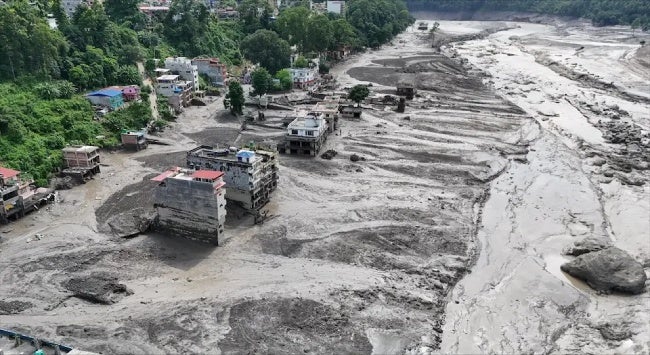
On 26 August 2026, disastrous floods struck the Nepal-Tibet (China) border, in which, as of now, around 794 people have been killed and more than 2,500 are missing. In Tibet, the official death toll is 16 and 546 are reported missing. At the Gyirong Port in Xigaze City on the Tibet-Nepal border, buildings in the border-crossing complex, including the border gate and a building housing customs and immigration agencies, were destroyed by the mudslide. In Nepal, besides killing people, the floods have also reportedly displaced thousands of people and destroyed about 40 kilometres of road, 19 motorable bridges, 45 suspension bridges and some hydropower plants.
Initial reports suggested that the flash floods were triggered by a 4.4-magnitude earthquake in the region. However, the United States Geological Survey later clarified that the disaster was the result of a “glacial collapse”. The impact of the collapsed part hitting the bottom of the valley was so hard that it registered as a 5.2-magnitude earthquake. Mohammad Farooq Azam, a cryosphere specialist at the International Centre for Integrated Mountain Development (ICIMOD)in Kathmandu, said, “The glacier collapse was 100 to 200 million cubic meters in size and hit the valley 1000 meters below”. Officials from Nepal’s National Disaster Risk Reduction Management Authority said the collapse occurred on Langtang Lirung mountain on the Nepali side. It is believed that due to the glacier collapse, a “large volume of ice and rock debris” entered the Lende Khola River, causing a sudden surge that carried water, mud and rock downstream.
Beyond the cause and origin of the floods, questions were raised over whether China could have issued an early warning after border facilities at the Rasuwagadhi-Gyirong crossing and Gyirong Port were hit, potentially saving many lives in downstream areas. However, the Chinese Embassy rejected the claim, stating that such a warning had not been withheld and calling for “cooperation” to save lives rather than engaging in such “accusations”.
On cross-border cooperation, under the Agreement on the Boundary Management System 2019, Nepal and China agreed not to attempt to change, or to cause to be changed, the course of shared rivers. If the river changes its course, both sides will take measures to restore it to its original course. The two countries also agreed to build consensus on “construction, administration and maintenance of cross-border facilities”. Six years later, following the flood incident in July 2025 in Nepal, in which 11 people died and Miteri Bridge (Friendship Bridge) at Rasuwagadhi was washed away, the two countries agreed to share cross-border real-time information on floods and landslides and to flag potential risks of glacial lake outburst floods. However, they did not sign any formal agreement on this. Nepal again raised the matter during the visit of its foreign minister, Shisir Khanal, to Beijing in May 2026. Following the August 2026 floods, officials from Nepal’s Department of Hydrology and Meteorology and the China Meteorological Administration again agreed in a virtual meeting to cooperate on weather monitoring, forecasting and the exchange of meteorological information.
Climate change is often considered a major factor contributing to natural disasters. Due to rising temperatures, glaciers around the world are weakening. In the Nepal-Tibet floods case, the link between disaster and climate change has not yet been established. A study by Gunjan Silwal et al. shows that glacier loss accelerated in the Langtang catchment region between 1964 and 2023, but the number of glaciers increased over the decades due to fragmentation, separation and disconnection.
Furthermore, the impact of various forms of construction activities on the ecology cannot be ignored as a contributing factor in any natural disaster. For instance, hydropower projects across the world have reconfigured water as a commodity within a “hydrocapitalist” framework and serve as a “wealth extraction mechanism”. There are more than 550 hydro projects – operational or under construction – in the Bhutanese, Indian, Nepalese and Pakistani Himalayan region.
Some Nepalis alleged that Beijing’s construction of a town near the course of the Trishuli River caused the disaster. In April this year, Nepal’s government asked China to halt building a safety wall along the Bhote Koshi River, fearing that it may affect the river’s course and cause damage to its side. Nepal, nevertheless, has built and plans many projects in the country. For instance, to produce around 28,500 megawatts of electricity by 2035, according to Independent Power Producers Nepal, investments have already been made in about 923 projects that are at different stages of construction. More than 60 per cent of large hydroprojects are in the Bagmati or Gandaki provinces.
The increasing number of natural disasters in the Hindu Kush Himalayan (HKH) region (Afghanistan, China, Nepal, Bangladesh, Bhutan, Pakistan, India and Myanmar) calls for effective institutional cooperation on environmental matters, regardless of the nature of bilateral political ties among the countries. This is required because, in some cases, due to a contiguous border, a natural disaster in one country often affects the others. For instance, due to a shared hydrological system, Nepal’s situation raised flood alarms in parts of the Indian states of Bihar and Uttar Pradesh. Also, in a few cases, human activities in one country raise environmental concerns in another. The ICIMOD is “an intergovernmental knowledge and learning centre” works on behalf of the people from the HKH region. Furthermore, within the respective countries, decisions regarding environmental issues need to be democratised and decentralised, providing sufficient space for dissent and safeguarding the future health of the ecology.
. . . . .
Dr Amit Ranjan is a Research Fellow at the Institute of South Asian Studies (ISAS), an autonomous research institute at the National University of Singapore (NUS). He can be contacted at isasar@nus.edu.sg. The author bears full responsibility for the facts cited and opinions expressed in this paper.
Pic Credit: UNICEF USA
-
 More From :
-
 Tags :
-
 Download PDF