


Summary
Brazil, Russia, India, China and South Africa (BRICS) Foreign Ministers’ Meeting in New Delhi in mid-May 2026 highlighted the deepening internal contradictions of the now expanded forum. Sharp disagreements over the Middle East conflict prevented the adoption of a joint statement, leading India to issue a Chair’s Statement instead. New Delhi’s central challenge in BRICS is to preserve the forum as a practical instrument for reforming global governance while preventing it from fragmentation amid the shifting dynamic among the great powers.
When India assumed the chairmanship of the Brazil, Russia, India, China and South Africa (BRICS) bloc for 2026, it inherited a grouping that has garnered much international interest but one that is more internally divided. What began in 2009 as a loose coalition of Brazil, Russia, India, and China – with South Africa joining in 2010 – has evolved into a broader political platform that now includes countries such as Iran, the United Arab Emirates (UAE), Egypt, Ethiopia and Indonesia. Many more countries are eager to join the grouping. Expansion has increased BRICS’ demographic heft and economic salience. However, it has also magnified internal contradictions.
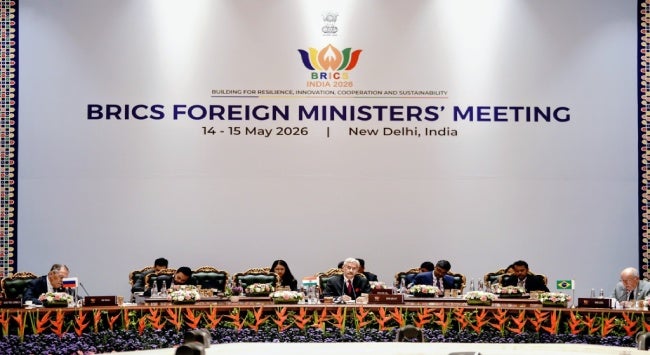
The BRICS Foreign Ministers’ Meeting in New Delhi from 13 to 15 May 2026 brought into focus the difficulties India was bound to confront during its presidency. Guided by the theme of ‘Building for Resilience, Innovation, Cooperation and Sustainability’, New Delhi sought to focus attention on practical cooperation and institutional reform. The inability of the foreign ministers to issue a joint communiqué, however, underscored the widening gap between the bloc’s growing ambitions and its limited political cohesion.
The immediate trigger for the breakdown was the disagreement over the conflict in the Middle East and the deepening conflict between two of its members – Iran and the UAE. Caught between two important partners, India had to issue a Chair’s Statement that acknowledged divergence on key issues in the Middle East, Palestine and the freedom of navigation. The statement emphasised dialogue and diplomacy on contested issues while highlighting agreement on a broad range of other global issues.
India, however, did not flinch from asserting its own interest in freedom of navigation in the Hormuz Strait. As Minister for External Affairs S Jaishankar declared in India’s national statement, “Safe and unimpeded maritime flows through international waterways, including the Strait of Hormuz and Red Sea, remain vital for global economic well-being”.
Even before the BRICS ministerial meeting concluded, Indian Prime Minister Narendra Modi headed to Abu Dhabi to express India’s solidarity with the UAE and its people and “strongly condemn” the attacks on it by Iran. Although Modi did not mention Iran by name, India’s deepening ties with the UAE were reflected in several new agreements, including a framework for defence cooperation that were signed during Modi’s visit.
The New Delhi meeting served as a reminder that BRICS is no cohesive bloc that many see as the great hope of the non-western world to end American hegemony. It is a coalition of states that may share dissatisfaction with aspects of the current international order but differ sharply on some key issues. Since its inception, BRICS has often been strongest in rhetoric and weakest in implementation. The creation of the New Development Bank was an important institutional achievement, but beyond that, many initiatives have remained aspirational.
India’s four priorities for the 2026 summit – resilience, innovation, cooperation and sustainability – seek to inject practical content into the agenda. The objective is to focus on functional cooperation without being detained by ideological posturing. A major challenge for India is to prevent BRICS from becoming defined primarily by opposition to the West. Russia, China and Iran often view BRICS as a vehicle to contest America’s global influence and reshape the international order.
India’s strategic partnerships with the United States (US), Europe, Japan and key Gulf states remain central to its foreign policy. New Delhi is acutely conscious that both Moscow and Beijing are themselves seeking better relationships with Washington even as they seek to mobilise the middle powers against the US. India has no desire to undermine its most important bilateral relationship – with the US – in the name of strengthening BRICS. At the same time, India is not about to discard its long nurtured political equities in the Global South and its support for the democratisation of the global order.
India’s BRICS presidency also unfolds against the backdrop of its complex relationship with China. Beijing has been the principal driver of BRICS expansion and sees the grouping as an important platform for projecting influence across the Global South. India welcomes a more representative international order but remains wary of any institutional arrangement that reinforces Chinese primacy.
The challenge for New Delhi is to keep BRICS sufficiently inclusive and productive while ensuring that its agenda is not subsumed by Beijing’s strategic priorities. This balancing act has long shaped India’s approach to multilateral diplomacy: participate actively, shape outcomes where possible, and resist domination by any single power.
India must also navigate the practical consequences of unilateral sanctions on BRICS members, especially Iran and Russia. These sanctions complicate trade, financing, and connectivity projects, including India’s investment in the Chabahar Port. The Chair’s Statement criticised unilateral coercive measures, reflecting a broad BRICS concern that sanctions often impose disproportionate costs on developing economies.
At a broader level, India sees BRICS as a platform to advance “reformed multilateralism”. This concept has been a recurring theme in Indian diplomacy over the last decade. It calls for updating institutions such as the United Nations Security Council, the International Monetary Fund and the World Bank to reflect contemporary economic and political realities.
It is not in India’s power to eliminate the structural contradictions within BRICS. Its task is to try and ensure that the internal divergence does not paralyse the grouping and prevent the quest for multipolarity turning into a fragmentation of the non-Western world.
. . . . .
Professor C Raja Mohan is an Honorary Senior Fellow at the Institute of South Asian Studies (ISAS), an autonomous research institute at the National University of Singapore (NUS). He can be contacted at crmohan53@gmail.com. The author bears full responsibility for the facts cited and opinions expressed in this paper.
Pic Credit: X
-
 More From :
-
 Tags :
-
 Download PDF