


Bangladesh’s Search for Partners:
Strategic Autonomy and Regional Balance
Sreeradha Datta
20 May 2026Summary
Since the February 2026 election that brought the Bangladesh Nationalist Party coalition led by Tarique Rahman to power, Bangladesh has seen a surge of engagement from external powers. While partnerships with countries such as China, the United States and Pakistan present significant opportunities, India will remain Bangladesh’s most consequential neighbour, regardless of broader geopolitical shifts. Arguably, establishing a cooperative framework between India and Bangladesh is the key to bilateral and regional stability.
Bangladesh held its 13th parliamentary election in February 2026 after a turbulent period marked by the collapse of the Awami League-led government and an 18-month interim administration. The election was expected to restore stability and reset Indo-Bangladesh ties. Although India viewed the polls as lacking inclusivity, broad international support made acceptance of the outcome inevitable. Tarique Rahman assumed office as Prime Minister, leading the winning Bangladesh Nationalist Party (BNP) coalition, while the Jamaat-e-Islami alliance emerged as the opposition.
Following the fleeing of ousted Prime Minister Sheikh Hasina to India in August 2025, New Delhi and Dhaka experienced a level of animosity, especially in the social media. A series of quick developments led to the two neighbours rapidly revoking much of their ongoing bilateral practices. Expectedly, the situation was to change post February 2026. Despite the right political rhetoric from both sides, full political ties are yet to be restored although visa issuances have begun.
In meantime, India, breaking away from its erstwhile practice, chose a politician, Dinesh Trivedi, to be the next Indian High Commissioner to Bangladesh, conveying a desire to strengthen political ties which have clearly flagged over the past few years. The Bharatiya Janata Party’s (BJP) victory in the West Bengal assembly election also holds the potential to improve bilateral ties. Tarique Rahman’s call for a BNP-BJP dialogue gains greater significance in light of the BJP’s recent electoral mandate in the state.
Presently, water-sharing issues have assumed renewed urgency, with the 30-year-old Ganges Water Treaty due for renewal in December 2026 and the long-discussed Teesta River water-sharing agreement expected to return to the negotiating table. An interim arrangement appears likely, as New Delhi can no longer cite resistance from the state government in the way it did previously.
While West Bengal’s position on Bangladesh is now likely to differ from that of the previous state government, it is hoped that improved coordination between the state and the Centre will enable West Bengal to emerge as a key pivot in strengthening ties with Bangladesh. This, in turn, would give New Delhi greater scope to advance measures aimed at enhancing cross-border connectivity and trade.
Recent state election campaigns in West Bengal and Assam saw sharp rhetoric surrounding undocumented migration from Bangladesh into India, including calls for pushbacks across the border. An issue long avoided by both neighbours deserves a more structured and informed bilateral discussion. Addressing these concerns through appropriate platforms is essential, particularly as unilateral cross-border measures by India have inherent limitations and risk undermining its ‘Neighbourhood First’ policy.
While India seems to be measured in its Bangladeshi policies, recent moves by its neighbours and other external powers point to a calibration of their engagement with Bangladesh.
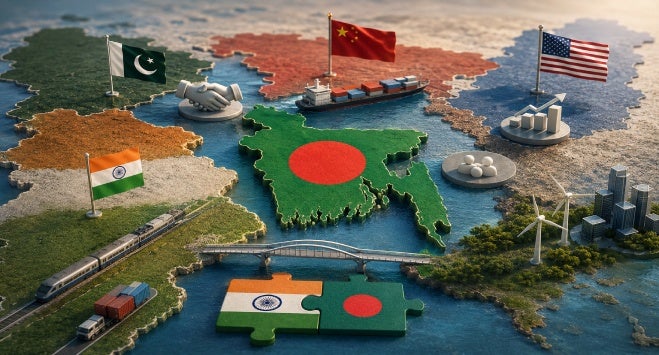
Following Tarique Rahman’s election as Prime Minister, Bangladesh appears to have become a renewed focus of engagement for China, Pakistan and the United States (US). While these powers remained actively involved even during the interim government period, the post-election phase has given them greater cause to converge in Dhaka.
The May 2026 visit of Bangladesh Foreign Minister Khalilur Rahman to China reaffirmed the strong partnership between the two countries and built upon their earlier bilateral commitments. Beijing reiterated its support to Bangladesh and Myanmar to help find “a mutually acceptable solution” to the issue of forcibly displaced people from Myanmar’s Rakhine State.
China has also continued to deepen its engagement with Bangladesh in practical ways. During Bangladesh’s interim government period, when Indian medical visas became limited, China stepped in to facilitate access for Bangladeshi patients. During the latest visit, Dhaka once again raised the long-discussed Teesta River management project with Beijing. More recently, China also extended invitations to Bangladeshi youths to experience its culture firsthand, signalling an effort to strengthen people-to-people ties alongside strategic cooperation.
The US has also seemed to have warmed up to Bangladesh now moving past its squabble over democracy and human rights issues. In 2025, there were intensive negotiations between Washinton and Dhaka which culminated in a formal reciprocal trade agreement in early 2026 with Dhaka committing to buy Boeing aircrafts for nearly US$4 million (S$5.4 million) over the next few years. However, while a defence deal seems to be in the offing, rumours are rife over their maritime cooperation as well as American demand for a naval base in the littoral waters of Bangladesh.
India is likely to view the growing proximity between Bangladesh and both China and the US with caution. However, the more significant source of concern may be the renewed outreach from Pakistan. After more than 15 years of limited engagement, bilateral ties between Dhaka and Islamabad have seen a noticeable revival, marked by a series of high-level exchanges over the past two years, including the visit of Pakistan’s Deputy Prime Minister and Foreign Minister Ishaq Dar to Dhaka last year. Notably, a memorandum of understanding signed earlier this month by the two Foreign Secretaries on combating narcotics trafficking and related transnational crime included an intelligence-sharing arrangement for a period of 10 years – a development likely to attract close attention in New Delhi.
Amid global realignments, India is unlikely to align with external powers on matters concerning South Asia. Its engagement with Bangladesh goes beyond trade and connectivity, encompassing geography, security and regional stability. As New Delhi assesses Dhaka’s strategic reliability, signs of disengagement could carry long-term consequences for both countries and the wider region. Despite their differences, New Delhi and Dhaka must continue to build on common interests, as their partnership remains vital for regional stability and growth.
. . . . .
Dr Sreeradha Datta is a Non-Resident Senior Fellow at the Institute of South Asian Studies (ISAS), an autonomous research institute at the National University of Singapore (NUS). She is also Professor at the Jindal School of International Affairs at O.P. Jindal Global University, India. She can be contacted at sreeradha@yahoo.com. The author bears full responsibility for the facts cited and opinions expressed in this paper.
Pic Credit: ChatGPT
-
 More From :
-
 Tags :
-
 Download PDF