


Summary
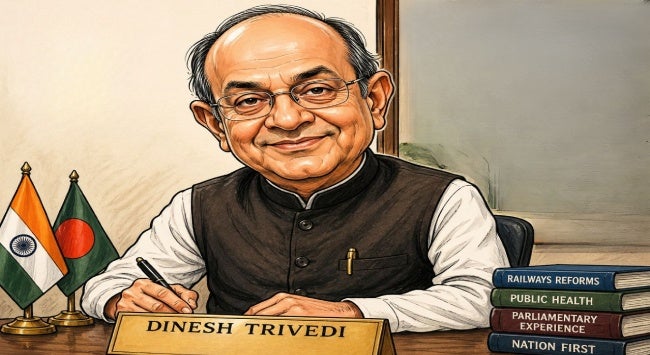
As India and Bangladesh seek to reset ties, several outstanding issues will require political resolution. The appointment of Dinesh Trivedi as India’s next High Commissioner to Bangladesh signals the Narendra Modi government’s intent to give political engagement a central role in improving bilateral relations with Dhaka.
According to Indian media reports, veteran Bharatiya Janata Party (BJP) politician from the Indian state of West Bengal, Dinesh Trivedi, is set to replace Pranay Verma as India’s High Commissioner to Dhaka. Verma has been named as India’s next Ambassador to Belgium and the European Union. Trivedi will be the first political appointee to head the Indian High Commission in Dhaka. In the past, India appointed individuals from non-diplomatic backgrounds to lead diplomatic missions in the neighbourhood.
Trivedi hails from a Kolkata-based Gujarati business family that immigrated from Pakistan to India during Partition in 1947. He is a former Union Railways Minister and Minister of State, Health and Family Welfare. He has close to three decades of parliamentary experience and was awarded the “Outstanding Parliamentarian” for the 2016-17 period. Before joining the BJP in 2021, the 75-year-old Trivedi served as a member of various political parties, including the Congress, the Janata Dal and the All India Trinamool Congress.
The decision to appoint Trivedi has been widely welcomed by several Indian news outlets. Shishir Gupta writes in Hindustan Times that “the appointment of Dinesh Trivedi is a clear signal from the [Narendra] Modi government that it is not averse to sending political leaders as India’s envoys to key countries, and these much sought-after postings are not merely a preserve of Indian Foreign Service officers.” The Rashtriya Swayammsevak Sangh’s publication, Organiser writes, “[The] appointment of Dinesh Trivedi as Bangladesh High Commissioner reflects the strategic importance asserted by New Delhi to the relations with Bangladesh, as it marks a high-profile appointment.” In Frontline magazine, Faisal Mahmud contends that the decision shows that New Delhi admits that “the old Hasina-centric approach will no longer work”.
Trivedi’s appointment comes at a pivotal moment as India and Bangladesh move to reset ties following 18 months of strained political relations. India and Bangladesh have differences on several key issues, including water sharing. In an interview with New Delhi-based NDTV, Bangladesh’s Foreign Minister Khalilur Rahman said, “As both countries are interested in rebuilding relations, the Ganges water-sharing agreement – based on fairness and climate resilience – will be the first test of fixing bilateral ties.”
However, the most politically sensitive issue between the two countries is the extradition of deposed Bangladeshi Prime Minister Sheikh Hasina, who is living in New Delhi. Whether India will extradite Hasina is a widely discussed topic in Bangladesh. In early April 2026, Khalilur Rahman, during a stopover in New Delhi, said, “We have already asked for [Sheikh Hasina’s] return under our extradition treaty. We reiterated that”. Before Rahman’s arrival in New Delhi, Humayun Kobir, foreign affairs advisor to Bangladesh’s Prime Minister Tarique Rahman said, “We have to create a new space for a new relation because Hasina-India relation will no longer be possible. Hasina is a spent force in Bangladesh, and her influence is non-existent.” He added that the two sides should have more regular exchanges “at the level of political parties and officials to deal with “difficult issues” so that misunderstandings are avoided”. On Hasina, India’s foreign ministry maintains that “The request is being examined as part of ongoing judicial and internal legal processes. We will continue to engage constructively on the issue with all stakeholders”.
The practice of political appointments to diplomatic posts is not new. In his second term, United States President Donald Trump’s administration has made a total of 76 appointments – career diplomats accounted for only six appointees while the rest were political or other appointees. Making a distinction between political leaders and professional diplomats, Jeffrey Robertson observes that political leaders rely on their domestic constituencies while diplomats are trained professionals. He further finds that political leaders need a quick fix while professional diplomats have the patience to reach an acceptable position for the other side. A political appointee is usually suspected of serving his/her political party while a career diplomat is trained to serve the state. It is also believed that through political appointments, the country’s political leadership exerts increasing control over events in important diplomatic missions.
It may not hold in every case, but through their constant engagement with diverse constituencies, elected politicians are often better attuned to public sentiment, more adept at reading fellow leaders and more skilled at navigating the political landscape. They are also more flexible in their approach and do not hesitate to move beyond the complex world of protocols. Further, a political appointee is sent by the country’s leadership to achieve a clearly stated political objective.
With Trivedi in Dhaka, the Modi government has signalled its readiness to strengthen ties with Bangladesh through direct political engagement. On sensitive matters such as Hasina’s potential extradition, which are inherently political, the presence of a political appointee may help facilitate a solution acceptable to both sides – without diluting New Delhi’s position or compromising its long-term interests
. . . . .
Dr Amit Ranjan is a Research Fellow at the Institute of South Asian Studies (ISAS), an autonomous research institute at the National University of Singapore (NUS). He can be contacted at isasar@nus.edu.sg. The author bears full responsibility for the facts cited and opinions expressed in this paper.
Image: Chatgpt
-
 More From :
-
 Tags :
-
 Download PDF