


Summary
India’s capital, New Delhi, was placed under a lockdown on 10 October 2026 to prevent protests organised by the Cockroach Janta Party (CJP) against India’s Chief Election Commissioner. CJP members and several opposition leaders were detained but were later released.
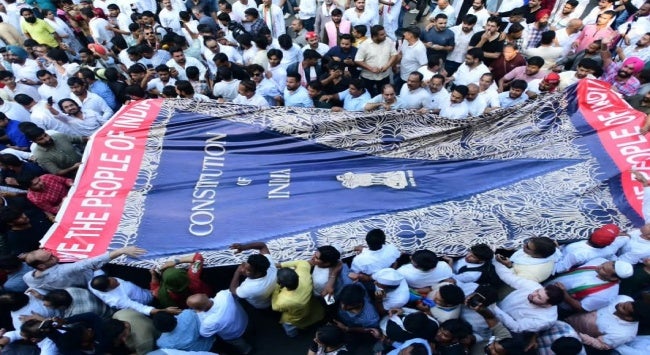
On 10 October 2026, Indian security forces turned New Delhi into a fortress in anticipation of protests called by the Cockroach Janta Party (CJP) against India’s Chief Election Commissioner (CEC) Gyanesh Kumar. The CJP had called for protests after a media investigation revealed disagreements among the three election commissioners on the controversial Special Intensive Review (SIR) of electoral rolls.
Nearly 40,000 security personnel descended on the streets of New Delhi to thwart the protests. Delhi Police detained an estimated 7,000 people, 45 metro stations were shut, several long-distance trains cancelled, main roads barricaded and internet services suspended in parts of the city. CJP members, including Abhijeet Dipke, Saurav Das and Ashutosh Ranka, were detained inside an aircraft once they landed in New Delhi on a flight from Mumbai. They were released on 11 October 2026. Several opposition leaders, including former chief ministers Mamata Banerjee, Arvind Kejriwal and Pinarayi Vijayan, were stopped and taken to detention centres where they were held for several hours.
The Supreme Court, in a special hearing on 11 October 2026, told the Centre that restrictions on public assembly and movement must comply with the conditions laid down under Article 19(2) of the Indian Constitution. Article 19(2) allows “reasonable restrictions” on freedom of speech and expression on various grounds, including “public order”, which still gives the government elbow room to impose curbs. The court asked the government to ensure that Delhi Metro and rail services operate normally, and internet services remain uninterrupted. The court also served contempt notices to several senior government functionaries, including Delhi’s police commissioner, for disregarding its 9 October 2026 order against an “outright prohibition” of metro and other transportation.
The CJP has remained defiant in the face of the government’s extraordinary measures. The movement’s leaders have said that they will continue their protests until the CEC resigns. They have also sought permission from Delhi Police to hold protests at Jantar Mantar, the site of their earlier sit-in against former education minister Dharmendra Pradhan. However, Delhi Police has sought to stymie the protesters by “de-notifying” Jantar Mantar as a designated protest site, naming other alternatives such as Ramlila Maidan in central Delhi. The other opposition parties too have pledged to continue the protests against Kumar. On 12 October 2026, the opposition, led by the Congress’ Rahul Gandhi, marched as a united front to the Supreme Court to submit a petition against the ECI.
While Prime Minister Narendra Modi and Home Minister Amit Shah, whose ministry is in charge of Delhi Police, have remained silent on the crackdown, several Bharatiya Janata Party (BJP) leaders have defended the show of force. BJP national president Nitin Nabin resurrected the “foreign hand”, which used to routinely figure during Indira Gandhi’s tenure as prime minister. He alleged that the opposition was “attempting to destabilise the country in collusion with foreign powers”. Another BJP leader and the party’s national spokesperson Sambit Patra claimed that “democracy triumphed over mob rule”. The BJP Chief Minister of Delhi, Rekha Gupta, described the CJP as the “B-team” of the Congress and the Aam Aadmi Party and said India’s citizens had “rejected” both the CJP and other opposition parties.
The protests might have been thwarted for the time being but the core issue of the legitimacy of the ECI’s actions in conducting the SIR remains to be addressed. The Indian government’s stand is that there has been no wrongdoing, and the opposition is spreading lies and anarchy.
The government’s show of strength and the statements emanating from its leaders also indicate a hardening in attitude towards the CJP from the time of the earlier protests against Pradhan. During those protests, the government had underestimated the CJP. After having initially dismissed the CJP as a minor nuisance, the government was caught by surprise at the movement’s popularity, particularly among India’s youth. This led to the government capitulating to the CJP’s demand for Pradhan’s resignation. It also prompted a rethink of the outreach strategies of the government and the prime minister on social media.
This time around, the government went to the other extreme by not even permitting the protests to take place and imposing a clampdown the likes of which has rarely been seen in Delhi. The handling of the situation is a signal of the government’s belief that, unlike the issue of mismanagement of examinations, the charges against the ECI are not an issue that will galvanise voters.
For the CJP, though, the scale of the government’s crackdown is a sign of how far it has travelled from being an internet phenomenon to one that is capable of rattling a government that is loath to show any weakness. It has also forced the government to take steps that sit uneasily with a democracy with constitutional rights to protest.
The Supreme Court too is now firmly in the picture, not only to judge the allegations against the CEC but also the legitimacy of the government’s crackdown. On the ECI, the court had initially backed the SIR despite reports of irregularities. By admitting the petitions demanding Kumar’s dismissal, the court has signalled that the CEC’s actions and the SIR need to be scrutinised. On the crackdown, the court has already hinted that it might have been disproportionate. Both issues are likely to roil Indian politics in the coming days.
. . . . .
Dr Ronojoy Sen is a Senior Research Fellow and Research Lead (Politics, Society and Governance) at the Institute of South Asian Studies (ISAS), an autonomous research institute at the National University of Singapore (NUS). He can be contacted at isasrs@nus.edu.sg. The author bears full responsibility for the facts cited and opinions expressed in this paper.
Pic Credit: X
-
 More From :
-
 Tags :
-
 Download PDF