


Summary
The Ganga/Ganges Waters Treaty between India and Bangladesh is set to expire on 12 December 2026, leaving its future uncertain as the deadline approaches. Bangladesh is seeking a long-term agreement that includes a guarantee clause, while India’s Janata Dal (United), a key ally of Prime Minister Narendra Modi’s government, has opposed its renewal.
In around two months’ time, the Ganga/Ganges Waters Treaty (GWT), signed by India and Bangladesh in 1996, will expire. India’s Ministry of External Affairs spokesperson, Randhir Jaiswal, said that all river-related matters are discussed by the Joint Rivers Commission and that “…the technical level meetings on [the] Ganga Water Treaty have continued to happen”. However, Bangladesh media reports say that Dhaka has formed a technical committee to discuss the GWT and has informed India on multiple occasions since last June, but it has not yet received any response. Nevertheless, Bangladesh’s Water Resources Minister, Md Shahiduddin Chowdhury Anee, “based on the meetings held so far”, expressed hope that the “agreement will be completed” before the GWT expires in December 2026.
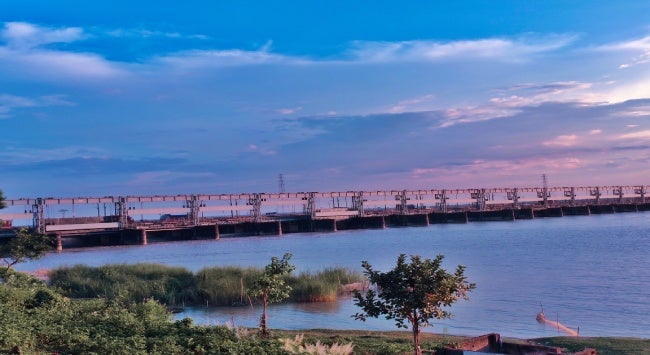
Physically, after entering the Indian state of West Bengal near Manikchak in Malda from Jharkhand, the Ganga River splits into two near Mithipur in Murshidabad District, located about 40 kilometres downstream of the Farakka. From there, one branch flows for about 65 kilometres along the India-Bangladesh border, leaving India at Jalangi and entering Bangladesh through Shibganj Upazila in Chapainawabganj District. Another, the Bhagirathi-Hooghli branch, flows southward.
In 1977 and 1996, India and Bangladesh signed major arrangements to share the Ganga waters. There are five major differences between the two agreements. First, the water arrangement signed on 5 November 1977 was when Ziaur Rahman, father of Bangladesh’s Prime Minister Tarique Rahman, was the president of the country. On the other hand, the 1996 water arrangement was signed by the Sheikh Hasina-led government. The former bears the stamp of the ruling Bangladesh Nationalist Party while the latter carries Hasina’s legacy. Second, the 1977 arrangement is called an agreement, while the 1996 arrangement is a treaty.
Third, the political context of the 1977 agreement differed from that of the GWT. The 1977 agreement was signed after Bangladesh raised the water-sharing issue on various platforms, including the United Nations (UN), in 1976, where the UN General Assembly issued a consensus statement. Unlike in 1977, the 1996 treaty was mainly a result of the election of an India-friendly government in Dhaka, the Gujral Doctrine – advocated by then Indian Foreign Minister I K Gujral – and support from then Chief Minister of West Bengal, Jyoti Basu. At that time, even Bangladesh realised the significance of addressing the Ganga water matter with India. Fourth, the 1977 agreement was signed by Indian Cabinet Minister Surjit Singh Barnala and a Member of Bangladesh’s President’s Council of Advisers, Rear Admiral Musharraf Hussain Khan. The GWT was signed by the two prime ministers – H D Deve Gowda and Hasina.
Fifth, Article II (ii) of the 1977 Agreement, states, “Provided that if the actual availability at Farakka of the Ganga waters during a 10-day period [from January to May as mentioned in column 1 of the agreement] is higher or lower than the quantum shown in column 2 of the Schedule [mentions flows reaching Farakka which is based on 75 per cent availability from observed data of 1948-73,] it shall be shared in the proportion applicable to that period.” It adds, “Provided further that if during a particular 10-day period, the Ganga flows at Farakka come down to such a level that the share of Bangladesh is lower than 80 per cent of the value shown in column 4 [mentions quantity of water release to Bangladesh], the release of waters to Bangladesh during that 10-day period shall not fall below 80 per cent of the value shown in column 4”. In 1982, under a memorandum of understanding, Bangladesh agreed to delete what is interpreted as a guarantee clause, and it was agreed that any excess or deficit would be shared proportionally between the two countries.
In the 1996 Treaty, Article II (iii) says, “In the event flow at Farakka falls below 50,000 cusecs in any 10-day period [mentioned in Annexure II of the GWT], the two governments will enter into immediate consultations to make adjustments on an emergency basis, in accordance with the principles of equity, fair play and no harm to either party.”
The GWT faces some questions and opposition. Manjur Chowdhury, chairman of the Bangladesh River Conservation Commission, calls GWT “three decades old and flawed”, and former Bangladeshi Foreign Secretary, Farooq Sobhan, who had negotiated the treaty, notes that the absence of the arbitration clause is a problem. Sobhan said, “India had promised to build a barrage for Padma (Ganga) in Bangladeshi territory at that time…That was the quid pro quo for not including the arbitration clause [in the GWT]. But that barrage was not built”. In India, Sanjay Kumar Jha, President of the Janata Dal (United), an important coalition partner of the Narendra Modi-led government, calls for fresh negotiations on the Ganga water sharing with Bangladesh.
In the current political environment, a decision on the GWT may prove a major factor in shaping the future trajectory of India-Bangladesh ties. However, the challenge is to meet the contrasting demands of various actors.
. . . . .
Dr Amit Ranjan is a Research Fellow at the Institute of South Asian Studies (ISAS), an autonomous research institute at the National University of Singapore (NUS). He can be contacted at isasar@nus.edu.sg. The author bears full responsibility for the facts cited and opinions expressed in this paper.
Pic Credit: Shutterstock
-
 More From :
-
 Tags :
-
 Download PDF