


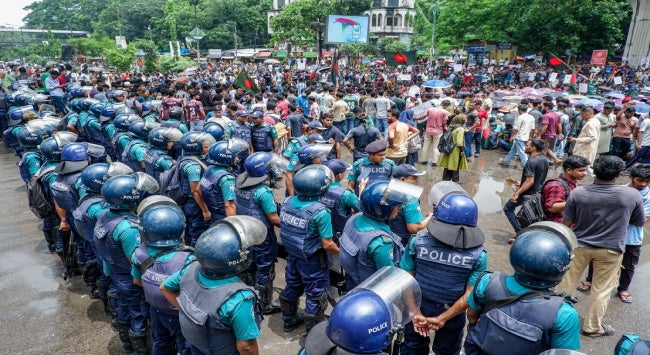
The BNP’s Law and Order Challenge:
Crime, Patronage and Political Accountability
Imran Ahmed, Sheikh Muzzammil Hussen
14 October 2026Summary
Restoring law and order was one of the Bangladesh Nationalist Party (BNP) government’s central promises after taking office in February 2026. It inherited a weakened security system following the July 2024 uprising, but seven months later, law and order have become a major source of political criticism. Crime statistics have become part of this debate. The government argues that violence is not historically exceptional, but the opposition claims the state is losing control. More concerning are allegations that people associated with the ruling party are using their political connections to engage in extortion, land grabbing and violence. Whether the BNP can distinguish its rule from the political practices it promised to replace is becoming a central test of its ability to govern.
Seven months after taking office, the Bangladesh Nationalist Party (BNP) faces growing pressure over law and order. The political challenge is not simply whether crime has increased, but whether the government can prevent people associated with the ruling party from using their political connections to engage in extortion, land grabbing and violence. Such activities risk undermining the BNP’s promise to restore public order.
The BNP won the general election and formed the government under Prime Minister Tarique Rahman in February 2026. Restoring law and order was one of its central promises. Policing had weakened badly after the July 2024 uprising, and the new government inherited a security system still struggling to recover. Seven months later, however, law and order has become one of the main lines of political attack against the government.
The national crime figures provide an important but contested backdrop. Police headquarters recorded 99,992 cases nationwide between February and July 2026. These included 1,791 murders, 512 kidnappings, 11,165 cases of violence against women and children and 317 attacks on police. Monthly murder figures also remained high, rising from 250 in February 2026 to 326 in June 2026. In the government’s first three full months, police registered 915 murders, an average of more than 10 a day.
These figures do not by themselves establish that Bangladesh has become more violent under the BNP. Police argue that many murders arise from longstanding personal disputes rather than politics. Of 605 murders recorded in March 2026 and April 2026, police attributed 55.5 per cent to previous enmity and only 0.5 per cent to political causes. The authorities have also pointed out that Bangladesh has recorded between 3,000 and 4,500 murders annually over the past decade. The dispute is, therefore, partly about how the figures should be interpreted. The government argues that the level of violence is not historically exceptional. The opposition, however, presents it as evidence that the state is losing control.
The more difficult problem for the BNP is the association of extortion and land grabbing with people linked to the ruling party. A Transparency International Bangladesh (TIB) survey found that 41 per cent of respondents believed extortion had worsened since the Awami League left power. On 27 September 2026, TIB’s Executive Director Iftekharuzzaman described the failure to control land grabbing and extortion as an ominous sign and pointed to their presence around bus terminals, footpaths, markets, water bodies and sand quarries. Two days later, the BNP expelled Mofizur Rahman Mamun, its Ward 91 president in Pallabi, after a Prothom Alo investigation alleged that a group known as ‘Mamun Bahini’ was involved in extortion and land grabbing in Mirpur. On 30 September 2026, the party dissolved three Dhaka committees and expelled another 14 leaders.
A series of incidents in September 2026 heightened concerns over law and order and the alleged involvement of politically connected groups in violence. The murder of 13-year-old Ishayat Shahriar Oprotim highlighted the problem of juvenile gangs, which intelligence reports suggest are sometimes used by influential individuals to exert local control, raising questions about their political links. On 25 September 2026, masked men attacked and demolished a maternity and vaccination centre in Mirpur. Police identified a BNP leader as the main accused and linked several others to the party and its affiliated organisations. The following night, content creator Salman Muqtadir alleged that BNP-linked men had vandalised his studio after demanding extortion money. Police, however, attributed the attack to a land dispute.
While the circumstances of these incidents differ and some allegations remain disputed, they have raised broader questions about the influence of politically connected groups and the government’s ability to prevent violence and intimidation at the local level. The opposition has sought to turn these incidents into a broader challenge to the government. Jamaat-e-Islami Ameer and Leader of the Opposition Shafiqur Rahman has accused the government of allowing mob violence under ruling-party patronage. Secretary General Mia Golam Porwar said on 27 September 2026 that law and order had collapsed. A Jamaat-led 11-party alliance, which includes the National Citizen Party (NCP), has also made law and order part of its campaign against the government. On 28 September 2026, NCP convener and Opposition Chief Whip Nahid Islam demanded the home ministers’ removal. The banned Awami League has, meanwhile, used reports of disorder to argue that the post-2024 political order has failed to deliver stability.
The BNP has responded by expelling members and dissolving local committees when allegations have emerged. Such disciplinary action may distance the party from accused individuals, but it does not by itself address the wider problem. The central test is whether the government can prevent local actors from using real or claimed political connections to exercise coercive power. Law and order have, therefore, become more than a question of crime statistics. They have become a test of whether the BNP can distinguish its rule from the political practices it promised to replace.
. . . . .
Dr Imran Ahmed is a Research Fellow at the Institute of South Asian Studies (ISAS), an autonomous research institute at the National University of Singapore (NUS). He can be contacted at iahmed@nus.edu.sg. Mr Sheikh Muzzammil Hussen is a Research Intern in the same institute. He can be contacted at isav47@partner.nus.edu.sg. The authors bear full responsibility for the facts cited and opinions expressed in this paper.
Pic Credit: Shutterstock
-
 More From :
-
 Tags :
-
 Download PDF