


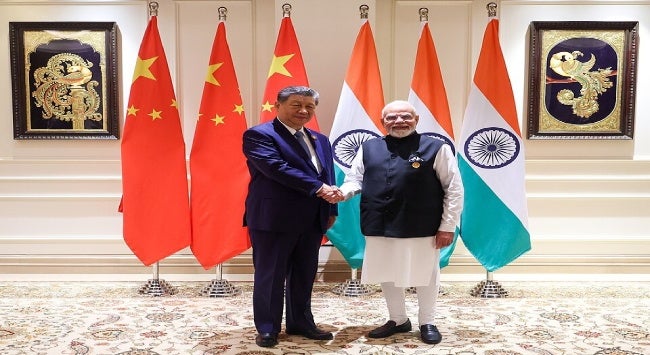
The Modi-Xi Meeting:
Symbolism, Disagreements and Reaffirming the Thaw
Ivan Lidarev
24 September 2026Summary
The successful meeting between Indian Prime Minister Narendra Modi and Chinese President Xi Jinping on 12 September 2026 on the sidelines of the BRICS Summit in New Delhi was a symbolic reaffirmation of the China-India thaw and a promise to move relations forward. Nevertheless, there were no concrete deliverables from the meeting and differences remained, particularly on the sensitive border issue.
The meeting between India’s Prime Minister Narendra Modi and China’s President Xi Jinping on the sidelines of the recent BRICS Summit in New Delhi marked an important symbolic moment in China-India relations. It took place as part of Xi’s first visit to India in seven years and enabled Beijing to “give face” to New Delhi as the host of the 18th BRICS Summit, a gathering meant to showcase India’s role on the international stage and leadership in the Global South. Most importantly, the summit symbolised the progressive improvement in China-India relations since October 2024. The importance of this symbolism made the meeting a success.
Significantly, Xi’s visit to India reciprocated Modi’s milestone visit to China for the Shanghai Cooperation Organisation (SCO) Summit in Tianjin in September 2026. Like the Xi visit, Modi’s visit took place after seven years, was organised within the framework of a large, multilateral summit and remained unconfirmed until the last moment. This interesting similarity might suggest the emergence of a diplomatic parallelism in China-India relations. In order to assess the impact of the Modi-Xi meeting on China-India relations, it is best to examine its positives, negatives and potential.
In terms of positives, the meeting officially sealed the thaw between the two sides and gave relations momentum for “renewed elevation”. The meeting raised two important points. First, the two sides agreed to manage their differences, which were duly listed by each side, and ensure that “differences should not become disputes”. On the Indian side, the differences included many of the usual items, including border stability, market access, trade imbalances and supply chain issues. On the Chinese side, they included interference by third parties (read the United States [US] and Japan), Tibet and Taiwan. The Chinese readout claimed Modi reassured Xi on these issues – reassurances altogether missing from the Indian version. Significantly, the Chinese language of “mutual understanding and mutual respect” and the Indian emphasis on “mutual respect, mutual sensitivity and mutual interest” suggest the outlines of a framework to manage these differences.
Second, both countries focused on the cooperative side of their relationship and not on competitive one; for example, they emphasised that they should be “partners, not rivals”. Of course, China and India are rivals and no amount of official rhetoric can change this fact. Nevertheless, this rhetoric is useful. It reassures the other side about intentions, creates a narrative of cooperation and signals to domestic audiences that relations should improve; hence, countering the substantial domestic opposition to the thaw in both countries.
On the negative side, the meeting did not produce any deliverables or make progress on any of the outstanding issues between the two sides. Admittedly, the meeting primarily sought symbolism and not deliverables, especially in the aftermath of the Special Representative talks in August 2026 which delivered new means to manage the border and a fresh push for early harvest agreements. Nevertheless, the lack of deliverables inevitably raises questions about how far the thaw can go.
More importantly, the meeting highlighted the continuing disagreement over the border dispute and its place in bilateral relations. Modi conditioned the further improvement in relations on stability along the border and placed the dispute at the centre of the relationship. In comparison, Xi proposed that the two sides should keep the dispute on a separate track from the rest of their relationship and deemphasise it. This old disagreement has continuously troubled the China-India thaw, although in practice, the border and the bilateral relationship have increasingly been delinked since last summer. Despite Indian attempts to tie the progress in relations to the border, Beijing has continued to use the issue to pressure New Delhi, most recently by announcing the activation of a long-delayed joint border commission with Pakistan.
In terms of potential, the meeting flagged two areas of potential cooperation. The first was economics. The Chinese readout included references to “developmental opportunities” and resolving “each other’s economic and trade concerns in a balanced way”, a point echoed in the Indian readout. This might suggest greater Chinese willingness to invest in India, share technology and address Indian concerns about trade imbalances.
Cooperation on the larger international stage is the second area in which the two sides can partner each other. This is the least contested part of the China-India relationship because both countries are officially committed to multipolarity, Global South cooperation and the institutions that promote these, namely, the SCO and BRICS. Xi’s comments during the meeting focused particularly on such cooperation, seemingly both to underscore ideological alignment with New Delhi and to draw attention to India’s relationship with the US. Nevertheless, Modi’s comments at the meeting and at the larger summit broadly supported such cooperation.
So, what was the strategic impact of the meeting for each of the two countries and for their relationship? For India, the meeting strengthened its “multi-aligned” foreign policy and gave it a bit more leverage on Washington in the face of the renewed US threat of sanctions. For Beijing, the meeting further strengthened its already good position vis-à-vis the US in the run-up to the summit between Xi and US President Donal Trump.
Bilaterally, the strategic impact of the meeting was somewhat limited. While successful and highly symbolic, it did not bring new dynamics to China-India relations but reaffirmed the gradual upward trajectory of relations and opened the possibility to move beyond the thaw.
In sum, the Modi-Xi meeting did not represent a reset in China-India relations but a reaffirmation of the ongoing thaw and a tentative promise to move relations forward.
. . . . .
Dr Ivan Lidarev is a Research Fellow at the Institute of South Asian Studies (ISAS), an autonomous research institute at the National University of Singapore (NUS). He can be contacted at ivanlidarev@nus.edu.sg. The author bears full responsibility for the facts cited and opinions expressed in this paper.
Pic Credit: Wikimedia Commons
-
 More From :
-
 Tags :
-
 Download PDF