


Summary
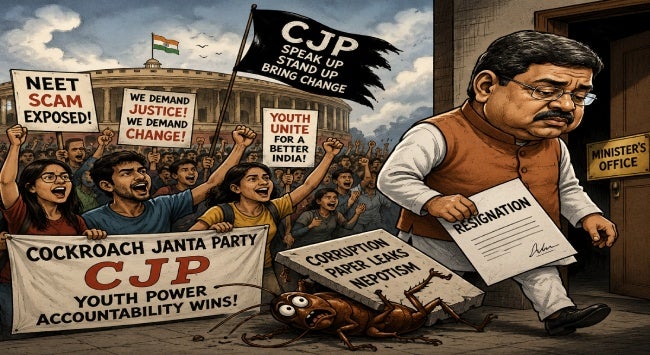
In the face of protests by the Cockroach Janta Party (CJP), India’s Education Minister Dharmendra Pradhan submitted his resignation. This is the first time a cabinet minister in the Narendra Modi government has resigned due to public pressure. The CJP has for the time being called off its protests though pending issues remain.
The recent protests in India, led by the Cockroach Janta Party (CJP), were called off on 25 July 2026 after Union Education Minister Dharmendra Pradhan decided to tender his resignation. The CJP had been protesting in New Delhi for little over a month on the mishandling of the National Eligibility cum Entrance Test, the main entrance exam for admission to India’s medical colleges. One of the key demands of the CJP was Pradhan’s resignation. Once that demand was met, the CJP called off its current protest.
The impact of the protests cannot be underestimated since this is the first time that a cabinet minister in the Narendra Modi government has resigned due to intense public pressure. The only other instance is that of M J Akbar, who was a junior minister for external affairs, resigning in 2018. He had been accused of sexual harassment by multiple women during his time as a newspaper editor before being appointed a minister. His resignation though was less an outcome of external protests and more a personal decision arising out pressure from within the Bharatiya Janata Party (BJP).
The Modi government, despite having a reputation for not bending to pressure, has given in to public protests on occasions, most notably during the farmers’ protest in 2021 when it rolled back its controversial farm laws. However, no individual in the government was held accountable for the protests that lasted over a year and were accompanied by violence. The relative rapidity with which the government gave in to the CJP’s demands was largely due to the fact that that the youth-led protests, unlike the farmers, were not restricted to a specific constituency or geography. The movement, which went viral on the internet, cut across the usual divides of Indian politics. Support for the movement had swelled, not just in New Delhi but other cities too, in the wake of the police action against the protesters on 20 June 2026. Moreover, the government had lost control over the narrative in a manner rarely seen under Modi’s tenure.
There were other practical reasons behind the BJP’s decision to jettison Pradhan. First, the government had realised that the proposed measures to assuage the CJP, fast track courts to ensure swift punishment for those involved in examination leaks, the transfer and sacking of government officials and a bill with harsh measures to prevent paper leaks, were not adequate. Second, with the Congress and other political parties taking up the cause, the government anticipated that the protests would expand and give the opposition a boost. Third, there were fears that the ongoing monsoon session of parliament, where the government has lined up several important bills, might be lost to disruptions if the protests persisted.
Pradhan’s resignation was a loss of face for a government that prides itself on its strength. It has also somewhat dented the aura around Modi. However, the BJP has tried to interpret the resignation as a sign of a government and prime minister that listens to the country’s youth. Modi has taken to Instagram to reach the protesters and India’s Gen Z, who comprise roughly a third of India’s population, and also instructed his ministers to be more active on the platform.
At the same time, it could be argued that though the government initially underestimated the strength of the CJP protests, it defused the situation through Pradhan’s resignation. The decision was perhaps informed by the Gen Z protests in neighbouring countries that have brought down governments. Pradhan’s resignation letter and the government’s subsequent statements have also been careful to separate the student protests from “anti-national forces”. This was one way of trying to prevent the opposition from appropriating the movement. Pradhan himself is far from disgraced. He was warmly welcomed to parliament on 27 July 2026 with several BJP MPs cheering him on.
The government is now keen to restrict the issue to examination reform. The Public Examinations (Prevention of Unfair Means) Amendment Bill was introduced in parliament on 27 July 2026. It provides for a 10-year jail term and a ₹5 million (S$68,000) fine for people convicted of involvement in such leaks. The government has also announced the formation of a task force, led by Infosys co-founder Nandan Nilekani, to suggest reforms to make the public exam system leak-proof.
The opposition, on its part, has attempted to shift the focus to the alleged excesses of the police and the Union home ministry, which controls the New Delhi Police, during the crackdown against protesters. It did not let parliament run on 27 July 2026. However, latest reports suggest the opposition parties have agreed to a debate in parliament on the new examinations bill.
Where does this leave the CJP? The past few weeks have seen an astonishing transformation of the CJP from a satirical online entity to one that led widespread protests forcing the resignation of a Union minister. CJP leaders have announced that they might begin protests again if another demand, withdrawal of cases across India against demonstrators, is not guaranteed by the government. However, it remains to be seen if the CJP has the staying power and popular support to agitate for other larger issues like reform of the education system and high unemployment among the youth.
. . . . .
Dr Ronojoy Sen is a Senior Research Fellow and Research Lead (Politics, Society and Governance) at the Institute of South Asian Studies (ISAS), an autonomous research institute at the National University of Singapore (NUS). He can be contacted at isasrs@nus.edu.sg. The author bears full responsibility for the facts cited and opinions expressed in this paper.
Pic credit: Chatgpt
-
 More From :
-
 Tags :
-
 Download PDF