


Summary
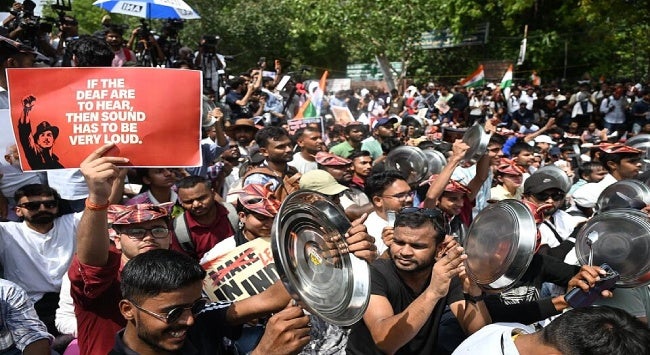
When the Cockroach Janta Party (CJP) was launched in India in May 2026, it was seen as something of a novelty. However, in the past few days, the CJP has led a movement that has put the government on the backfoot on reforms in the country’s examination and education system.
The protests in India over the past few days, led by the Cockroach Janta Party (CJP), have been grabbing headlines both within the country and outside. It has also forced the Indian government to sit up and take notice of a movement that had until now been seen as a minor nuisance. When the CJP was launched in India in May 2026, it was regarded as something of a novelty. The movement was initiated in response to a remark by the Chief Justice of India, Surya Kant, calling a section of unemployed youngsters “parasites” and “cockroaches” during a courtroom hearing. Though Kant subsequently said he had been misquoted, the CJP quickly garnered 22 million online followers.
What began as a satirical take on Indian democracy and a platform for airing the grievances of India’s youth, who have largely avoided political engagement, has turned serious over the past few weeks. The founder of CJP, United States-returned Abhijeet Dipke, and his supporters had begun a sit-in at New Delhi’s Jantar Mantar, a popular site for protests, from 6 June 2026 over the mishandling of the National Eligibility cum Entrance Test (NEET), the main entrance exam for admission to India’s medical colleges. The NEET, which was held on 3 May 2026, with over 2.2 million candidates sitting for the test, had to be cancelled after the examination questions were leaked. The examinations were held again on 21 June 2026.
One of the initial demands of the CJP was the resignation of Union Education Minister Dharmendra Pradhan. The CJP had also announced a march to parliament on 20 Jul 2026, the opening day of the ongoing monsoon session of parliament, to press its demands. The CJP protesters were joined by the Ladakh-based activist Sonam Wangchuk who went on a hunger strike from 28 June in support of the CJP. The forcible removal of Wangchuk to a government hospital on 18 July 2026 galvanised the protesters. Subsequently, Wangchuk ended his hunger strike early on 24 July 2026.
Matters came to a head during the CJP’s march to parliament on 22 July 2026 where the thousands who joined were subject to a police lathi (baton) charge and tear gas shelling. Several people were injured, including both demonstrators and police personnel. The police also dismantled the stage at the protest site, but protesters refused to vacate the area. In fact, more people from all walks of life, including the parents of students, have joined the protests following the 22 July 2026 events.
The protests widened on 21 July 2026 when the opposition Congress party protested outside Prime Minister Narendra Modi’s residence, condemning the police action against the demonstrators. Other opposition parties like the Samajwadi Party too joined the protests. Congress leader Rahul Gandhi and other party members were briefly detained by the police before being released.
The ramping up of pressure has forced the government to respond, even if belatedly, to the CJP and opposition parties’ demands. At the back of the government’s mind was perhaps the Gen-Z movements that have shaken up politics in neighbouring Bangladesh, Nepal and Sri Lanka. Union Health Minister J P Nadda met the CJP leaders and visited the hospital where the injured protesters had been admitted. The government sent Union minister Jitendra Singh to assure Rahul that a discussion would take place in parliament on the NEET issue. The prime minister also issued a statement on social media on 23 July 2026saying the government has decided to set up fast-track courts to ensure swift punishment for those involved in paper leaks.
However, the government’s actions have not yet had the desired effect. Both the CJP and the opposition parties are insisting on the resignation of Pradhan before any discussion takes place. Among their other demands are compensation of ₹10 million (S$134,000) each for about a dozen students who committed suicide following the NEET leak and action against the police personnel who assaulted students. Besides, the issues at hand have moved beyond exam leaks to discontent over the education system and the bleak job prospects for India’s youth.
There are some parallels between the current movement and the 2011 anti-corruption movement led by Anna Hazare. During that time too, the issue behind the movement – the appointment of a Lokpal or anti-corruption ombudsman – had struck a chord among a wide swathe of India’s population. The anti-corruption movement though was being steered by a group, including Arvind Kejriwal who would go on to become a three-term chief minister of Delhi, which was far more politically and media savvy. They also followed a smart strategy of keeping political parties out to give the movement an apolitical colour. Moreover, the government of the day, the Congress-led United Progressive Alliance, buffeted by corruption charges, had quickly capitulated to Hazare’s demands. In the current instance, a much stronger government might be unwilling to make real concessions or to sack Pradhan since it would amount to an admission of wrongdoing.
The CJP has called for nationwide protests on 24 July 2026 in solidarity with the victims of “police brutality” earlier in the week. It is not the first time that the Modi government has faced protests. The most noteworthy of these were the farmers’ protests in 2021 that forced the government to roll back controversial farm laws. The movement led by the CJP though is far more diffuse and not restricted to a specific geography or constituency. That makes it more challenging both for the government to keep things under control as well as for the movement to sustain momentum.
. . . . .
Dr Ronojoy Sen is a Senior Research Fellow and Research Lead (Politics, Society and Governance) at the Institute of South Asian Studies (ISAS), an autonomous research institute at the National University of Singapore (NUS). He can be contacted at isasrs@nus.edu.sg. The author bears full responsibility for the facts cited and opinions expressed in this paper.
Pic Credit: X
-
 More From :
-
 Tags :
-
 Download PDF