


Summary
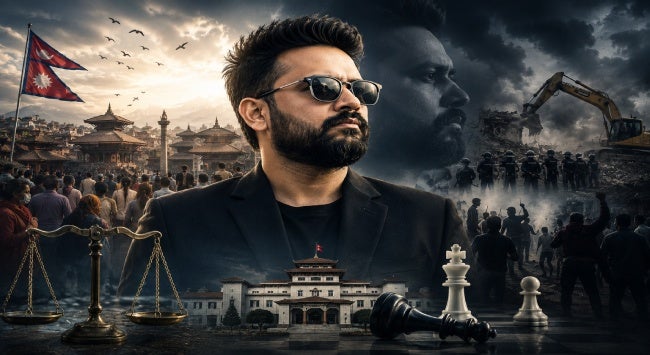
With four months in office, it is too early to assess the Balendra Shah government’s performance in Nepal. However, as per the saying that ‘the morning shows the day’, the new government’s decisions and actions have provided less hope and more concerns.
Introduction
The Balendra Shah (Balen)-led Rastriya Swatantra Party (RSP) government in Nepal has completed four months. A government formed by a relatively new political party with promises of good governance and progress has made some positive changes in this brief period. The RSP government’s norm-breaking actions in some instances have been with good intentions, and these have been welcomed. However, several other actions have raised concerns because of the government’s disregard for institutions and unwillingness to follow due process. The government’s desire to accomplish tasks at breakneck speed, as affirmed by the Prime Minister,[1] could have serious legal, political and social implications.
This paper provides an analytical assessment of the positive departures and the controversial actions taken by the Balen Shah government. This will provide a sense of the direction that Nepal is possibly heading towards.
Welcome Changes
The first cabinet meeting held immediately after inauguration decided to approve a 100-point governance reform action plan.[2] This was a break from the norm, and an important means of keeping the government in check. While some of the items in the plan are questionable, others reflect the government’s approach towards achieving good governance.
For example, the government reduced the existing number of federal ministries, primarily to curb the country’s recurrent expenditure. This is a welcome change, particularly because Nepal has adopted a federal system of governance. A meaningful devolution of authority to the provincial governments against the consolidation of power at the centre is necessary to make the federal system successful. However, there are contradictions in the RSP’s views on federalism, with some of its leaders indicating support for federalism and some others against it.[3] A push against federalism, which the country has established after a long and arduous political struggle, would be disastrous. The RSP needs to handle federalism-related issues with utmost care.
Another action taken by the Balen Shah government was expediting investigations of some of the alleged high-profile corruption cases. The investigations led to several arrests, including that of a former Finance Minister Bishnu Paudel. Businessmen and power brokers, who were alleged to have built cosy relationships with the old political guards and engaged in corruption, were arrested and are being tried in courts.[4] While these actions, carried out by relevant agencies following due process, were welcomed, there were also concerns with arrests and detentions based on inadequate investigations. For instance, the court ordered the release of Paudel without requiring a bail. Citing a lack of evidence prima facie, the court ordered that he face court appearances on a general date.[5] Such instances raise questions on whether the government is serious about fighting corruption or is drawn towards spectacles.
The government also made reforms in a few areas in which the public has a direct stake. Two that stand out are the timely publication of high school results and ending a backlog in the printing and distribution of driving licences.
The Grade 10 (called the Secondary Education Examination) and Grade 12 final examinations are administered by two separate education boards under the Ministry of Education. Students had to wait for several months for these examination results. The new government managed to publish these results in about a month after the examinations. However, it was not foolproof. Several students took to the streets in protest when they found errors and lapses in the results.[6]
Regarding driving licences, until recently, there was a backlog in the printing and distribution of 2.7 million driving licences. The printing machine purchased years ago to print security-sensitive items remained non-functional due to corruption charges in its purchase.[7] The interim government formed after the Gen Z movement decided to fix the machine and started printing the licence cards. The Balen Shah government expedited this ensuring that the backlogs were cleared by the end of the last fiscal year ending mid-July 2026.
The Balen Shah government deserves appreciation for taking some concrete reform measures within just a few months in office. However, it should control its speed to ensure that the errors and lapses are minimised. Some actions of the government show the government’s intentions otherwise. A few of the significant ones are discussed below.
Forced Evictions
One of the controversial and inhuman actions taken by the Prime Minister was the forceful eviction of squatters from Kathmandu’s riverbanks. The Prime Minister, without discussing the agenda in the cabinet, ordered the security forces to immediately clear the riverbanks providing a short notice to the squatters.[8] This was against the stipulated legal process, and also against the RSP’s promises on how it planned to follow due process to ensure a permanent settlement to this problem that has persisted for decades, partly due to politicisation.[9]
Why did Balen Shah take such a harsh decision? The justification he provided, through a Facebook post on 24 April 2026, was to relocate the people to safer places in view of the monsoon floods.[10] However, the flooding of one of the temporary shelters on 12 July 2026, which was close to a riverbank, undermined his claim. The real reason for the Prime Minister’s forceful measure could be his intent to accomplish a task the way he desired since he had failed in it while serving as the Mayor of Kathmandu.
During his stint as the Kathmandu Mayor, Balen Shah had tried to take the same approach of forceful evictions but his request to mobilise the police had been turned down by the federal government.[11] He was required to follow the due process, starting with identifying the landless and the encroachers. The next step would be evicting the encroachers and providing land or housing to the landless. However, Balen Shah ignored the process and the RSP’s promises.
The inhuman way of evicting the squatters resulted in sufferings of the displaced people.[12] A few people committed suicides out of hopelessness. A Gen Z activist, who had visited a temporary shelter and spoken against the government’s actions, was assaulted by the police and had to remain hospitalised for a few days.[13]
The forced eviction has drawn criticism from all quarters, including, unusually, from some members of parliament of the RSP. The Prime Minister’s preference of working through his secretariat team members, largely ignoring the party and his cabinet, is a reason for the missteps that he is taking. This is corroborated by another act of high-handedness that is discussed next.
The Prime Minister Secretariat’s Imperiousness
After becoming the Prime Minister, Balen Shah inducted his acquaintances in his secretariat. There are media reports that it is this group of people that is at the centre of running state affairs.[14] A recent incident has exposed the group’s imperiousness. In a case related to passport procurement from international vendors through competitive bidding, which the government before the Gen Z movement had finalised, the current Prime Minister’s secretariat, without evidence, insisted there had been corruption.[15] So, breaching constitutional provision, the Prime Minister’s secretariat summoned the Chief of the Commission for the Investigation of Abuse of Authority (CIAA) in the Prime Minister’s office, held him there for eight hours, and forced him to issue arrest warrant against the Chief and other officials of the Passport Department which he complied with.
The CIAA is a constitutional body with the mandate to investigate cases of corruption and the abuse of authority, including policy corruption by the Prime Minister and the cabinet. To treat this institution as a subordinate of the Prime Minister’s office and forcing it to act as per the Prime Minister’s instructions is unconstitutional.
Under pressure, the CIAA has filed a corruption case against several individuals alleged to have been engaged in corruption in this case. It also includes representatives of the German company, in which the German government has a share, that had won the bid. The arrested officials were released on bail by the court.[16]
Another issue of concern in this case is the Prime Minister’s office bypassing the authority of the line ministry, which is the Ministry of Foreign Affairs (MoFA), in dealing with officials of the Department of Passport that falls under MoFA. Whether all this was done with good intentions suspecting of corruption or there was something else to it, the concern is the haughtiness of the Prime Minister’s secretariat consisting of people who are not legally accountable to anyone.
Populism, Control and Intimidation
Several actions of the Balen Shah government appear as populist measures. For instance, the first cabinet meeting of the Balen Shah government had decided to selectively implement the report of the commission on the Gen Z movement.[17] The report has not yet been officially publicised, but it had been leaked before the Balen Shah government took office. The commission has recommended the prosecution of K P Oli and Ramesh Lekhak (the Prime Minister and the Home Minister, respectively, when the Gen Z movement happened) and security officials for the protestors’ killings. The cabinet decided to immediately implement the commission’s recommendations in relation to Oli and Lekhak, but it decided to form another committee to seek recommendations regarding prosecution of security officials. Consequently, the Ministry of Home Affairs arrested Oli and Lekhak early next morning. However, they were later released by the court. While a decision to selectively implement the report was problematic, the report also provided weak grounds for Oli’s and Lekhak’s prosecution.[18]
The courts have struck down several other decisions of the government.[19] Partly because of this reason, and partly with the motive of keeping the judiciary in check, the Balen Shah government amended the structure of the constitutional council that makes constitutional appointments, including the supreme court justices, through an ordinance. Then, breaking from the norm of appointing the senior-most judge of the supreme court as the chief justice, the council appointed the fourth-most senior judge in that position. On 24 July 2026, Amnesty International, Human Rights Watch and International Commission of Jurists released a joint statement cautioning against the Balen Shah government’s interference in Nepal’s judiciary. “The organizations have received credible reports that the three more senior Supreme Court justices, Sapana Pradhan Malla, Kumar Regmi and Hari Phuyal have been subjected to political pressure to resign and threatened with impeachment if they refuse”, as stated in the statement, is an issue of serious concern.[20]
The government appears to be intolerant also towards the media for its scrutiny of the government’s decisions and actions. On 13 July 2026 vehicles were parked blocking the entrances of media houses in Kathmandu.[21] Some of these vehicles belonged to RSP members, and the home minister had used one of them during the RSP’s convention. It was a coordinated and planned act, but the vehicles were released by collecting fines for normal parking offences.
Telltale Signs of Despair
Balen Shah, since becoming the Prime Minister, has repeatedly undermined Nepal’s parliament and other institutions including the Office of the President.[22] Most of the government’s controversial decisions and actions have come out of a coterie in the Prime Minister’s secretariat. There are two camps in the party and the government, one close to Rabi Lamichhane, the party chair, and the other to Balen Shah. Trust deficit between the two camps have started surfacing. The supposedly cold relationship between the Prime Minister and the Finance Minister is visible in the Prime Minister bypassing the finance minister, for example, meeting business representatives in the finance minister’s absence.[23] The members of parliament and party members in the Lamichhane camp have started questioning the actions of the government, some of them calling the government actions as childish behaviours.[4]
The amalgamation of the two camps before the election was not based on a shared value, ideology or anything substantive. It was to strengthen the party in the elections with two popular leaders at the helm. The risks of personality clashes had been feared early on. However, it was not expected to start a few months into government formation. The Prime Minister’s actions giving a sense of him as a directly elected powerful executive on the one hand, and the alleged secret inclusion of a provision in the RSP’s constitution during the recently concluded party’s convention that gives the party chair full authority to recall the Prime Minister on the other, have contributed to the visible rift in the party.[25]
If this is not contained on time, it will not take long for people’s trust in the new government to crumble. This would not bode well for Nepal that has been witness to several political trials and errors and instabilities in the past.
. . . . .
Dr Puspa Sharma is a Senior Research Fellow at the Institute of South Asian Studies (ISAS), an autonomous research institute in the National University of Singapore (NUS). He can be contacted at puspa.sh@nus.edu.sg. The author bears full responsibility for the facts cited and opinions expressed in this paper.
[1] “PM Shah uses ‘expressway’ analogy to defend government’s pace”, Nepal News, 21 June 2026, https://english.nepalnews.com/s/politics/pm-shah-uses-expressway-analogy-to-defend-governments-pace/.
[2] “Government unveils 100-point governance reform agenda (full text)”, Nepal News, 29 March 2026, https://english.nepalnews.com/s/politics/government-unveils-100-point-governance-reform-agenda-full-text/.
[3] Rajesh Mishra and Rishiram Paudyal, “Opposition parties question RSP’s commitment to federalism, demand clarity”, The Kathmandu Post, 1 July 2026, https://kathmandupost.com/politics/2026/07/01/opposition-parties-question-rsp-s-commitment-to-federalism-demand-clarity.
[4] “Businessman Deepak Bhatta arrested in money laundering probe”, The Kathmandu Post, https://kathmandupost.com/national/2026/04/02/businessman-deepak-bhatta-arrested-in-money-laundering-probe.
[5] “UML Vice Chair Bishnu Paudel released on general date”, Nepal News, 17 July 2026, https://english.nepalnews.com/s/crime-news/uml-vice-chair-bishnu-paudel-released-on-general-date/.
[6] Daya Dudraj, “Protest by students dissatisfied with Grade 12 results”, Kantipur News, 26 June 2026, https://ekantipur.com/news/2026/06/26/en/protest-by-students-dissatisfied-with-grade-12-results-44-07.html.
[7] “Security printing press controversy intensifies as CIAA files corruption case against project chief”, Onelinekhabar, 16 April 2023, https://english.onlinekhabar.com/security-printing-press-bikal-paudel.html.
[8] Gyanu Ghimire, “Eviction drive sparks rift concerns as RSP leaders claim lack of consultation”, Khabarhub, 25 April 2026, https://english.khabarhub.com/2026/25/545698/.
[9] Rastriya Swatantra Party, Bacha patra 2082, https://rspnepal.org/manifesto.
[10] See Balen Shah’s Facebook post, available at https://www.facebook.com/balenOfficial.
[11] Akchhar Kaka, “Balenkai karan alapatra pareko sukumbasi pahichanako prakriya”, Setopati, 7 July 2024, https://www.setopati.com/politics/333728.
[12] Biswas Baral, “Nepali PM Balendra Shah’s image as a change agent is at risk”, The Diplomat, 23 July 2026, https://thediplomat.com/2026/07/nepali-pm-balendra-shahs-image-as-a-change-agent-is-at-risk/.
[13] Gaurav Pokharel, “Majid Ansari discharged from hospital after five days, questions legal basis of police detention”, The Kathmandu Post, 15 July 2026, https://kathmandupost.com/national/2026/07/15/majid-ansari-discharged-from-hospital-after-five-days-questions-legal-basis-of-police-detention.
[14] Editorial, “Shaashan sattamaa saanghuro teamko baaklido chhayaa”, Setopati, 20 July 2026, https://www.setopati.com/opinion/393971.
[15] A three-part special story in Setopati, https://www.setopati.com/cover-story/special-story/393775.
[16] The German representatives were not arrested.
[17] The cabinet decision is available at https://giwmscdnone.gov.np/media/pdf_upload/CABINET%202082%20chaitra_veoiplv.pdf.
[18] Puspa Sharma, “Nepal’s Gen-Z protest and violence: Divergent findings and questions of legitimacy”, ISAS Brief, No. 1383, 3 June 2026, https://www.isas.nus.edu.sg/papers/nepals-gen-z-protest-and-violence-divergent-findings-and-questions-of-legitimacy/.
[19] Durga Dulal, “Court halts government’s ‘reform push’, and some see institutional friction”, The Kathmandu Post, 15 May 2026, https://kathmandupost.com/national/2026/05/15/court-halts-government-s-reform-push-and-some-see-institutional-friction.
[20] Amnesty International, Human Rights Watch and International Commission of Jurists, “Joint statement: Nepal-Government actions threaten judicial independence”, 24 July 2026, https://amnestynepal.org/joint-statement/nepal-government-actions-threaten-judicial-independence.
[21] “Mystery vehicle blockade targets media houses, sparks political questions”, Nepal News, 13 July 2026, https://english.nepalnews.com/s/nation/mystery-vehicle-blockade-targets-media-houses-sparks-political-questions/.
[22] Lokendra Bishwakarma, “Government gone astray: Balendra Shah drifts far from the ‘Gen Z’ spirit”, Nepal News, 26 May 2026, https://english.nepalnews.com/s/politics/government-gone-astray-balendra-shah-drifts-far-from-the-gen-z-spirit/.
[23] Binod Dhakal, “Balen’s business outreach: An attempt at political reform or a political maneuver?”, Nepal News, 21 July 2026, https://english.nepalnews.com/s/long-reads/balens-business-outreach-an-attempt-at-economic-reform-or-a-political-maneuver/.
[24] Khabarhub, “Childish behavior has no place in governance: Manish Jha”, Khabarhub, 15 July 2026, https://english.khabarhub.com/2026/15/558676/.
[25] Gyanu Ghimire, “RSP statute: Has the alarm bell rung for Balen?”, Khabarhub, 9 July 2026, https://english.khabarhub.com/2026/09/557676/.
Pic Credit: Chatgpt
-
 More From :
-
 Tags :
-
 Download PDF