


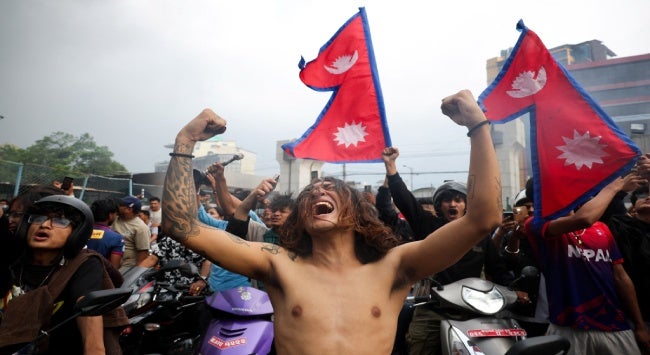
Nepal’s Gen-Z Protest and Violence:
Divergent Findings and Questions of Legitimacy
Puspa Sharma
3 June 2026Summary
Nepal’s National Human Rights Commission (NHRC) recently publicised its recommendations to the Nepal government concerning the violence and deaths of 8 and 9 September 2025. Notably, it has called for an investigation into Gauri Bahadur Karki, chair of the commission established by the interim government to examine the same incidents. This recommendation implicitly raises questions about the credibility and legitimacy of the Karki Commission, whose report the new government acted upon swiftly, albeit selectively. While some aspects of the NHRC’s recommendations may warrant scrutiny, the government should not disregard the findings of a constitutional body with both national authority and international standing.
On 27 May 2026, the National Human Rights Commission (NHRC) of Nepal publicised the recommendations it has provided to the Nepal government in relation to the Gen-Z protest and the subsequent destruction of life and property on 8 and 9 September 2025. The recommendations are based on the findings of the study undertaken by an NHRC committee under the leadership of one of the commission members. Some of the NHRC committee’s recommendations align with those made by another inquiry commission headed by Gauri Bahadur Karki, a retired justice, which was formed by Nepal’s interim government after the protest. However, there are significantly more differences than similarities in their coverage and recommendations. The most interesting recommendation of the NHRC committee is to investigate Karki, the chair of the other commission, for his social media posts of 9 September 2025 which could have contributed to fanning the violence on that day.
The interim government’s decision to form the inquiry commission under Karki’s leadership had been questioned earlier. However, the interim government did not reconsider its decision. The NHRC committee has also recommended investigating Sushila Karki and Om Prakash Aryal, the Prime Minister and Home Minister, respectively, in the interim government for their public comments and their potential impacts in fuelling further violence on 9 September 2025. Hence, there are legitimacy concerns regarding the Karki commission report.
The Karki commission report, which has not been officially released yet but was leaked in the media, drew strong criticisms for being biased and one-sided. It recommended legal actions against K P Sharma Oli and Ramesh Lekhak, then Prime Minister and Home Minister, respectively, at the time of the Gen-Z protest. It also recommended actions against chiefs of security forces (except the Nepal Army) but avoided investigating the second day violence. Its recommendations for legal actions against the accused were also not underpinned by existing legal provisions. Instead, they contradicted their own findings that security forces resorted to lethal force only after exhausting all available non-lethal measures, including water cannons, tear gas and rubber bullets when protesters stormed the parliament building and attacked security personnel.
The NHRC committee has also accused the then Prime Minister, Home Minister and chiefs of security forces of the 8 September 2025 killings. However, unlike the recommendation of the Karki commission, it has stated that there is a lack of provision in Nepal’s existing law to take legal action against political office bearers in cases of such human rights violations; hence, it recommends instituting the necessary legal provisions and charge them retrospectively. Experts have questioned whether legal norms would allow taking such retrospective actions.
Nonetheless, two things have made the NHRC committee’s recommendations more credible and acceptable. These are its nuanced observations of the 8 September 2025 events leading to the shootings, and the equal importance it has given to the violence on 9 September.
Regarding the first, the committee has questioned the motives of one group of protest organisers. It questions, for example, the need to pre-arrange ambulances despite seeking permission for a peaceful protest in which the organisers themselves had expected less than a thousand participants. The committee has categorically questioned the role of Sudan Gurung, who was later appointed the Home Minister in the Balendra Shah government, but who stepped down in less than a month because of questions on his official reporting of his property and its sources. The committee has stated that the protest on the first day turned violent after Sudan took charge.
Regarding the second, the NHRC committee has termed the 9 September 2025 acts of vandalism and arson as organised crime and, hence, the need to book the culprits. It has been recommended that the government undertake detailed investigations on the role of several individuals, including 17 sitting members of parliament representing the governing Rastriya Swatantra Party. One of these 17 members of parliament is Rabi Lamichhane, the party chair, who has been accused of jailbreak amidst the chaos of 9 September 2025. As the NHRC committee stated, Lamichhane’s jailbreak instigated several jailbreaks throughout the country, posing threat to society and people’s human rights.
The NHRC committee has also concluded that the Nepal Army failed to take necessary actions and safeguard the state’s vital institutions, including the office and official residence of its Supreme Commander-in-Chief, the country’s president. It also stated its displeasure at the army’s non-cooperation during its investigation. However, while it recommended further investigation and action against the army commanders guarding the important state institutions, it refrained from recommending any specific actions against the army chief.
The NHRC committee is being criticised for refraining from including the current prime minister Balendra Shah in the list of people that it has recommended for further investigation for their role in the 9 September 2025 violence. This is because Shah was also active on 8 and 9 September 2025, communicating with the protestors/rioters one-way through his social media accounts, and the protesters/rioters following his suggestions.
The first cabinet meeting of the new government led by Shah had decided to selectively implement the Karki commission report. Oli and Lekhak were arrested immediately at the behest of then Home Minister Sudan Gurung. However, the Supreme Court ordered their release after a few days. Now that the NHRC committee has provided its detailed and categorical recommendations to the government, including naming the ruling party chair and several of its members of parliament in the list of people to be further investigated, it remains to be seen whether and how the government will act on the recommendations and the possible implications of taking or avoiding the actions.
. . . . .
Dr Puspa Sharma is a Senior Research Fellow at the Institute of South Asian Studies (ISAS), an autonomous research institute in the National University of Singapore (NUS). He can be contacted at puspa.sh@nus.edu.sg. The author bears full responsibility for the facts cited and opinions expressed in this paper.
Pic Credit: Shutterstock
-
 More From :
-
 Tags :
-
 Download PDF