


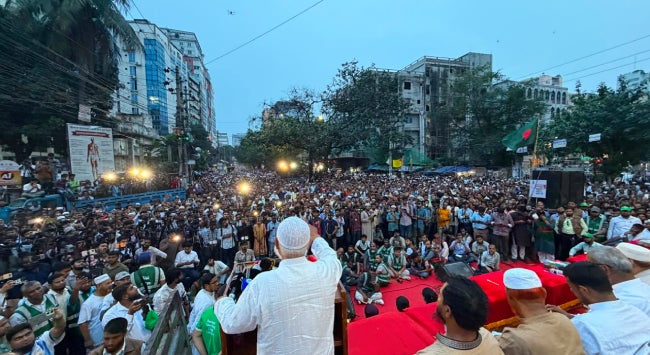
Post-Hasina Bangladesh:
Jamaat and the Future of Opposition Politics
Imran Ahmed, Sheikh Muzzammil Hussen
24 June 2026Summary
Bangladesh Jamaat-e-Islami’s emergence as the principal parliamentary opposition following the February 2026 election marks one of the most significant political transformations in the country’s post-independence history. However, what does Jamaat’s rise reveal about the future of political competition, pluralism and citizenship in post-Sheikh Hasina Bangladesh? Opposition politics is no longer defined by the traditional Awami League-Bangladesh Nationalist Party rivalry and debates over pluralism, representation and the role of religion in public life are becoming increasingly central to the country’s democratic future.
Jamaat-e-Islami’s emergence as Bangladesh’s principal parliamentary opposition marks a remarkable political transformation. Banned after independence because of its alignment with Pakistani forces during the 1971 Liberation War, the party returned to politics following its reconstitution in 1979. However, it remained an electorally modest force for much of the post-independence period, winning 18 seats in 1991, three in 1996, 17 in 2001 and only two in 2008. Its political fortunes deteriorated further after 2013 as the trials and convictions of senior leaders contributed to its growing marginalisation within Bangladesh’s political system. Yet the February 2026 election reversed this trajectory dramatically. The Jamaat secured 68 seats independently and 77 through its 11-party alliance. Securing its strongest electoral performance since independence, the party moved from a position of political marginalisation to the centre of parliamentary politics, assuming a role that would have seemed unlikely only a decade earlier.
The announcement of a shadow cabinet, undertaken jointly with the National Citizen Party (NCP), represented one of Jamaat’s recent most significant attempts to institutionalise its opposition role. By assigning opposition figures portfolios corresponding to government ministries, the party sought to project policy competence and governance readiness. The move nevertheless takes place within an alliance that remains politically fragile and is shaped by broader tensions between the two parties over the future direction of opposition politics. While both parties share support for constitutional reform, implementation of the July Charter and opposition to the Awami League’s return to electoral politics, significant differences remain on questions relating to women, minorities and the broader ideological direction of the state.
In parliament, Jamaat used the April 2026 fuel supply crisis to challenge the government’s handling of shortages and pushed for the creation of a cross-party committee to oversee fuel pricing. It subsequently criticised the government for bypassing the committee when fuel prices were raised. It also sought to distinguish itself through budget politics by presenting its own shadow budget. The party subsequently denounced the government’s proposal as anti-people and highlighted concerns over revenue projections, taxation thresholds and spending priorities. Beyond immediate policy issues, Jamaat has also positioned itself as an advocate of institutional reform. The party championed proportional representation for the proposed Senate and demanded the implementation of the July Charter through a Constitution Reform Council. It also repeatedly used parliamentary walkouts to protest what it viewed as the government’s retreat from reform commitments.
While its parliamentary role and activism have helped project an image of institutional engagement and policy competence, important questions remain about the party’s broader vision of representation and citizenship. While the legacy of 1971 is being reinterpreted and contested in post-Sheikh Hasina Bangladesh, Jamaat has been unable to fully escape the historical associations tied to its role during the Liberation War. Its position on women’s political leadership remains at odds with Bangladesh’s long history of female political leadership and has become a point of partisan attack from critics such as the Bangladesh Nationalist Party (BNP) as well as a source of tension within its alliance with the NCP. Questions have also been raised regarding the party’s approach to religious minorities. Although Jamaat fielded a Hindu candidate, Krishna Nandi, for the first time in the 2026 election as a visible gesture of inclusivity, critics noted that the move sat uneasily alongside a party constitution that permits non-Muslims only to hold associate membership. Moreover, between August 2024 and the 2026 election, the Bangladesh Hindu Buddhist Christian Unity Council documented over 2,442 incidents of anti-minority violence, with United Nations investigators identifying supporters of the BNP and Jamaat among the perpetrators. Parliamentary speeches by senior Jamaat figures advocating a wider role for Islamic law in public life have further contributed to debate about the party’s approach to pluralism and minority rights.
These debates extend beyond Jamaat itself and reflect broader concerns about the direction of Bangladeshi politics. As analyst Ragib Anjum argues, “The risk lies not in an immediate theocratic turn, but in a gradual narrowing of pluralistic politics.” He suggests that the BNP faces a particular challenge as a centre-right governing party. It must balance engagement with conservative religious constituencies while continuing to uphold pluralism, minority rights and a civic conception of Bangladeshi nationalism. This challenge is made more difficult by the decline of secular and progressive alternatives and the growing influence of Jamaat and other Islamist groups such as Hefazat-e-Islam. This may create incentives for the BNP to accommodate religiously conservative demands rather than challenge them.
For Jamaat, the question is no longer whether it can secure electoral support or parliamentary relevance. Rather, its growing prominence has intensified scrutiny of its positions on pluralism, representation and citizenship. Its significance lies not only in its electoral performance but also in what its rise reveals about the shifting contours of political competition and ideological debate in post-Sheikh Hasina Bangladesh.
. . . . .
Dr Imran Ahmed is a Research Fellow at the Institute of South Asian Studies (ISAS), an autonomous research institute at the National University of Singapore (NUS). He can be contacted at iahmed@nus.edu.sg. Mr Sheikh Muzzammil Hussen is a Research Intern in the same institute. He can be contacted at isav47@partner.nus.edu.sg. The authors bear full responsibility for the facts cited and opinions expressed in this paper.
Pic Credit: (15) BNP jamaat e – Search / X
-
 More From :
-
 Tags :
-
 Download PDF