


Summary
Obituaries for the Quadrilateral Security Dialogue (Quad) had become commonplace during United States’ (US) President Donald Trump’s second term amid tensions in US-India relations and Washington’s renewed outreach to Beijing. Yet the Quad Foreign Ministers’ Meeting in New Delhi on 26 May 2026 suggested that reports of the grouping’s demise were premature. A few days later, US Secretary of War Pete Hegseth’s address at the Shangri-La Dialogue reaffirmed that Washington views the preservation of an Asian balance, in partnership with allies and friends like India, as a core strategic objective, even as it seeks a more stable relationship with China.
The revival of the Quadrilateral Security Dialogue (Quad) in 2017 was one of the defining strategic developments in the Indo-Pacific during Donald Trump’s first term as United States (US) President. For many observers, however, the Quad, which brings together Australia, India, Japan and the US, appeared to be losing momentum during Trump’s second term. Washington’s massive tariffs on Indian exports, pressure on New Delhi to curtail purchases of Russian oil, and Trump’s repeated claims of having mediated peace between India and Pakistan after the May 2025 crisis contributed to a sharp deterioration in bilateral ties. At the same time, Trump’s efforts to stabilise relations with Beijing led many to question whether balancing China remained a priority for Washington. The absence of enthusiasm for convening a Quad leaders’ summit seemed to reinforce the perception that the forum was fading away into irrelevance.
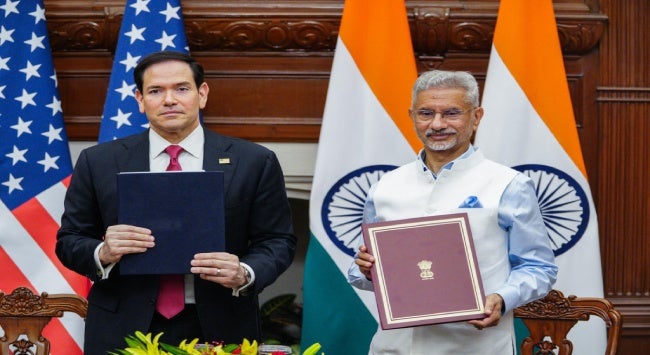
Yet the four-day visit by US Secretary of State Marco Rubio to New Delhi in May 2026 – the first by a Cabinet level official in Trump’s second term – signalled a serious effort to arrest the slide in India-US relations. Rubio’s outreach sought to restore regular high-level political engagement, reaffirm the importance of defence and technology cooperation and emphasise India’s important role in America’s Asia strategy.
Rubio’s bilateral engagement was followed by the Quad Foreign Ministers’ Meeting in New Delhi on 26 May 2026. The meeting did not produce a resounding declaration. Instead, it focused on a series of practical initiatives designed to deepen functional cooperation among the four partners. The centrepiece was a critical minerals framework intended to mobilise public and private investment in secure supply chains for the mining, processing and recycling of rare earths and other strategic resources. Given China’s overwhelming dominance in this sector, the initiative addresses one of the most significant vulnerabilities facing advanced industrial and defence economies.
Alongside this framework, the ministers advanced the Indo-Pacific Maritime Surveillance Initiative, aimed at strengthening maritime domain awareness across the region. They also launched new cooperation on energy security, undersea cable infrastructure, cyber-enabled crime, and port development in Fiji. The significance of these initiatives lies less in their individual scope or merit than in what they reveal about the evolution of the Quad. The forum is now narrowing its agenda and focusing on a few strategic areas of consequence. Maritime surveillance generates the collective awareness of the big picture in Asia’s waters. Critical minerals cooperation reduces excessive dependence on a single supplier. Infrastructure and energy projects strengthen the Quad’s economic presence across the Indo-Pacific.
However, what about the apparent softening of the US approach to China in the second term? The unavoidable fact though is that China has grown stronger since Trump’s first term. There is no escaping the dangers of a direct US confrontation with China. That the US is tempering its strategy towards China is quite obvious. In his speech to the annual Shangri-La Dialogue in Singapore on 30 May 2026, the US Secretary of War Pete Hegseth pointed out US relations with China have “better than they’ve been in many years”. He also did not refer to Taiwan and US support for it – which has become the main source of irritation to Beijing.
At the same time, Hegseth reaffirmed the US’ determination to maintain balance and geopolitical equilibrium in Asia. “What we seek and what the President has constantly articulated is a genuinely stable equilibrium that works for Americans as well as our allies – a favorable but durable balance of power in which no state, including China, can impose its hegemony and hold the security or prosperity of our nation and our allies in question”, Hegseth declared. The message was clear: The US’ engagement with Beijing does not imply acceptance of Chinese primacy.
Hegseth also insisted that the challenge of balancing in Asia “is not a burden America can or should carry alone. A favourable balance of power requires capable allies with real military strength, real industrial capacity, and real political resolve.” He cast India as one of its capable regional partners. “A powerful India, acting in its own self-interest, advances our shared goal of maintaining a balance of power across the region”, Hegseth said. He added that “India is modernising its military to carry its share of the security burden, particularly in the Indian Ocean.”
That an India acting in its own interest will help stabilise Asia has been an essential foundation of the US’ strategy towards India in the 21st century. Hegseth’s speech also reflects the continuing political fit between India’s long-standing quest for strategic autonomy and Washington’s growing expectation that regional partners assume greater responsibility for their own security. Far from diminishing India’s relevance, the American preference for burden-sharing increases the value of capable and willing partners like India.
The pessimism surrounding the Quad now appears overstated. The grouping is not disappearing; it is adapting. Its future may depend less on summit diplomacy and more on the ability to deliver on the modest but consequential agenda laid out in New Delhi. Equally, Washington’s engagement with Beijing should not be mistaken for an abandonment of Asia to Chinese primacy. Great powers have often combined competition with negotiation. The US did so with the Soviet Union during the Cold War, and it appears intent on doing so with China today. The preservation of a balanced Asia continues to be a shared interest among the Quad partners. The grouping’s quieter, more functional form may ultimately prove more durable than its earlier, more ambitious expression.
. . . . .
Professor C Raja Mohan is Honorary Senior Fellow at the Institute of South Asian Studies (ISAS), an autonomous research institute at the National University of Singapore (NUS). He can be contacted at crmohan53@gmail.com. The author bears full responsibility for the facts cited and opinions expressed in this paper.
Pic Credit: Twitter
-
 More From :
-
 Tags :
-
 Download PDF