


Cooperation Amid Constraint:
Limits and Possibilities of India-China Climate Interactions
Karthik Nachiappan, Pooja Ramamurthi, Constantino Xavier
23 July 2026Summary
India and China occupy central positions in the global energy transition, yet their relationship is defined by a paradox: decarbonisation deepens their economic interdependence even as geopolitical rivalry constrains cooperation. India’s transition targets are ambitious with 500 gigawatts of non-fossil capacity by 2030, net-zero by 2070 and clean-energy investment needs exceeding US$170 billion (S$219.4 billion) a year. Given China’s command of over 80 per cent of solar manufacturing and the bulk of battery and processing supply chains globally, these targets cannot be met without access to Chinese technology, capital and critical minerals. China is, therefore, an important but politically sensitive partner.
This paper argues that India-China climate engagement will remain limited, selective and calibrated rather than integrated. A large Indian bilateral trade deficit (roughly US$99 billion [S$127.8 billion] in 2024-25), restrictive investment screening of Chinese investments under Press Note 3 in India, episodes of weaponised export controls by China and the strategic mistrust entrenched since the 2020 border clash together limit deep cooperation. Complete decoupling, however, is neither feasible nor affordable at the pace India’s energy transition demands. The realistic space lies in governance-oriented, technically framed, lower-risk domains where mutual gains are tangible and strategic exposure is managed.
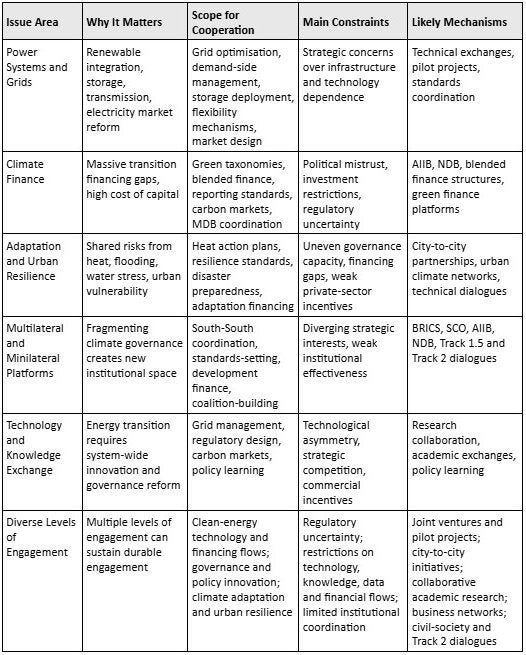
The paper identifies six domains: power-system modernisation (grid planning, market design, flexibility and curtailment management); climate finance (blended templates, green-taxonomy, green-bond alignment and carbon-market linkage); adaptation and urban resilience (heat action, flood and water management, city-to-city partnerships and shared Himalayan resilience); multilateral and minilateral engagement (coordination through the United Nations Framework Convention on Climate Change, BRICS (originally Brazil, Russia, India, China and South Africa), Shanghai Cooperation Organisation, G20 and multilateral development banks, and within India and China-led coalitions such as the International Solar Alliance, Coalition for Disaster Resilient Infrastructure and the Belt and Road Initiative); technology and knowledge exchange (concentrated in pre-competitive, system-level areas and academic collaboration rather than hardware transfer); and climate diplomacy through diverse channels (private players, civil society and subnational authorities).
A recurring theme is that past engagement was broad but shallow, wide in coverage, thin in implementation and renewed cooperation must be reimagined around actors beyond the state. With formal bilateral channels being constrained, subnational governments, firms, research institutions and Track 1.5 and Track 2 dialogues offer potentially worthy, durable and less politically exposed avenues to sustain links, build trust and generate practical outcomes.
The likely future of India-China climate engagement will not rest on a comprehensive partnership or political convergence. It will depend on whether both countries can institutionalise narrow, sector-specific forms of interdependence that advance decarbonisation while keeping geopolitical risk containable. This is particularly salient as the United States (US) retreats from climate leadership and a fragmenting governance architecture creates openings for Asian powers to shape standards and coalitions.
This paper draws on secondary sources and two full-day Track 2 workshops convened in Singapore in August 2025 and January 2026 with Indian and Chinese scholars, practitioners and private-sector experts on climate and clean energy.
Introduction
This paper maps the scope for India and China to cooperate in the clean energy and climate space to advance mutual interests. An Indian approach to such engagement with China will need to consider the complex interplay of strategic necessity, economic dependence and geopolitical constraint. As India seeks to advance and achieve its ambitious climate mitigation and adaptation goals, its ability to meet these targets is shaped not only by domestic policy but also by access to international technology, finance and knowledge flows. Within this landscape, China occupies a paradoxical position – as both a critical partner in green supply chains and a strategic competitor.
This paper argues that India-China climate engagement is likely to remain limited, strategic and calibrated. Integrated cooperation across multiple sectors is unlikely under current geopolitical conditions. Instead, engagement in narrow, functional areas that are neither economically competitive nor geopolitically sensitive is encouraged. Such domains offer practical opportunities without unduly exacerbating strategic vulnerabilities to (re)build trust, eventually leading to deeper bilateral green technological and financial flows.
That said, progress in cooperation will likely depend on focusing on these narrowly defined areas of mutual interest while simultaneously diversifying institutional channels or mechanisms. Multilateral and minilateral platforms, such as BRICS (originally Brazil, Russia, India, China and South Africa), Shanghai Cooperation Organisation (SCO) and multilateral development banks (MDBs), could serve as these alternative venues. These forums can facilitate joint investments, knowledge exchange and private-sector engagement while potentially mitigating political risks. Moreover, Track 1.5 and Track 2 dialogues involving think tanks, universities and industry groups can also sustain engagement during periods of uncertainty.
The paper is organised as follows. The first section covers the context, constraints and strategic drivers shaping India-China climate engagement. It outlines nuances of the current landscape of green bilateral trade and investments. It argues that cooperation is increasingly necessary but politically constrained, driven by India’s transition needs and China’s dominance in clean energy supply chains, calling for the practical logic of selective engagement. The second section examines six areas where pragmatic cooperation remains possible: power sector modernisation, climate finance, climate adaptation and urban resilience, multilateral and minilateral climate engagement, technology and knowledge exchange and climate through diverse levels of engagement. The conclusion synthesises the opportunities and constraints across these domains and assesses how India and China can pursue limited but meaningful cooperation to advance climate and energy transition objectives.
Bilateral Context: Old Obstacles and New Motivations
A key premise for this paper is that clean energy and climate engagement between India and China remains necessary but complicated and constrained. The difficulties stem from a deterioration in bilateral ties since 2020, following a military confrontation along the disputed Himalayan border. This was the first lethal clash between the two countries in almost half a century and came after two decades of bilateral normalisation and engagement. Since the 1990s, India and China have achieved unprecedented progress across political, economic and security domains, including a deep alignment in climate negotiations at various Conference of Parties summits and bilateral climate agreements.
After 2015, however, signs of a slowdown and tensions grew and three attempts at high-level “summit diplomacy” between Prime Minister Narendra Modi and President Xi Jinping could not reverse them. After the 2020 conflict, bilateral relations froze, including a series of unprecedented restrictions on travel and investment. Modi’s visit to China in August 2025 marked a positive step toward re-engagement, albeit still conditional.
There are several obstacles now hindering full normalisation from India’s perspective. One is economic protectionism and concerns about market access. Trade has boomed in recent years, but it has been skewed heavily towards Chinese imports to India, resulting in a large bilateral trade imbalance of roughly US$99 billion (S$127.8 billion) in 2024-25.[1] Further, New Delhi’s 2019 decision to stay out of the Regional Comprehensive Economic Partnership (RCEP) agreement reflects a reluctance anchored in political economy calculations with pressures from a variety of domestic industry and employment segments based on competitiveness concerns with China.[2] Most recently, this sentiment was reflected in India’s Commerce Minister’s critical reference to the Association of Southeast Asian Nations (ASEAN) as China’s ‘B-team’, implying that trade agreements with these countries indirectly lead to Chinese competitors entering the Indian market.[3]
Second, India worries about China’s growing dominance in critical sectors – which is often weaponised – affecting India’s economic growth and developmental needs. Recent instances include Chinese restrictions on exports of rare earth magnets and tunnel boring machines.[4] Primarily targeted at the United States (US), China put in place restrictions on rare earth magnets in April 2025, which had a spillover effect of curbing exports to India. This supply chain shock forced Indian automakers to reconsider their ambitious electric vehicle (EV) production targets with Bajaj, a prominent manufacturer, claiming it was forced to halve its output of EV two-wheelers in July 2025. After bilateral negotiations, Beijing agreed to ease restrictions on magnet exports to India, but Indian industry still fears similar shocks amidst inconsistent diplomatic ties.[5] There are also security concerns regarding Chinese finance in sensitive economic sectors, such as transportation and energy infrastructure, leading to a lively debate in India about how best to derisk much-needed Chinese investments for a more “cautious peace” between the two countries.[6] Finally, the 2020 military clash also increased the political leadership’s audience costs, as reflected in pervasive negative perceptions of China among Indian youth.[7]
None of these obstacles are insurmountable, as evidenced by the experiences of Japan, ASEAN or the European Union (EU), which continue to have robust economic integration with China. Yet they continue to significantly constrain India’s China policy, given the different – and often clashing – calculations of political and economic stakeholders. Except perhaps for Pakistan, this is today India’s most difficult bilateral relationship.
In this context, cooperation on climate and clean energy emerges as a possible avenue to build trust. Leaders of both countries can work towards realising their 2015 joint vision of a “bilateral partnership on climate change [that] is mutually beneficial and contributes to global efforts”. Areas identified then included “clean energy technologies, energy conservation, energy efficiency, renewable energy (RE), sustainable transportation, including EVs, low-carbon urbanisation and adaptation”.[8]
There are important motivations to do so now. India’s ambitious energy transition goals, spanning renewable expansion, electric mobility and emissions reduction, require significant external inputs, including finance, technology and critical minerals. India has set a target of 500 gigawatts of non-fossil fuel electricity capacity by 2030 and net-zero emissions by 2070.[9] Annual clean energy investment needs are estimated to be over US$170 billion (S$219.4 billion) through the decade, far above current levels of roughly US$40-50 billion (S$51.6-64.5 billion) annually.[10] The country is also projected to become one of the world’s largest markets for electric mobility, with EV sales expected to account for 30 per cent of private cars, 70 per cent of commercial vehicles and 80 per cent of two- and three-wheelers by 2030.[11]
Given China’s dominance in clean energy supply chains, the country will remain an indispensable, though politically sensitive partner for India to achieve its energy transition objectives.[12] As emphasised by the 2024-25 Economic Survey of India, “the road to energy transition runs through China” and India will have to carve its own path with guardrails to not only deal with but also benefit from the emerging Chinese electrostate.[13] China can accelerate India’s energy transition by supplying capital, clean-energy technologies and critical minerals at scale, particularly in solar manufacturing, battery storage, grid equipment and EV supply chains, while also supporting lower-cost deployment and industrial learning.
Moreover, the evolving global climate landscape is creating new openings for India-China engagement. As the US retreats from climate leadership and global climate governance becomes more fragmented, India and China have greater opportunities to shape agendas and institutions across the Global South. Similar opportunities and challenges raised from the national decarbonisation goals of both countries and a move away from coal also create areas of practical convergence, particularly in sectors such as power-system modernisation and green finance.[14]
Despite opportunity, previously mentioned structural asymmetries and persistent tensions limit the scope of engagement. China’s technological and industrial lead in clean energy contrasts with India’s capacity constraints. The coexistence of opportunity and threat perceptions within India’s policy and business landscape underscores this tension.
Past climate engagement between India and China was broad but mostly shallow, characterised by wide thematic coverage but limited implementation. Today’s engagement is, therefore, likely to be selective, concentrated in areas where mutual gains appear possible without deepening strategic dependence or undermining domestic priorities.[15] Incremental, confidence-building measures, rather than large-scale, ambitious frameworks, offer a more realistic pathway forward.
Navigating Cooperation Amid Trade Asymmetries
Green trade and clean energy cooperation between India and China largely hinges on the intersection of trade imbalances, industrial strategy and the political economy of the energy transition. Over the past decade, bilateral green trade has expanded rapidly but asymmetrically with Chinese dominated supply-chains. Therefore, India’s green transition is increasingly shaped by a structural contradiction: strategic efforts to reduce dependence on China coexist with technological and industrial dependencies that make decoupling costly and impractical.
China has established a strong comparative advantage across major segments of the clean energy value chain, reflecting decades of industrial policy, scale advantages and integration into global markets. Today, China accounts for over 80 per cent of global solar module manufacturing, dominating photovoltaic wafer and critical mineral processing supply chains.[16] India retains strengths in select areas, particularly wind energy components and battery technologies, but continues to face challenges in scaling production and achieving cost competitiveness.[17]
India’s policy response has combined protectionist measures with industrial policy initiatives aimed at reducing external dependence and building domestic manufacturing capacity.[18] Tariffs, local content requirements, production-linked incentives and investment restrictions have all been deployed to support domestic industry. These measures are driven by multiple concerns: the large trade deficit, energy security, domestic industrial development and employment generation. India also seeks to position itself as a beneficiary of global supply chain diversification amid shifting geopolitical alignments and growing efforts by advanced economies to reduce dependence on China. This is reflected through the recent signing of free trade agreements with partners such as the EU and the United Kingdom. Further, there has been a flurry of bilateral agreements with advanced and emerging economies to create partnerships across critical minerals value chains.[19]
Through these strategies, India has made some gains in limiting Chinese dependency such as reducing the share of imported solar cells and modules from roughly 90 per cent in 2022 to 60 per cent in 2024.[20] There is a catch, however: alternative import partners such as Malaysia or Vietnam are often themselves dependent on Chinese components. Further, India is still 80 per cent dependent on China to provide critical minerals required to create green technologies, with import volumes increasing annually.[21] This interdependence raises difficult questions about how India can balance industrial policy objectives with the need for affordable and scalable clean energy deployment while also navigating national security concerns.[22]
Ultimately, the existing trade relationship underscores a central dilemma in India-China climate and clean energy diplomacy – while economic logic supports engagement, political and strategic considerations constrain its scope and realisation. This conundrum highlights the limits of trade as a standalone mechanism for advancing bilateral cooperation. Imports of components alone are insufficient to generate domestic technological capabilities, manufacturing ecosystems, or substantial local value addition. Instead, foreign direct investment (FDI), technology transfer and industrial learning are likely to play a more important role in supporting India’s long-term manufacturing ambitions.
Limited Green Bilateral Financial Flows
Integrating Chinese investment into India’s industrial strategy, under appropriate safeguards, could help bridge domestic capability gaps while strengthening domestic production.[23] However, similar to trade, the investment environment remains constrained by political and regulatory factors. China’s global green FDI has taken multiple forms characterised by a mix of state-led and private capital. These include blended financing structures combining concessional loans from banks with equity investments from state-backed funds, as well as joint ventures in infrastructure such as electricity grids.[24] In several cases, investments have focused on upgrading transmission systems, reducing losses and enabling renewable integration. Recent trends highlight the growing role of private firms, particularly in EV manufacturing and battery supply chains, where investments increasingly span the entire green value chain, from raw material extraction to processing and recycling. These models illustrate the scale, integration and long-term orientation of Chinese green investments abroad.[25]
Green FDI[26] between India and China must be seen within broader regional dynamics and the changing architecture of climate finance. A key starting point is the pattern of Chinese overseas investment in non-fossil fuel energy sectors, which has remained relatively stable in recent years, averaging several billion dollars annually across Asia. However, India does not feature amongst the major recipients of Chinese investment. For instance, between 2000 and 2025, total Chinese FDI into India was US$2.5 billion (S$3.2 billion) across all sectors.[27] In comparison, during the past two decades, China has invested US$35 billion (S$45.2 billion) into Indonesia with 25 per cent into the energy sector, including minerals, hydropower and solar.[28]
Early instances of Chinese engagement in India, including financing thermal power projects and RE, did not translate into sustained investment flows.[29] April 2020, reflected a shift in India’s policy environment towards Chinese financing, particularly following the introduction of stricter investment screening mechanisms through Press Note 3.[30] These measures are designed to identify investments deemed strategic, which are then subject to extensive scrutiny given implications for national security and technological dependence. These restrictions have stifled Chinese green investments in India, as many of these areas fell under the ‘strategic’ label.
In 2026, certain relaxations were made to Press Note 3, in part to promote Chinese investments in the solar and electronics sector. However, concerns over market access, regulatory stability and profit repatriation have contributed to a more cautious stance among Chinese companies, weakening trade and investment as potential channels for deeper cooperation even as economic complementarities persist. For instance, in the EV sector, BYD’s US$1 billion (S$1.3 billion) investment proposal with a local manufacturer was rejected and Great Wall Motor Ltd. exited the Indian market after facing significant regulatory hurdles.[31]
At the same time, the realities of the energy transition complicate this approach. India’s clean energy expansion is expected to require substantial capital investment in the coming decade, alongside continued access to global supply chains.[32] While domestic and international sources of finance are available, the scale and speed of the transition raise questions about whether existing channels are sufficient. In this context, the limited flow of Chinese FDI arguably represents a missed opportunity to leverage capital and manufacturing capacity.
Avenues for Cooperation
The previous sections have laid out the factors that drive and constrain engagement between the two countries. Within this backdrop, this section covers a gamut of areas where cooperation, albeit selective and strategic, could occur between India and China in the clean energy and climate sector.
Power Systems and Grids
Power sector modernisation has emerged as a central pillar of energy transition strategies in large developing economies, particularly as electricity demand rises. Demand is expected to deepen with the expansion of e-mobility, green hydrogen, electrification of domestic and industrial processes.[33] Both India and China, historically reliant on coal, are undergoing simultaneous transitions shaped not only by decarbonisation imperatives but also by digitalisation, urbanisation, decentralisation, industrialisation and extreme temperatures. These overlapping transformations introduce complexities in system design, governance and infrastructure integration.
In both countries, a critical challenge lies in managing the rapid expansion of RE. While renewables are moving from a marginal contributor to a central component of electricity supply, grid operations, market design and regulatory frameworks lag behind, still catering toward fossil-fuel based systems.[34] This has created a structural mismatch between generation capacity and system readiness. The uneven geographical distribution of renewable resources further exacerbates transmission stress, increasing the risks of congestion and curtailment.
So far, policy frameworks in both countries have largely prioritised the rapid entry of renewables into the system rather than overall system efficiency. Mechanisms such as priority dispatch, renewable obligations and tariff incentives have facilitated capacity growth but have not sufficiently addressed operational flexibility.[35] As a result, the benefits of declining generation costs are not fully realised, and curtailment has been on the rise. While modelling suggests that uninterrupted renewable-heavy systems could be cheaper in the long term, these outcomes depend on enabling conditions such as flexible generation, storage, advanced market design and efficient grid operations. However, progress across these areas remains slow. Although there is a pipeline of storage projects, uncertainties remain regarding implementation and scalability. At the same time, interconnection capacity, while technically sufficient in the short term, is expected to face congestion pressures as renewable penetration increases.[36]
Market design represents another bottleneck. Electricity systems in both countries remain dominated by long-term contracts, limiting the role of short-term and spot markets, which constrains efficient price discovery and the ability of power systems to respond to fluctuations in supply and demand. Political economy constraints, including concerns over financial viability and local autonomy, further hinder the development of dynamic electricity markets.[37]
Power system modernisation reflects a broader shift in climate governance from commitment to execution. This requires not only infrastructure expansion but also a fundamental reconfiguration, including integration of distributed resources, digital technologies and private sector participation. This sector is a practical entry point for India-China cooperation which can focus on implementation challenges such as grid planning, market design, flexibility mechanisms and operational standards. The breadth of the sector, spanning technology innovations (smart meters, artificial intelligence), regulation and finance, provides multiple avenues for technical exchange and incremental trust-building. Collaboration can occur through knowledge sharing of methodologies, particularly in areas such as electricity dispatch regulations, grid optimisation, minimising curtailment and system resilience. Regulators from both countries could convene a standing forum, drawing particularly on regions facing similar challenges around RE curtailment and extreme weather events. However, deeper cooperation using Chinese technology in Indian grids or sharing consumer demand data bilaterally is constrained by concerns over supply chain security and strategic autonomy.[38]
Climate Finance
Unlike trade and direct investment, where the flows themselves are politically constrained, the more tractable opening in climate finance lies in the architecture around capital – the standards, taxonomies and verification systems that determine its cost and credibility. Here the two countries are unevenly matched rather than directly rivalrous, which makes alignment, not large bilateral transfers, the realistic basis for cooperation. The magnitude of financing required is substantial. India is estimated to need US$10-12 trillion (S$12.9-15.5 trillion) cumulatively to meet its 2070 net-zero commitments, roughly US$170 billion (S$219.4 billion) a year,[39] while China requires an estimated US$155 billion (S$200 billion) annually through 2060.[40]
China’s domestic experience illustrates how green finance can be effectively mobilised. Large-scale investment in RE has been supported by a combination of public incentives, preferential credit, green bonds and investment funds, alongside regulatory mandates that shape market demand.[41] Crucially, these policies are embedded within a broader market mechanism that links research and development (R&D), industrial production and reinvestment cycles. This integrated loop ensures that green investment is not only initiated but sustained over time. India has also made a similar push, providing incentives and policy regulations that have helped private sector investment into clean energy industries. While these efforts have seen success, they are limited compared to China’s scale and ambition.
In both countries, there is a sense that public finance should be catalytic, not dominant. Public capital could de-risk projects through guarantees, concessional instruments and blended finance structures, thereby enabling larger volumes of private investment. Lowering risk premiums and the cost of capital is critical to accelerating investment. This depends on three aspects – clarity in defining green activities; credibility in reporting and verification; and consistency in policy frameworks. Aligning taxonomies, standardising data and improving measurement, reporting and verification systems can reduce due diligence costs for investors and improve project bankability. In these aspects, China is ahead of India. It has managed to put in place the world’s largest carbon market and has formalised its green taxonomy. In contrast, India only has a draft green taxonomy policy and a nascent carbon market for select industrial sectors.
Practical, low risk India-China cooperation can focus on jointly developing templates for blended finance, improving guarantee structures to manage risk without creating moral hazard and standardising green bond reporting to enhance transparency and investor confidence. There can be exchanges on design of green taxonomies and green market instruments of both countries. These mechanisms aim to create scalable financial architectures rather than one-off projects. There can also be the development and linkage of carbon markets, which could enable cross-border trading and align incentives for emissions reduction. For instance, India and Japan signed a memorandum of understanding to establish a Joint Crediting Mechanism under Article 6.2 of the Paris Agreement.[42] China and India can think of a similar agreement, either bilaterally or with the ASEAN region.
While state-led initiatives have historically dominated Chinese investment, there is growing recognition that private capital could play a central role in scaling up climate finance. On the other hand, in India, driven by central and state policies the private sector has dominated the clean energy sector. Therefore, industry-led collaboration, particularly in areas such as technology standards, investment practices and market development, offers a pragmatic avenue for engagement between India and China. This is especially relevant given the increasing role of asset owners, financial institutions and corporate actors in shaping climate finance frameworks.
Moreover, the multilateral dimension of climate finance remains important. These frameworks can help standardise practices and reduce transaction costs for cross-border climate investment. Currency and financial architecture also influence the feasibility of cooperation. The dominance of the US dollar introduces exchange rate risks and hedging costs. Greater use of local currencies, such as the renminbi or rupee, could potentially reduce these frictions, although practical implementation remains complex given existing financial constraints.
Another possibility is the creation of joint or coordinated investment vehicles, potentially anchored within MDBs, to support green infrastructure projects across the region. Financial innovation, such as currency swaps and bond market integration, also offers opportunities to mobilise more capital. Both India and China are participants in organisations such as the Asian Infrastructure Investment Bank (AIIB), New Development Bank (NDB) and the Asian Development Bank. In addition, specialised financing facilities, such as regional green finance initiatives, help de-risk projects and attract private capital.
Large-scale bilateral finance flows will be constrained by geopolitics, regulatory barriers and structural asymmetries. However, targeted engagement in areas such as standards alignment, data transparency, blended finance mechanisms and multilateral coordination offers a more feasible pathway.
Adaptation and Urban Resilience
Adaptation is the domain where the strategic stakes are lowest and the shared exposure highest, the area least burdened by the competitive and security sensitivities that constrain trade and technology. Here the scope for India-China cooperation centres on climate risks in rapidly urbanising environments, spanning adaptation, infrastructure, governance and financing. Cities in both countries face increasingly acute and overlapping climate vulnerabilities, including sea-level rise, extreme heat, flooding and water stress.[43] These risks are intensified by dense populations, concentrated infrastructure and high exposure of economic assets.
Urban systems amplify the cascading effects of climate shocks, where disruptions in one sector, such as electricity, can trigger systemic breakdowns across water supply, transport and public health systems. Urban areas also reflect deep inequalities, with vulnerable populations disproportionately exposed to climate risks while possessing limited adaptive capacity. Informal settlements, outdoor workers and low-income communities face heightened exposure to heat stress, flooding and pollution. At the same time, cities offer critical opportunities for climate intervention. Many of the key levers for adaptation like land use planning, housing, drainage systems and health infrastructure are concentrated at the urban level, making cities pivotal to national resilience outcomes.
India and China share these structural challenges but differ in terms of governance and implementation capacity. India’s system is characterised by fragmented governance, fiscal constraints and decentralisation across states and cities. China’s model also includes decentralisation but with stronger municipal capacity, targeted responsibility systems, integrated planning and the ability to execute large-scale infrastructure projects.[44] However, growing unserviceable debt and overborrowing in urban governance bodies, estimated at approximately US$9 trillion (S$11.6 trillion), remains a key challenge in China.[45] There are opportunities for mutual learning rather than convergence. China’s experience demonstrates the value of embedding climate adaptation into core urban investment decisions, integrating resilience into transport, housing and water systems and prioritising standards-based approaches supported by data-driven decision-making. India’s strengths lie in adaptive governance, health-based interventions and targeted approaches to vulnerable populations, including heat action plans, early warning systems and community-led adaptation strategies.
Joint research efforts, including urban climate risk assessment, modelling and comparative evaluation of resilience indicators, can generate shared knowledge applicable across diverse urban contexts. Technical exchange and capacity building also present viable avenues for engagement. Collaboration among engineers, planners and urban practitioners can facilitate the transfer of practical knowledge and implementation strategies. Aligning resilience standards and metrics for infrastructure across sectors such as transport, housing and drainage can improve comparability and scalability of urban adaptation efforts. Integrating nature-based solutions into engineering frameworks, combining green, blue and grey infrastructure, represents another area of shared interest.
Financing remains a critical constraint in urban resilience. Traditional public funding mechanisms cannot meet the scale of required investment, necessitating alternative models. This has called for the increased role of the private sector. However, this remains limited because returns are not immediate and harder to quantify. Blended finance, municipal bonds, parametric insurance, structured finance mechanism and credit enhancement mechanisms are identified as potential tools to mobilise capital and ensure private sector participation. However, implementation and scalability challenges persist, particularly in contexts where local government capacity is limited or where accountability mechanisms lag. Experimentation with new financial instruments, alongside the development of robust governance frameworks, is necessary to bridge this urban financing gap. Building a clear business case for adaptation, alongside capacity building and risk-sharing mechanisms, will be necessary to expand private sector engagement. Therefore, joint workshops with private-sector participants could explore how to create an enabling environment through supportive policies, regulatory clarity and innovative financial instruments to attract private capital.
Pathways for cooperation extend beyond bilateral engagement. City-level partnerships, technical dialogues and engagement through multilateral platforms including urban climate networks such as C40 provide alternative channels for collaboration. These mechanisms can facilitate knowledge exchange, standard-setting and resource mobilisation while reducing political sensitivities. India and China had a number of sister city agreements signed between 2013 and 2015.[46] The revival of these city-to-city partnerships, particularly those focused on specific thematic areas such as heatwave management or air quality, can enable more targeted and practical collaboration.
There is a growing space for alternative frameworks and standards emerging from the Global South, particularly in areas such as green construction materials, resilience metrics and infrastructure benchmarks. Aligning methodologies and developing performance-based standards can facilitate trade, reduce dependence on external regulatory frameworks and position India and China as norm-shapers in global climate governance.
Beyond urban systems, both India and China are part of a shared Himalayan eco-system where glacial melting, flooding and landslides are going to increasingly result in threats to human security. While India and China had robust river water data sharing agreements, these lapsed in 2022 due to geopolitical tensions. Recently, with attempts to normalise ties, officials have broached the topic of reopening talks on shared water resources.[47] Beyond the bilateral, engaging on these issues in regional forums such as the International Centre for Integrated Mountain Development, housed in Nepal, provides avenues for engagement on shared resilience measures. Given that both countries have large agrarian economies, collaboration on sustainable food systems, irrigation management and climate security aspects of rural livelihoods has potential for engagement.
Multilateral and Minilateral Platforms
In the past, multilateral institutions have provided structured avenues for India-China engagement. These include platforms such as the United Nations Framework Convention on Climate Change, BRICS, BASIC (Brazil, South Africa, India and China), SCO and other international climate and energy forums, as well as multilateral development banks and central bank networks focused on green finance. India and China have aligned closely in these settings, particularly as developing countries. Shared positions on principles such as common but differentiated responsibilities and the importance of loss and damage funding have facilitated convergence.[48] Climate cooperation was seen not only as an environmental imperative but also as a potential stabilising mechanism in a complex bilateral relationship. This example of major power engagement on global climate issues illustrates how cooperation can proceed independently of, or even help mitigate, strategic rivalry at multilateral forums.
Today, India and China have to navigate a shifting landscape of global climate governance, focusing on alternate institutional frameworks amid geopolitical constraints. Multilateral climate institutions are experiencing a stasis, compounded by the withdrawal and reduced engagement of major powers such as the US. This situation has created both uncertainty and opportunity, particularly for large developing economies like China and India to shape alternative pathways to steer coalitions for climate cooperation. Specifically, the weakening of traditional multilateral platforms has accelerated two parallel responses. One approach seeks to preserve and reform existing climate institutions, maintaining their relevance despite declining consensus and effectiveness. The second approach involves building new frameworks, institutions and coalitions that operate alongside or outside traditional structures.
Over the past decade, India and China have actively, albeit independently pursued the latter strategy, supporting or establishing mechanisms such as issue-specific alliances and initiatives. India has set up institutional innovations including the International Solar Alliance, Global Biofuels Alliance and Coalition for Disaster Resilient Infrastructure (CDRI).[49] China’s Global Development Initiative and the Belt and Road Initiative have also focused on climate action and green development projects in the Global South.[50] These efforts reflect a broader shift toward a fragmented and pluralistic climate governance architecture, where multiple forums coexist with overlapping mandates and varying degrees of effectiveness. It is worth analysing whether India and China can engage with each other within these institutional frameworks that they have spearheaded. For instance, India can consider adding China as a member country within the CDRI, for both countries to set up inter-operable climate resilient infrastructure.
Despite this institutional diversification, traditional platforms such as the UN climate regime remain important arenas for both countries. They continue to provide legitimacy, visibility and a platform to represent Global South climate and clean energy interests. At the same time, engagement in smaller coalitions and forums, such as the G20 and emerging sectoral initiatives, has expanded, reflecting a pragmatic recognition that progress may increasingly occur outside UN frameworks.
However, the effectiveness of these newer platforms varies significantly. Some lack clear mandates or operational depth, while others are nascent and yet to demonstrate tangible progress. Technological and economic asymmetries further complicate cooperation. China’s dominant role in the green economy creates both opportunities and constraints: while China can act as a provider of technology and infrastructure, the scale of this advantage may generate strategic concerns for India. Consequently, India continues to diversify its partnerships, particularly with Western countries, for technology and finance, even as it engages China multilaterally.
Sector-specific cooperation in specialised multilateral and specific frameworks emerges as a more viable pathway. Areas such as adaptation, disaster risk reduction, maritime decarbonisation, aviation emissions and infrastructure resilience offer opportunities for collaboration that are technical in nature and less politically contentious at international forums. These domains allow for incremental progress through standards-setting, data sharing and joint initiatives, even in the absence of broader strategic alignment. Similarly, as mentioned in the previous section, cooperation through development finance institutions, both traditional and more recent, continues to provide practical avenues for engagement, particularly in supporting infrastructure and energy transition projects.
Technology and Knowledge Exchange
The scope and limits of technological exchange between India and China in the context of the climate transition appears to be constrained by structural asymmetries, strategic priorities and the tepid state of bilateral relationship. China has become a global energy and manufacturing powerhouse, with energy consumption now exceeding that of some advanced economies.
Technological development in China follows a broad, exploratory approach. Mature technologies such as solar photovoltaics and onshore wind have already achieved large-scale deployment, while others such as concentrated solar power, hydrogen and carbon capture are at various stages of scaling or R&D. This portfolio-based strategy reflects both policy direction and market incentives, with multiple institutions driving innovation across different segments. China has become the dominant supplier of green goods across the value chain from extracting minerals, processing them and then creating the final-end product. India, on the other hand, has made limited gains; it struggles to be cost competitive and relies on Chinese raw materials for its green industry.[51]
In this context, prospects for India-China technology transfer and cooperation are limited. Typically, technological collaboration occurs in pre-competitive domains, where knowledge sharing does not directly affect market competition. China’s sustained investments in R&D, higher education and industrial policy over decades have created a significant lead in both innovation and deployment. In contrast, India’s investments in green energy-related innovation remain modest and there is no comparable long-term strategy linking R&D and commercialisation. In 2024, 2.7 per cent of China’s gross domestic product (US$500 billion [S$645.4 billion]) went into R&D, while in India, it was less than 0.7 per cent (US$27 billion [S$34.8 billion]).[52] China focuses on strategic sectors, amongst which are semiconductor production, EVs and RE.[53]
In many cases, what is described as ‘cooperation’ in global climate governance is effectively technology transfer from more advanced to less advanced economies. However, such arrangements are constrained by commercial interests and strategic considerations. Firms, rather than governments, control most technologies and their incentives are aligned with maintaining competitive advantage, not facilitating diffusion. This is the same for India-China relations. As a result, meaningful technology transfer is limited to contexts where commercial risks are low or where markets are not strategically significant. Given these constraints, the focus has to shift toward identifying areas where engagement appears feasible. Rather than hardware technologies, opportunities are more likely to emerge in system-level and governance domains. These include grid management, regulatory design, carbon markets and demand-side management, energy efficiency, waste management and battery recycling. Such areas involve knowledge exchange and policy learning rather than direct competition, making them more conducive to collaboration.
Academic collaboration is the one channel through which some technological exchange may be possible. Universities and research institutes can conduct joint research and technological deployment of low-cost, scalable solutions to deal with issues such as plastic waste management, climate resilient food systems and inter-operable climate resilient infrastructure. Under the BRICS Science, Technology and Innovation Framework, Indian and Chinese research teams have been involved in joint projects.[54] Further, there are instances of collaboration such as for paleo sciences, botany and space, which can now be extended into clean and climate resilient technologies as well.
Despite advances in energy transitions, structural constraints remain in both countries. Coal continues to dominate the energy mix and managing its gradual decline poses economic and social challenges, particularly in regions dependent on coal-related employment.[55] Chinese targets to peak emissions before 2030 and achieve carbon neutrality by 2060 have driven an increasingly comprehensive policy framework that integrates energy efficiency, renewable expansion and carbon management.[56] While India has not committed to a peaking year, it has a goal of achieving net zero by 2070. RE has expanded at an impressive scale, with energy efficiency and electrification of end-use consumption being key pushes. Yet, 58 per cent of China’s electricity still comes from coal, with 22 per cent from solar and wind. Similarly, while India has more than 50 per cent of installed capacity from clean energy, 73 per cent of its electricity still comes from fossil fuels, with 14 per cent from solar and wind.[57] Therefore, there is opportunity for both countries to address these similar challenges in terms of just transitions, particularly in regions economically dependent on coal mining and industries. Beyond the energy sector, climate adaptation remains an area of uncertainty, where no country has fully developed effective strategies. As mentioned in the previous section on climate resilience cooperation, there can be research and policy experiments to cope with the emerging challenges caused by climate induced extreme weather events and changing weather patterns.
This section also highlights the importance of domestic strategy in shaping external engagement. Without a clear articulation of objectives on engagement with China, whether related to mitigation, energy security, industrial development, or innovation, external cooperation risks becoming ineffective. In a fragmented landscape characterised by technological competition, trade restrictions and strategic rivalry, cross-border technological collaboration is increasingly shaped by national interests and corporate incentives rather than multilateral pledges. Therefore, India should create a narrow, sector focused strategy to engage with China, understanding what can provide actionable win-win outcomes, enabling India to meet its domestic goals.
Diverse Levels of Engagement
Bilaterally, institutional mechanisms for climate engagement existed but have been disrupted by recent tensions. Agreements dating back to the late 2000s established formal frameworks for dialogue, including joint working groups and strategic economic dialogues with dedicated energy and climate components.[58] These arrangements facilitated exchanges on both mitigation and adaptation, supported by designated ministries and agencies in each country. However, geopolitical tensions have stalled these mechanisms, highlighting the vulnerability of bilateral cooperation to external shocks. While reviving these institutional channels is a key priority, there is also a need to understand what role other actors can play to diversify clean energy and climate engagements.
A more conceptual perspective highlights the need to rethink the foundations of cooperation and reframe the bilateral partnership as a global, public good. With the US retreating from international climate action initiatives and Europe facing rising fiscal pressures, India and China may have space to fill the leadership vacuum. One approach emphasises framing climate change as a shared civilisational challenge rather than a purely national or geopolitical issue. By drawing on deeper historical and philosophical commonalities, this perspective seeks to elevate climate cooperation above immediate strategic concerns and create a more durable basis for engagement. Such a framing could, in principle, support the development of long-term agreements that are insulated from short-term political fluctuations. However, this approach faces limitations. Past experiences have shown us that geopolitical tensions stress India-China bilateral relations and currently there are no effective mechanisms to insulate climate cooperation from these pressures. Therefore, exploring the role of actors beyond bilateral constraints is important. However, rather than building new frameworks from scratch, the emphasis must go toward reactivating and adapting existing mechanisms to current conditions to include more actors.
At the domestic and non-state level, bilateral ties can also benefit from closer private sector engagement. As both Indian and Chinese businesses are increasingly exposed to new green metrics and climate-centric standards from global investors, there are opportunities for dialogue and mutual learning.[59] Previous engagement patterns before the 2020 standoff, show that private actors were involved in pilot projects, on-site visits, training programmes and technical exchanges. Today, there are a few notable India-China private sector partnerships, such as the JSW-SAIC partnership for MG Motors EVs and Olectra Greentech and BYD alliance for e-buses. These partnerships, however, are an exception, considering the scale of Chinese green manufacturing industries. Therefore, understanding Indian and Chinese private sector perspectives, challenges and opportunities is key going forward.
Previous engagements highlight sub-national actors who were actively involved in agreements. There were several sister-city agreements, highlighting the need for more granularity. Similarly, today, there is also the possibility of a sub-national reframing, allowing the bilateral relationship to develop with a diverse set of domestic governance actors. Provinces and states, play an increasingly important role in climate policy implementation, creating opportunities for decentralised cooperation. These can also include industry partnerships, academic collaboration, civil society initiatives and exchanges between regional governments. While directed by national policies, such interactions are less constrained and can facilitate incremental progress through knowledge sharing, joint research and pilot projects.
Including civil society and academia will also be key. With proper safeguards, this includes Track 2 dialogues that may help maintain channels of communication even during periods of tension. An example is the biannual India-China Track 2 climate and clean energy dialogue being held jointly by the Institute of South Asian Studies at the National University of Singapore and the Centre for Social and Economic Progress in New Delhi. Joint research projects in specific areas of scientific merit provide opportunities for academic exchange.
Climate cooperation remains embedded in broader geopolitical and economic dynamics. National interests, strategic competition and domestic priorities often take precedence over environmental considerations. Earlier frameworks emphasised technology transfer and collective action, but the current environment is characterised by fragmentation, competition and the prioritisation of domestic industrial capabilities. This shift makes traditional mechanisms for cooperation limited and necessitates new approaches that account for these changing dynamics including newer actors such as private, subnational and civil society.
Conclusion
This paper began from a paradox – decarbonisation deepens India-China economic interdependence even as geopolitical rivalry constrains cooperation – and its central finding is that the paradox will not resolve; it has to be managed. Both countries have articulated ambitious transition pathways centred on RE expansion, electrification and long-term net-zero commitments. At the same time, both face structural constraints linked to development priorities, energy security, financing gaps and uneven technological capabilities. Given India and China are among the world’s largest economies with shared mitigation and adaptation challenges, climate cooperation seems an appropriate way to re-engage. Yet the geopolitical and economic aspects associated with the climate challenge limit the extent to which both countries are incentivised to engage with each other.
The preceding analysis suggests that India-China climate engagement will remain selective, incremental and pragmatic, shaped less by strategic alignment than by implementation pressures and the operational demands of the climate transition. The weakening of traditional multilateral leadership and the fragmentation of global climate governance have created greater space for Asian powers like India and China to shape institutions, standards and coalitions through South–South cooperation, minilateral arrangements and sector-specific initiatives. However, the feasibility of bilateral cooperation will hinge on how both countries navigate the tension between economic complementarity and strategic mistrust.
Across finance, technology, power systems and adaptation, the paper finds that cooperation is feasible where the work is technical, the gains are mutual and the political exposure is manageable. China’s dominance across clean energy supply chains, including solar photovoltaics, batteries, EVs and critical minerals processing, makes it a partner that India’s energy transition can neither fully embrace nor do without. While India continues to pursue industrial policies aimed at reducing external dependence and strengthening domestic manufacturing capacity, complete decoupling appears unrealistic given the scale and urgency of its transition requirements. The resulting relationship is, therefore, characterised simultaneously by interdependence, competition and strategic caution.
The viable entry points are narrow and technical: grid management, carbon market design, climate finance standards, blended finance mechanisms, adaptation planning, urban resilience and knowledge exchange. Of these, adaptation and urban resilience carry the lowest political risk and could move first; power-system and climate-finance exchanges can follow wherever the work stays technical; technology and investment cooperation will move last, if at all, because they cut closest to the security concerns that froze the relationship. Past engagement was heavily dominated by government institutions. Yet future engagement will need to be reimagined, including subnational, private, academic and civil society actors. Efforts need to be made to engage the private sector from both countries, to understand the scope for joint ventures. Multilateral development banks, sector-specific platforms, academic pursuits and Track 2 dialogues are also likely to play a more important role than formal bilateral frameworks, particularly given continuing sensitivities around technology transfer, investment screening and supply chain security.
At the same time, broader geopolitical tensions will likely constrain engagement. Recent frictions have reinforced strategic mistrust and introduced greater caution into economic and technological interactions. Although there are signs of stabilisation in the bilateral relationship, the trajectory remains uncertain and increasingly shaped by wider geopolitical dynamics, particularly intensifying US-China rivalry and competing regional alignments. These conditions limit the prospects for deep cooperation. Yet they do not eliminate the rationale for targeted engagement in sectors where implementation needs are urgent, mutual benefits are clear and political risks remain containable.
The future of India-China climate engagement, in short, will be decided not by grand partnership or political convergence but by whether the two countries can make narrow, well-chosen forms of cooperation stick – advancing decarbonisation while keeping geopolitical risk managed in an increasingly fragmented global order.
. . . . .
Dr Karthik Nachiappan is a Research Fellow at the Institute of South Asian Studies (ISAS), an autonomous research institute at the National University of Singapore (NUS). He can be contacted at karthiknach@nus.edu.sg. Dr Pooja Ramamurthi is a Fellow at the Centre for Social and Economic Progress, New Delhi. She can be contacted at pramamurthi@csep.org. Dr Constantino Xavier is a Senior Fellow at the same centre. He can be contacted at cxavier@csep.org. The authors bear full responsibility for the facts cited and opinions expressed in this paper.
[1] Embassy of India in Beijing, China, https://eoibeijing.gov.in/eoibejing_pages/Mjg.
[2] Ram Singh and Surendar Singh (2020), ‘Domestic Sources of India’s Trade Policy Preferences in RCEP Negotiations’, https://doi.org/10.54648/trad2020023.
[3] ‘Union minister Piyush Goyal calls ASEAN trade deals ‘silly’, brands bloc ‘B-team of China’, Business Today, https://www.businesstoday.in/india/story/union-minister-piyush-goyal-calls-asean-trade-deals-silly-brands-bloc-b-team-of-china-481259-2025-06-20.
[4] Atul Kumar, ‘China’s export denial strategy against India: A national security challenge,’ February 2024, https://www.orfonline.org/expert-speak/china-s-export-denial-strategy-against-india-a-national-security-challengehttps://www.orfonline.org/expert-speak/china-s-export-denial-strategy-against-india-a-national-security-challenge.
[5] Gurvinder Singh, “How rare earth shortages are stalling India’s burgeoning EV sector”, Al Jazeera, 28 August 2025, https://www.aljazeera.com/economy/2025/8/28/how-rare-earth-shortages-are-stalling-indias-burgeoning-ev-sector?utm_source=chatgpt.com.
[6] Ajit Ranade, Nitin Pai and Ajay Shah, ‘A narrow path for India and China: de-risking engagement for a cautious peace’, The Leap Blog, 8 September 2025, https://blog.theleapjournal.org/2025/09/a-narrow-path-for-india-and-china-de_8.html#gsc.tab=0.
[7] Harsh V Pant, Nilanjan Ghosh, Sayantan Haldar, Shivam Shekhawat, Kabir Taneja and Sahil Deo, ‘Foreign Policy Survey 2025: Young India and the Middle East’, Observer Research Foundation, 20 May 2026, pp 9 and 35, https://www.orfonline.org/research/foreign-policy-survey-2025-young-india-and-the-middle-east.
[8] Government of India. Joint Statement on Climate Change between India and China during Prime Minister’s visit to China, 15 May 2015, https://www.mea.gov.in/bilateral-documents.htm?dtl/25238/.
[9] International Energy Agency, India Energy Outlook 2021 (Paris: IEA, 2021); and International Energy Agency, World Energy Investment 2025 (Paris: IEA, 2025).
[10] International Energy Agency, Global Supply Chains of EV Batteries (Paris: IEA, 2024); International Renewable Energy Agency, Geopolitics of the Energy Transition: Critical Materials (Abu Dhabi: IRENA, 2023).
[11] Government of India, Electric Mobility Promotion Scheme and NITI Aayog/Rocky Mountain Institute estimates on EV adoption pathways.
[12] See Joanna Lewis, Cooperating for the Climate: Learning from International Partnerships in China’s Clean Energy Sector (Cambridge, MA: MIT Press, 2023); International Energy Agency, Global Supply Chains of EV Batteries, op. cit.; and International Energy Agency, Energy Technology Perspectives 2024 (Paris: IEA, 2024). China currently dominates major segments of global clean energy manufacturing and processing, including solar photovoltaics, battery cells and critical mineral refining.
[13] Government of India, 2025-2026 Budget, p 143, https://www.indiabudget.gov.in/budget2025-26/economicsurvey/doc/echapter.pdf.
[14] Government of India, India’s Long-Term Low Carbon Development Strategy submitted to the UNFCCC at COP27 (2022); State Council of the People’s Republic of China, Working Guidance for Carbon Dioxide Peaking and Carbon Neutrality in Full and Faithful Implementation of the New Development Philosophy (2021).
[15] Pooja Ramamurthi and Shruti Jargad, ‘Framing India’s China Strategy on Climate and Clean Energy’, Working Paper, Centre for Social and Economic Progress, 18 May 2026, https://csep.org/working-paper/framing-indias-china-strategy-on-climate-and-clean-energy/.
[16] China controls roughly 95 per cent of global solar wafer production, over 75 per cent of lithium-ion battery cell manufacturing and between 60-70 per cent of global lithium and cobalt refining capacity. See International Energy Agency, Energy Technology Perspectives 2024 (Paris: IEA, 2024).
[17] Michael Davidson et al, ‘The India-China Clean Energy Trade; White Paper of the Agenda on Renewable Energy Trade between India and China (ARETIC)’, April 2025, https://india.ucsd.edu/_files/paper_michael-davidson_india-china-clean-energy-trade.pdf.
[18] India allocated roughly US$2.4 billion under its Production-Linked Incentive) scheme for advanced solar manufacturing. See Government of India, Ministry of New and Renewable Energy, “Production Linked Incentive Scheme: National Programme on High Efficiency Solar PV Modules”, Government of India, 2021.
[19] Anindita Sinh and Constantino Xavier, ‘Partnerships for Self-Reliance: Internationalising India’s Critical Minerals Sector’, Working Paper, Centre for Social and Economic Progress, 13 November 2025, https://csep.org/working-paper/partnerships-for-self-reliance-internationalising-indias-critical-minerals-sector/.
[20] Upamanyu Dutta, ‘India’s solar success is riding high, but remains wired to the Dragon, Down to Earth, 25 July 2025, https://www.downtoearth.org.in/energy/indias-solar-success-is-riding-high-but-remains-wired-to-the-dragon/.
[21] Noel Therattil, ‘The Role of Critical Minerals Stockpiles in India’s Energy and National Security’, Working Paper, Centre for Social and Economic Progress, 26 December 2025, https://csep.org/blog/the-role-of-critical-minerals-stockpiles-in-indias-energy-and-national-security/.
[22] India’s target of 500 GW (gigawatt) of non-fossil electricity capacity by 2030 and projected clean-energy investment requirements continue to depend heavily on imported technologies and components. See Government of India, “Panchamrit Commitments” announced at the 26th Conference of the Parties (COP26), Glasgow, 2021; International Energy Agency, India Energy Outlook 2021, op. cit.; and International Energy Agency (IEA), World Energy Investment 2025, op. cit.
[23] Ajit Ranade, Nitin Pai and Ajay Shah, ‘A narrow path for India and China: de-risking engagement for a cautious peace’, op. cit.
[24] Kevin Gallagher and Amos Irwin, ‘China’s Global Energy Finance’, Global Policy 12, no. S5 (2021): pp 45-52; and Boston University Global Development Policy Center – China’s Overseas Development Finance Database.
[25] International Energy Agency, Global Supply Chains of EV Batteries, op. cit.; and International Renewable Energy Agency, Geopolitics of the Energy Transition: Critical Materials, op. cit.
[26] Green foreign direct investment (Green FDI) refers to cross-border investments that support environmentally sustainable activities, particularly those linked to decarbonisation, renewable energy, climate resilience and low-carbon industrial development. See United Nations Conference on Trade and Development, World Investment Report 2023: Investing in Sustainable Energy for All (Geneva: UNCTAD, 2023); and Organisation for Economic Co-operation and Development (OECD), FDI Qualities Policy Toolkit (Paris: OECD, 2022).
[27] Akanksha Jain, ‘Clean Energy, Hard Choices: India’s Case for Conditional Cooperation with China’, Chintan Research Foundation, 7 April 2026, https://www.crfindia.org/publications/research-article/clean-energy-hard-choices-indias-case-for-conditional-cooperation-with-china.
[28] Xing Jiaying and Hu Xinyue, ‘China’s Expanding Green Investments in Indonesia: A Catalyst for Energy Transition?’, https://rsis.edu.sg/wp-content/uploads/2025/02/CO25039.pdf.
[29] Pooja Ramamurthi and Shruti Jargad, ‘Framing India’s China Strategy on Climate and Clean Energy’, op. cit.
[30] Government of India, Department for Promotion of Industry and Internal Trade (DPIIT), Press Note No. 3 (2020 Series): Review of Foreign Direct Investment (FDI) Policy for Curbing Opportunistic Takeovers/Acquisitions of Indian Companies due to the COVID-19 Pandemic, 17 April 2020. The policy required prior government approval for investments originating from countries sharing a land border with India, including China.
[31] ‘India keeps China’s BYD at red signal, shifts gears to court Elon Musk’s Tesla’, The Economic Times, 8 April 2025, https://economictimes.indiatimes.com/industry/renewables/india-hits-the-brakes-on-chinas-byd-amid-it-shifting-gears-to-court-elon-musk-owned-tesla/articleshow/120082249.cms?from=mdr.
[32] Estimates vary depending on scope and methodology, but most major assessments place required investment between roughly US$10-12 trillion by 2070 to achieve India’s net-zero target, with annual clean energy investment needs exceeding US$170 billion through the 2020s and 2030s. See International Energy Agency, India Energy Outlook 2021, op. cit.; Council on Energy, Environment and Water, ‘Financing India’s 2070 Net-Zero Target’, 2023; and BloombergNEF, Energy Transition Investment Trends 2025 (New York: BloombergNEF, 2025).
[33] International Energy Agency, Net Zero by 2050: A Roadmap for the Global Energy Sector (Paris: IEA, 2021).
[34] International Renewable Energy Agency, Renewable Energy Benefits: Leveraging Local Capacity for Solar PV (Abu Dhabi: IRENA, 2022); and International Energy Agency, Electricity 2024: Analysis and Forecast to 2026 (Paris: IEA, 2024).
[35] Navroz K. Dubash et al., India’s Energy Transition: The Cost of Meeting Air Pollution Standards in the Coal-Fired Electricity Sector (New Delhi: Centre for Policy Research, 2018).
[36] Rahul Tongia, ‘Complexities of integrating Renewable Energy into India’s grid’, Impact Paper, Centre for Social and Economic Progress, 8 November 2018, https://csep.org/impact-paper/complexities-of-integrating-renewable-energy-into-indias-grid/.
[37] Pooja Ramamurthi, ‘The Role of the State and Actor Participation in Polycentric Governance: The Case of India’s Renewable Energy Transitions’, Environmental Policy and Governance 36, no. 2: 199-220. https://doi.org/10.1002/eet.70045.
[38] Akanksha Jain, ‘Clean Energy, Hard Choices: India’s Case for Conditional Cooperation with China’, op. cit.
[39] Council on Energy, Environment and Water, ‘Financing India’s Long-Term Low-Carbon Transition’, 2023; and BloombergNEF, New Energy Outlook 2024 (New York: BloombergNEF, 2024).
[40] Climate Policy Initiative (CPI), Global Landscape of Climate Finance 2023 (San Francisco: CPI, 2023); and Nicholas Stern and Vera Songwe, Finance for Climate Action: Scaling Investment for Emerging Markets and Developing Economies (London: Grantham Research Institute, 2022).
[41] Simon Zadek and Nick Robins, ‘Aligning China’s Financial System with Green Transformation’, International Institute for Sustainable Development (IISD), 2015.
[42] ‘India and Japan sign Memorandum of Cooperation on Joint Crediting Mechanism (JCM) under Article 6.2 of the Paris Agreement on Climate’, Ministry of Environment, Forest and Climate Change, India, 29 August 2025, Change https://www.pib.gov.in/PressReleasePage.aspx?PRID=2161892®=3&lang=2.
[43] Intergovernmental Panel on Climate Change (IPCC), Climate Change 2022: Impacts, Adaptation and -Vulnerability (Cambridge: Cambridge University Press, 2022); and United Nations Human Settlements Programme (UN-Habitat), World Cities Report 2022 (Nairobi: UN-Habitat, 2022). Cities in both India and China face increasingly severe and overlapping climate risks, including sea-level rise, extreme heat, flooding and water stress, driven by rapid urbanisation, dense infrastructure concentration and rising climate variability.
[44] Pooja Ramamurthi and Tejal Atul Karad, ‘Decarbonising the Asian Giants: Comparing Indian and Chinese Models of Climate Action’, Blog, Centre for Social and Economic Progress, 1 September 2025, https://csep.org/blog/decarbonising-the-asian-giants-comparing-indian-and-chinese-models-of-climate-action/.
[45] Noel Therattil and Pooja Ramamurthi, ‘Strengthening Urban Governance for Climate Resilience’, The Hindustan Times, 23 February 2026, https://www.hindustantimes.com/opinion/strengthening-urban-governance-for-climate-resilience-101771852931938.html.
[46] Pooja Ramamurthi and Shruti Jargad, ‘Framing India’s China Strategy on Climate and Clean Energy’, op. cit.
[47] ‘35th Meeting of the Working Mechanism for Consultation & Coordination on India-China Border Affairs’, Media Release, Ministry of External Affairs, India, 27 May 2026, https://www.mea.gov.in/press-releases.htm?dtl/41241/35th_Meeting_of_the_Working_Mechanism_for_Consultation__Coordination_on_IndiaChina_Border_Affairs_May_27_2026.
[48] Navroz K Dubash, India in a Warming World: Integrating Climate Change and Development (New Delhi: Oxford University Press, 2019). India and China have historically converged in international climate negotiations around principles such as common but differentiated responsibilities, equity, climate finance and adaptation support for developing countries.
[49] Constantino Xavier and Karthik Nachiappan, ‘Tracks to transition: India’s global climate strategy’, Centre for Social and Economic Progress (2023).
[50] Jeffrey Qi Jianfeng and Peter Dauvergne, ‘China’s rising influence on climate governance: Forging a path for the global South’, Global Environmental Change 73 (2022).
[51] See Michael Davidson et al, The India-China Clean Energy Trade: White Paper of the Agenda on Renewable Energy Trade between India and China (ARETIC)’, op. cit.
[52] ‘China’s R&D spending reports rapid growth in 2024’, Xinhua News Agency, 23 January 2025, https://english.www.gov.cn/archive/statistics/202501/23/content_WS6791e90fc6d0868f4e8ef19b.html; and Government of India. ‘Parliament Question: R&D Expenditure’, 5 February 2026, https://www.pib.gov.in/PressReleasePage.aspx?PRID=2223736®=3&lang=2.
[53] Debjani Ghosh and Sharad Sharma, ‘Beyond Planning: India’s Urgent Need for a 10-Year R&D Vision, Action and Accountability’, NITI Aayog Discussion Paper, https://www.niti.gov.in/sites/default/files/2025-04/Beyond-Planning-Indias-Urgent-Need-fo-a-10-Year-RD-Vision-Action-and-Accountability.pdf.
[54] BRICS, STI Framework Programme, http://brics-sti.org/index.php?p=projects.
[55] Lauri Myllyvirta, ‘Coal power drops in China and India for first time in 52 years after clean-energy records’, CarbonBrief, Centre for Research on Energy and Clean Air, 13 January 2026, https://www.carbonbrief.org/analysis-coal-power-drops-in-china-and-india-for-first-time-in-52-years-after-clean-energy-records/. Coal continues to dominate China’s energy mix despite rapid renewable expansion and managing its gradual decline poses significant economic and social challenges, particularly in provinces dependent on coal production, heavy industry and coal-related employment.
[56] State Council of the People’s Republic of China, Working Guidance for Carbon Dioxide Peaking and Carbon Neutrality in Full and Faithful Implementation of the New Development Philosophy (Beijing, 2021); and The People’s Republic of China, ‘China’s Achievements, New Goals and New Measures for Nationally Determined Contributions’, submitted to the UNFCCC, 2021.
[57] See Ember country wise statistics: https://ember-energy.org/countries-and-regions/.
[58] Pooja Ramamurthi and Shruti Jargad, “Framing India’s China Strategy on Climate and Clean Energy’, op. cit.
[59] ‘State of Investor Climate Transition in Asia 2026 – 7th Edition’, Asia Investor Group on Climate Change, May 2026, https://aigcc.net/wp-content/uploads/2026/04/AIGCC-Climate-Transition-Report_May2026.pdf.
Annex 1: India-China Climate Cooperation – Key Domains, Opportunities and Constraints
Bibliography
AIGCC (Asia Investor Group on Climate Change). Climate Transition Report. Singapore: AIGCC, May 2026.
BloombergNEF. Energy Transition Investment Trends 2025. New York: BloombergNEF, 2025.
BloombergNEF. New Energy Outlook 2024. New York: BloombergNEF, 2024.
Boston University Global Development Policy Center. “China’s Overseas Development Finance Database”. Boston: Boston University.
BRICS Science, Technology and Innovation Framework Programme. “Joint Projects”. http://brics-sti.org/index.php?p=projects.
Business Today. “Union Minister Piyush Goyal Calls ASEAN Trade Deals ‘Silly’, Brands Bloc ‘B-Team’ of China”. 20 June 2025. https://www.businesstoday.in/india/story/union-minister-piyush-goyal-calls-asean-trade-deals-silly-brands-bloc-b-team-of-china-481259-2025-06-20.
Climate Policy Initiative. Global Landscape of Climate Finance 2023. San Francisco: CPI, 2023.
Council on Energy, Environment and Water (CEEW). “Financing India’s 2070 Net-Zero Target”. New Delhi: CEEW, 2023.
Council on Energy, Environment and Water (CEEW). “Financing India’s Long-Term Low-Carbon Transition”. New Delhi: CEEW, 2023.
Davidson, Michael. “The India-China Clean Energy Trade”, White Paper of the Agenda on Renewable Energy Trade between India and China (ARETIC)”. San Diego: UC San Diego School of Global Policy and Strategy, April 2025. https://india.ucsd.edu/_files/paper_michael-davidson_india-china-clean-energy-trade.pdf.
Dubash, Navroz K., ed. India in a Warming World: Integrating Climate Change and Development. New Delhi: Oxford University Press, 2019.
Dubash, Navroz K., et al. India’s Energy Transition: The Cost of Meeting Air Pollution Standards in the Coal-Fired Electricity Sector. New Delhi: Centre for Policy Research, 2018.
Dutta, Upamanyu. Down To Earth. “India’s Solar Success Is Riding High but Remains Wired to the Dragon”, Down To Earth. 28 July 2025.
Embassy of India, Beijing. “India-China Trade and Economic Relations”. https://www.eoibeijing.gov.in/page/trade-and-economic-relation/
Ember. “Countries and Regions: Electricity Data”. https://ember-energy.org/countries-and-regions/.
Gallagher, Kevin P. and Amos Irwin. “China’s Global Energy Finance”. Global Policy 12, no. S5 (2021): 45-52.
Ghosh, Debjani and Sharad Sharma, Beyond Planning: India’s Urgent Need for a 10-Year R&D Vision, Action and Accountability’, NITI Aayog Discussion Paper, https://www.niti.gov.in/sites/default/files/2025-04/Beyond-Planning-Indias-Urgent-Need-fo-a-10-Year-RD-Vision-Action-and-Accountability.pdf.
Government of India, Department for Promotion of Industry and Internal Trade (DPIIT). Press Note No. 3 (2020 Series): Review of Foreign Direct Investment (FDI) Policy for Curbing Opportunistic Takeovers/Acquisitions of Indian Companies due to the COVID-19 Pandemic. 17 April 2020.
Government of India, Ministry of Finance. Economic Survey 2024–25. New Delhi: Government of India, 2025.
Government of India, Ministry of Heavy Industries. Electric Mobility Promotion Scheme. New Delhi: Government of India, 2024.
Government of India, Ministry of New and Renewable Energy (MNRE). “Production Linked Incentive (PLI) Scheme: National Programme on High Efficiency Solar PV Modules”. New Delhi: Government of India, 2021.
Government of India. India’s Long-Term Low-Carbon Development Strategy. Submitted to the UNFCCC at 27th Conference of Parties (COP27), 2022.
Government of India. “Panchamrit Commitments”. Announced at COP26, Glasgow, 2021.
Government of India. ‘Parliament Question: R&D Expenditure’, 5 February 2026, https://www.pib.gov.in/PressReleasePage.aspx?PRID=2223736®=3&lang=2.
Intergovernmental Panel on Climate Change (IPCC). Climate Change 2022: Impacts, Adaptation and Vulnerability. Cambridge: Cambridge University Press, 2022.
International Energy Agency (IEA). Electricity 2024: Analysis and Forecast to 2026. Paris: IEA, 2024.
International Energy Agency (IEA). Energy Technology Perspectives 2024. Paris: IEA, 2024.
International Energy Agency (IEA). Global Supply Chains of EV Batteries. Paris: IEA, 2024.
International Energy Agency (IEA). India Energy Outlook 2021. Paris: IEA, 2021.
International Energy Agency (IEA). Net Zero by 2050: A Roadmap for the Global Energy Sector. Paris: IEA, 2021.
International Energy Agency (IEA). World Energy Investment 2025. Paris: IEA, 2025.
International Renewable Energy Agency (IRENA). Geopolitics of the Energy Transition: Critical Materials. Abu Dhabi: IRENA, 2023.
International Renewable Energy Agency (IRENA). Renewable Energy Benefits: Leveraging Local Capacity for Solar PV. Abu Dhabi: IRENA, 2022.
Jain, Akanksha, ‘Clean Energy, Hard Choices: India’s Case for Conditional Cooperation with China’, Chintan Research Foundation, 7 April 2026, https://www.crfindia.org/publications/research-article/clean-energy-hard-choices-indias-case-for-conditional-cooperation-with-china.
Jiaying, Xing and Hu Xinyue, ‘China’s Expanding Green Investments in Indonesia: A Catalyst for Energy Transition?’, RSIS, Nanyang Technological University, https://rsis.edu.sg/wp-content/uploads/2025/02/CO25039.pdf.
Kumar, Atul. “China’s Export Denial Strategy Against India: A National Security Challenge”. Expert Speak, Observer Research Foundation, February 2025.
Lewis, Joanna I. Cooperating for the Climate: Learning from International Partnerships in China’s Clean Energy Sector. Cambridge, MA: MIT Press, 2023
Ministry of External Affairs, Government of India. “35th Meeting of the Working Mechanism for Consultation & Coordination on India-China Border Affairs”. Press release, 27 May 2026.
Ministry of External Affairs, Government of India. “Joint Statement on Climate Change between the Government of the Republic of India and the Government of the People’s Republic of China”. 15 May 2015. https://www.mea.gov.in/bilateral-documents.htm?dtl/25238/.
Myllyvirta, Lauri. “Coal power drops in China and India for first time in 52 years after clean-energy records”. Centre for Research on Energy and Clean Air (CREA), January 2026.
NITI Aayog and Rocky Mountain Institute. “India’s Electric Mobility Transformation: Progress To Date and Future Opportunities”, India’s Electric Mobility Transformation Progress To Date And Future Opportunities, April 2019.
NITI Aayog. Beyond Planning: India’s Urgent Need for a 10-Year R&D Vision, Action and Accountability. New Delhi: NITI Aayog, April 2025.
Observer Research Foundation. The ORF Foreign Policy Survey 2025: Young India and the Middle East. New Delhi: ORF, 2025.
Organisation for Economic Co-operation and Development (OECD). FDI Qualities Policy Toolkit. Paris: OECD, 2022.
People’s Republic of China. “China’s Achievements, New Goals and New Measures for Nationally Determined Contributions”. Submitted to the UNFCCC, 2021.
Press Information Bureau, Government of India. “India and Japan Sign Memorandum of Cooperation on the Joint Crediting Mechanism under Article 6.2 of the Paris Agreement”. Press release, 2025. https://www.pib.gov.in/PressReleasePage.aspx?PRID=2161892. 29 August 2025.
Qi, Jianfeng Jeffrey and Peter Dauvergne. “China’s Rising Influence on Climate Governance: Forging a Path for the Global South”. Global Environmental Change 73 (2022).
Ramamurthi, Pooja, and Karad, Tejul. Centre for Social and Economic Progress. “Decarbonising the Asian Giants: Comparing Indian and Chinese Models of Climate Action”. CSEP Blog, September 2025, https://csep.org/blog/decarbonising-the-asian-giants-comparing-indian-and-chinese-models-of-climate-action/.
Ramamurthi, Pooja, 2026. “The Role of the State and Actor Participation in Polycentric Governance: The Case of India’s Renewable Energy Transitions”. Environmental Policy and Governance 36, no. 2: 199–220. https://doi.org/10.1002/eet.70045.
Ramamurthi, Pooja and Shruti Jargad. “Framing India’s China Strategy on Climate and Clean Energy”. Working Paper. New Delhi: Centre for Social and Economic Progress, May 2026.
Ranade, Ajit, Nitin Pai and Ajay Shah. “A Narrow Path for India and China: De-risking Engagement for a Cautious Peace”. The Leap Blog, September 2025. https://blog.theleapjournal.org/2025/09/a-narrow-path-for-india-and-china-de_8.html.
Sinh, Anindita, and Xavier, Constantino. Centre for Social and Economic Progress. “Partnerships for Self-Reliance: Internationalising India’s Critical Minerals Sector”. November 2025, Working Paper. New Delhi: CSEP.
Singh, Gurvinder. “How Rare Earth Shortages Are Stalling India’s Burgeoning EV Sector”. Al Jazeera, 28 August 2025, https://www.aljazeera.com/economy/2025/8/28/how-rare-earth-shortages-are-stalling-indias-burgeoning-ev-sector?utm_source=chatgpt.com.
Singh, Ram and Surendar Singh. “Domestic Sources of India’s Trade Policy Preferences in RCEP Negotiations”. Journal of World Trade (2020). https://doi.org/10.54648/trad2020023.
State Council of the People’s Republic of China. Working Guidance for Carbon Dioxide Peaking and Carbon Neutrality in Full and Faithful Implementation of the New Development Philosophy. Beijing, 2021.
Stern, Nicholas and Vera Songwe. Finance for Climate Action: Scaling Up Investment for Emerging Markets and Developing Economies. London: Grantham Research Institute, 2022.
The Economic Times. India keeps China’s BYD at red signal, shifts gears to court Elon Musk’s Tesla, 8 April 2025, https://economictimes.indiatimes.com/industry/renewables/india-hits-the-brakes-on-chinas-byd-amid-it-shifting-gears-to-court-elon-musk-owned-tesla/articleshow/120082249.cms?from=mdr.
Therattil, Noel. “The Role of Critical Minerals Stockpiles in India’s Energy and National Security”. CSEP Blog, 26 December 2025, New Delhi: Centre for Social and Economic Progress.
Therattil, Noel and Ramamurthi, Pooja. ‘Strengthening Urban Governance for Climate Resilience, The Hindustan Times, 23 February 2026, https://www.hindustantimes.com/opinion/strengthening-urban-governance-for-climate-resilience-101771852931938.html.
Tongia, Rahul Santosh Harish, and Rahul Walawalkar.“ Complexities of Integrating Renewable Energy into India’s Grid”. Impact Paper. Centre for Social and Economic Progress, New Delhi, November 2018. https://www.brookings.edu/wp-content/uploads/2018/11/Complexities-of-Integrating-RE-into-Indias-grid2.pdf.
United Nations Conference on Trade and Development (UNCTAD). World Investment Report 2023: Investing in Sustainable Energy for All. Geneva: UNCTAD, 2023.
United Nations Human Settlements Programme (UN-Habitat). World Cities Report 2022. Nairobi: UN-Habitat, 2022.
Xavier, Constantino and Karthik Nachiappan, eds. Tracks to Transition: India’s Global Climate Strategy. New Delhi: Centre for Social and Economic Progress, 2023.
Xing, Jiaying and Hu Xinyue. “China’s Expanding Green Investments in Indonesia: A Catalyst for Energy Transition?” RSIS Commentary No. 039/2025. Singapore: S. Rajaratnam School of International Studies, February 2025.
Xinhua News Agency. ‘China’s R&D spending reports rapid growth in 2024’, January 23, 2025, https://english.www.gov.cn/archive/statistics/202501/23/content_WS6791e90fc6d0868f4e8ef19b.html.
Zadek, Simon and Nick Robins. “Aligning China’s Financial System with Green Transformation”. International Institute for Sustainable Development (IISD), 2015.
Pic Credit: Chatgpt
-
 More From :
-
 Tags :
-
 Download PDF