


Assets Without Access:
India’s Deepening Economic Stake in Sri Lanka
Karthik Nachiappan
14 August 2026Summary
India’s economic footprint in Sri Lanka currently outweighs Sri Lanka’s capacity to benefit from the relationship. Growing interdependence will require additional market access, local value creation and credible safeguards alongside investment for both parties.
India appears indispensable to Sri Lanka’s economic recovery. Since the 2022 crisis, New Delhi has supplied emergency finance, backed debt restructuring and moved into infrastructure central to the island’s future: ports, railways, energy, digital public infrastructure and industrial production. Yet India’s presence is deepening faster than Sri Lanka’s ability to earn from the Indian market. Indian assets and credit are highly visible while gains from exports, jobs and local participation are more diffuse. Unless that gap is addressed, interdependence can be seen in Colombo as dependence.
The trade figures capture the tension. Bilateral trade reached about US$7.1 billion (S$9.09 billion) in India’s 2025-26 financial year. Sri Lankan exports to India grew to US$1.6 billion (S$2.05 billion) but remain far below Indian exports. India, nevertheless, became Sri Lanka’s second-largest export market, and Sri Lankan shipments to India rose by 36 per cent in the first half of 2026. The issue is, therefore, not that India buys nothing but that market integration has not kept pace with financial and infrastructural integration.
The India-Sri Lanka Free Trade Agreement (FTA), in force since 2000, remains significant: Sri Lanka’s Department of Commerce reports that 60 per cent of Sri Lankan exports to India used FTA preferences in 2020. However, it is inadequate now. Exporters face product exclusions, quotas, standards delays, customs frictions and weak transport links while the agreement does little on services, investment, digital commerce or professional mobility The problem is not the bilateral deficit; a smaller economy will naturally import more from a larger neighbour. The test is whether those imports and investments increase Sri Lanka’s capacity to produce, compete and earn foreign exchange.
Services narrow the imbalance. India sent 531,511 tourists to Sri Lanka in 2025, about 22.5 per cent of arrivals, making it the largest source market. Tourism generates earnings but remains vulnerable to shocks and should complement broader exports in manufactures, agriculture, logistics and information and communication technology (ICT) services.
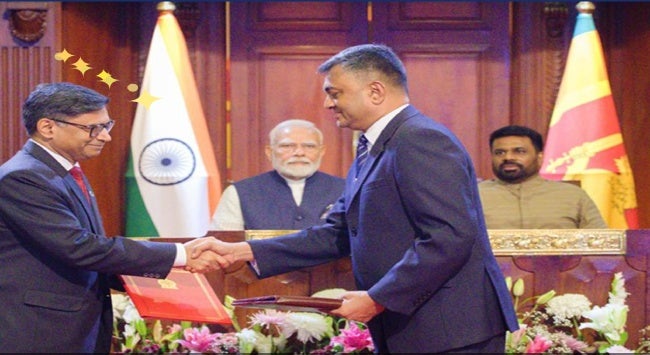
Meanwhile, India’s economic role is becoming more structural. The US$450 million (S$576 million) post-Cyclone Ditwah reconstruction package includes US$350 million (S$448 million) in rupee-denominated credit lines and US$100 million (S$128 million) in grants. The two governments are advancing the power-grid interconnection, Sampur solar project, Trincomalee energy hub, Sri Lanka Unique Digital Identity project and a US$65 million (S$83.2 million) grant to modernise Kankesanthurai port. In April 2026, Mazagon Dock Shipbuilders acquired 51 per cent of Colombo Dockyard, placing an Indian state-owned firm inside a strategically important industrial asset.
These initiatives can strengthen Sri Lanka’s productive base but the bargain matters. Rupee-denominated finance may reduce currency risk and procurement costs; its legitimacy will be stronger if Sri Lankan firms generate more returns from India. The digital identity project likewise requires clear guarantees on procurement, data governance, cybersecurity and Sri Lankan control of citizens’ information.
The relationship should not be reduced to a contest with China. Beijing remains embedded in Sri Lankan infrastructure and finance but India’s advantages are proximity, crisis responsiveness, people-to-people ties and access to a vast neighbouring market. Strategic gains should be measured not by assets acquired relative to China but by whether Indian engagement generates visible, reciprocal benefits that endure across Sri Lankan governments.
Sri Lanka’s recovery makes this urgent. The International Monetary Fund released about US$695 million (S$889.6 million) in May 2026 while judging debt-sustainability risks high and restructuring incomplete. Opaque agreements or one-sided infrastructure can be weaponised politically; projects creating local suppliers, skilled jobs, export revenue and transparent benefits can instead anchor the relationship across governments.
From an FTA Update to a Robust Economic Compact
The June 2026 decision to update the bilateral FTA is an opportunity but an exercise confined to tariffs would be a missed opportunity. India and Sri Lanka need a compact connecting market access to their new infrastructure and investment relationship. Reciprocity need not mean symmetrical trade or equal concessions; it means ensuring deeper integration creates identifiable opportunities for Sri Lanka to grow, export and build productive capacity.
First, both governments should negotiate better market access where Sri Lanka can scale exports quickly, including agriculture, logistics, ICT and business services. This should combine meaningful product coverage and quotas with faster customs clearance, time-bound standards approvals and mutual recognition where regulation is comparable. Sri Lanka must also ease supply-side constraints and improve testing capacity.
Second, Indian investment should be export-enabling. The objective should be to use Indian capital not simply to build infrastructure but to increase Sri Lanka’s ability to export to India and join regional value chains. Major projects should include local procurement, supplier-development programmes, skills transfer and pathways for Sri Lankan firms into Indian and regional markets.
Third, the FTA update should sequence sensitive issues rather than let them block progress. Goods access, customs, standards and selected services can move first; professional mobility, digital regulation and investment protection can proceed separately, with safeguards for vulnerable professions and smaller firms. Energy and digital projects should operate under clear governance frameworks protecting oversight and sovereignty.
India does not need to import as much from Sri Lanka as it exports. It does need to ensure that Sri Lanka benefits more materially. That requires a shift from assets acquired to capacity created, from credit extended to exports enabled, and from connectivity announced to two-way flows. The test is whether India’s growing presence expands Sri Lanka’s productive capacity, export revenue and stake in the relationship. Greater market access can turn that presence from a source of dependence into a more reciprocal and durable partnership.
. . . . .
Dr Karthik Nachiappan is a Research Fellow at the Institute of South Asian Studies (ISAS), an autonomous research institute at the National University of Singapore (NUS). He can be contacted at karthik@nus.edu.sg. The author bears full responsibility for the facts cited and opinions expressed in this paper.
Pic Credit: High Commission of India, Colombo, Sri Lanka
-
 More From :
-
 Tags :
-
 Download PDF