


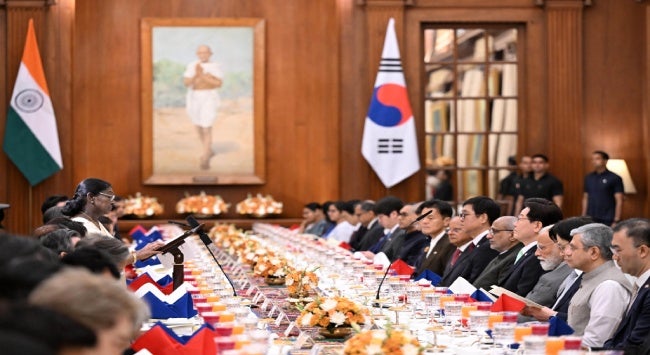
President Lee Jae Myung in India:
Boosting Strategic Industrial Collaboration
C Raja Mohan
23 April 2026Summary
South Korean President Lee Jae Myung’s state visit to India – the first in eight years – marks a determined push by New Delhi and Seoul to strengthen bilateral partnership amid significant changes in the regional and global order. The summit between Narendra Modi-Lee summit produced agreements on shipbuilding, defence co-production and a commitment to double trade to US$50 billion (S$63.8 billion) by 2030. The visit elevates a rising South Korea to a higher place in India’s Asian strategy.
South Korean President Lee Jae-myung’s visit to India from 19 to 21 April 2026 has come at a moment when Asia’s strategic landscape is being reordered by changes in the great power relations and geoeconomic disruption. The visit marked New Delhi’s recognition of South Korea’s rise as a consequential industrial, technological and geopolitical actor. For Seoul, grappling with the economic shock of the Gulf War and the emerging structural constraints on growth, India has moved from the periphery to the centre of its Asian strategy.
As he arrived in India, Lee made it clear that the prolonged United States (US)-Iran conflict and the effective closure of critical shipping routes had underlined the importance of wider maritime security cooperation among Asian nations. India too has been forced to confront the fragility of its energy lifelines through the western Indian Ocean and the importance of boosting its energy and maritime security in partnership with fellow Asian powers that are so deeply dependent on the Persian Gulf for their hydrocarbon supplies.
The centrepiece of the visit was the Joint Strategic Vision for the India-Republic of Korea Special Strategic Partnership, signalling a shift from transactional commercial exchange to an alliance premised on industrial production and technology collaboration. The new framework covers shipbuilding, semiconductors, artificial intelligence and co-production of arms.
Cooperation in shipbuilding, port development and maritime logistics has emerged as an important new dimension of the strategic partnership. South Korea is one of the world’s leading ship builders and India offers a large market of unrealised maritime potential. New Delhi and Seoul are now committed to bringing their maritime synergies into an alignment. The memorandum of understanding between HD Korea Shipbuilding and Indian partners to build and operate a large greenfield shipyard in Tamil Nadu is among the many ambitious elements of the new maritime industrial collaboration between the two countries.
For India, whose naval ambitions have long been constrained by weak domestic shipbuilding, South Korean partnership could be transformative. For Seoul, facing demographic pressures and rising labour costs, India offers a production ecosystem that sustains South Korean competitiveness.
Defence cooperation follows a similar convergence of interests. South Korea has risen to be a major defence industrial powerhouse and is exporting weapons around the world, including to Central Europe and the Middle East. India, long the largest arms importer in the world, is now eager to produce weapons at home for its own consumption and the world. It is looking to South Korea as a partner in acquiring arms as well as joint production.
The launch of the India-Korea Digital Bridge aims to expand cooperation in semiconductors, artificial intelligence and digital infrastructure. The complementarity is real: South Korea’s fabrication strengths align with India’s engineering talent and software depth. The ambition now is to translate this synergy into concrete outcomes.
The two sides have also decided to intensify talks on upgrading the 2009 Comprehensive Economic Partnership Agreement. Bilateral trade stands at roughly US$27-28 billion (S$36.5-37.8 billion), but the imbalance is stark: India exports around US$6.5 billion (S$8.8 billion) to South Korea while importing nearly US$18.5 billion (S$25 billion). India seeks to rebalance the agreement, expand services exports and address non-tariff barriers. The Modi government has been highlighting the trade imbalance for some time and is keen to institute a new framework for bilateral trade, as it sets a target of US$54 billion (S$72.9 billion) by 2030. This will involve significant policy innovation and coordinated action on the part of the trade authorities of both countries.
The new factor cementing the strategic partnership is the shared vulnerability to Middle Eastern instability, its impact on their energy supplies and the security of shipping in the Western Indian Ocean. The issue of freedom of navigation, of course, has its own resonance in the eastern Indian Ocean and the Western Pacific. Both leaders reaffirmed their commitment to maintaining peace and stability across the Indo-Pacific and to an open maritime order. The Indo-Pacific framing for India-South Korea cooperation is not new, but the Gulf War has given it sharper economic meaning. Energy diversification, supply-chain resilience and maritime security have moved from abstract strategy to operational necessity.
In a joint statement on energy resource security, New Delhi and Seoul agreed to “maintain a stable, secure and reliable supply of energy resources to each other including efforts by both countries to maintain open trade in naphtha and other petroleum products” and “explore closer collaboration among LNG-consuming countries”.
India and South Korea have talked the language of strategic cooperation before, but Modi and Lee have now sought to give some serious substance. Yet structural constraints remain. Korea’s economic opportunities elsewhere in the world mean, New Delhi will have to work harder than ever before to improve the ease of business for South Korean conglomerates. During the visit, the Indian side announced plans to develop a “Korea enclave” with “plug-and-play infrastructure to encourage” greater South Korean investments in industrial production.
India’s ‘Act East’ policy has long listed South Korea among preferred partners without generating the density of cooperation that was possible between a leading industrial nation and a large emerging economy. Lee’s visit to India has set the stage for realising the full potential of the partnership.
. . . . .
Professor C Raja Mohan is an Honorary Senior Fellow at the Institute of South Asian Studies (ISAS), an autonomous research institute at the National University of Singapore (NUS). He can be contacted at crmohan53@gmail.com. The author bears full responsibility for the facts cited and opinions expressed in this paper.
Pic Credit: X
-
 More From :
-
 Tags :
-
 Download PDF