


Summary
The Quadrilateral Security Dialogue summit in Manila on 17 November 2026 renewed leader-level engagement and advanced cooperation on maritime surveillance, artificial intelligence, connectivity and cybersecurity. United States President Donald Trump’s emphasis on critical-mineral supply chains strengthened its economic-security agenda. However, as uncertainties surrounding American foreign policy endure, the recovery will remain to be transformed into a sustainable transformation.
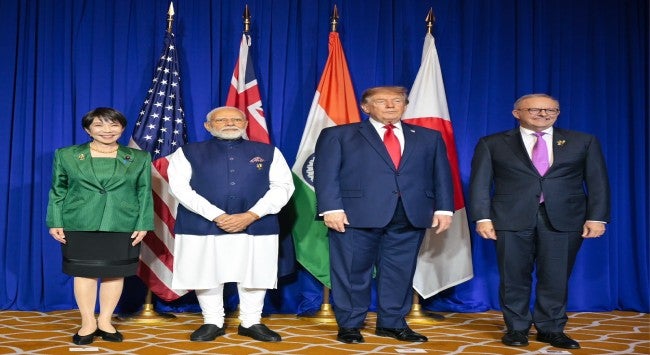
The Manila meeting of the Quadrilateral Security Dialogue (Quad) on 17 November 2026 brought together Australian Prime Minister Anthony Albanese, Indian Prime Minister Narendra Modi, Japanese Prime Minister Takaichi Sanae and United States (US) President Donald Trump for the first leaders-level meeting in two years. The brief joint press release issued after the meeting expressed concern about Chinese economic coercion and arbitrary export restrictions, and promised cooperation on open, safe and resilient maritime transit corridors.
The meeting’s immediate significance was political – to signal that Trump has not lost interest in a summit level meeting. Yet, contrary to the widespread impression that the Quad is dead for all practical purposes, the foreign ministers of the four countries have met five times in the last couple of years and kept pushing the four establishments to expand engagement and cooperation. Nevertheless, restoring engagement at the level of leaders does not establish that the ambivalence afflicting the partnership has disappeared.
The shadow over the Quad in Trump’s second term arose partly from contradictions within his administration. Washington supported Quad cooperation while simultaneously unsettling relations with its partners. India experienced this tension in a sharp manner.
In August 2025, American tariffs on affected Indian imports rose to 50 per cent, including an additional penalty linked to Russian oil purchases. The measures damaged a relationship that successive administrations had cultivated as a strategic investment. They demonstrated that geopolitical partnership offered limited protection against Trump’s commercial and political demands.
His frequent claims to have mediated between India and Pakistan added to the political friction with New Delhi. More broadly, Trump’s focus on prioritising the special personal relationship with Chinese leader Xi Jinping over reassurance to Asian partners seemed to undermine the Quad. Even as Trump focused on improving the ties with China, the second Trump administration sustained contacts with the three Asian partners.
Three meetings at the level of foreign ministers in 2026 helped signal that the US was not abandoning the Quad. The New Delhi meeting on 26 May 2026 sought to focus on a few issues rather than become a talking shop covering too many issues. The new emphasis was on maritime security, economic prosperity, critical and emerging technologies and humanitarian assistance. Its joint statement announced a Critical Minerals Framework covering policy coordination and investment in mining, processing and recycling. Economic resilience was becoming integral to the Quad’s security agenda and China’s weaponisation of its monopoly over rare earths and its dominance of global manufacturing.
The Manila ministerial meeting on 22 July 2026 addressed regional legitimacy. Its dedicated statement on the Association of Southeast Asian Nations (ASEAN) cooperation linked the Quad’s priorities to practical implementation of the ASEAN Outlook on the Indo-Pacific. This provided a framework to explain how the grouping might strengthen and complement Southeast Asian institutions. The meeting in Atlanta on 31 October 2026 advanced economic and technological cooperation. Ministers outlined assistance exceeding US$85 million (S$109.55 million) for trusted AI access, promoted business engagement and anticipated further maritime activity. Much of the leaders’ programme was therefore prepared before their arrival in Manila.
Trump’s public remarks in Manila on 17 November 2026 gave critical minerals greater prominence than the summit release alone suggests. Speaking to reporters ahead of the meeting, he announced “several important new critical mineral deals” intended to secure supply chains and prevent vulnerability to coercion by a single foreign supplier. Yet, the press release issued after the meeting neither identifies these agreements nor specifies their financing, participants or implementation arrangements. Trump’s announcement should not be treated as proof of a new, comprehensive Quad-wide minerals agreement.
The Quad leaders welcomed the inaugural Quad Business Leaders’ Forum, scheduled for early 2027. It will hopefully connect strategic objectives with private investment. Its success will depend on projects and commercial partnerships rather than attendance alone. Similarly, the leaders’ support for an AI Accelerator programme for the Indo-Pacific, announced by the foreign ministers in Atlanta, underlines the importance of coordinated funding, deployment and technical assistance across the region.
The Quad’s clearest operational commitment concerns the Indo-Pacific Maritime Surveillance Collaboration. The four countries’ P-8 and P-3C patrol aircraft are scheduled to participate in a maritime exercise in 2027, the first such activity in a Quad context. This extends cooperation beyond exchanging information towards coordinating surveillance capabilities. It does not create an alliance or establish a common response to regional contingencies. Its value lies in incremental operational familiarity and improved maritime awareness.
The leaders also welcomed new connectivity initiatives. Australia’s contribution to the cable partnership will now extend to electricity cables. Enhanced cybersecurity cooperation offers another practical avenue, although the release provides few institutional details. For India, the condemnation of cross-border terrorism is welcome.
The release does not name China or explicitly discuss Taiwan and the East and South China Seas. Beijing has been warning against the Quad’s meddling on issues that concern China’s claimed territorial sovereignty. The Quad’s silence on these issues seems to be compensated by the strategic implications of deeper maritime security coordination.
For Southeast Asia, the Quad’s strongest proposition remains practical assistance without demands for exclusive alignment. The Quad’s declared commitment to ASEAN centrality will acquire substance through consultation, local ownership and projects addressing regional priorities.
Manila demonstrates that the Quad can preserve cooperation through political disruption. Its durability, however, will depend on exercises conducted, investments mobilised and capabilities delivered. It will also depend on whether Washington’s treatment of its partners reinforces strategic reassurance amid the intensifying American engagement with Beijing.
. . . . .
Professor C Raja Mohan is an Honorary Senior Fellow at the Institute of South Asian Studies (ISAS), an autonomous research institute at the National University of Singapore (NUS). He can be contacted at crmohan53@gmail.com. The author bears full responsibility for the facts cited and opinions expressed in this paper.
Pic Credit: X
-
 More From :
-
 Tags :
-
 Download PDF