


Loss and Damage Funding for Nepal:
A Modest Beginning but More Needs to be Done
Puspa Sharma
2 November 2026Summary
The Fund for Responding to Loss and Damage (FRLD) has decided to provide a modest provisional support to Nepal in response to the August 2026 catastrophic flash floods. The support is extremely small compared to the requirement. Nonetheless, it is a good beginning. This should set an example for similar occurrences in the future, along with, more importantly, strengthening the FRLD.
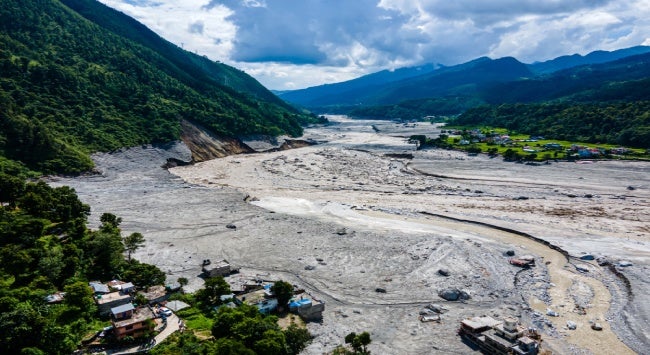
Following the catastrophic flash floods that hit Nepal on 26 August 2026, there was a global debate on whether it was due to climate change. The floods were caused by a massive ice-and-rock avalanche in the Himalayas. Several experts, based on scientific observations, claimed that rising temperatures due to global warming was an important factor in the collapse of the ice-rock. However, the evidence was not conclusive. Further studies were necessary to establish the relationship of the disaster with climate change. Hence, when the Nepal government sent an urgent letter to the Fund for Responding to Loss and Damage (FRLD), which is an operating entity of the financial mechanism under the United Nations Framework Convention on Climate Change, for an immediate response in less than a week of the disaster, it invited some concerns regarding whether the government acted in a haste. There were viewpoints that the government should have waited for some time to establish firmly that climate change was a cause of the disaster.
However, to the surprise of many, the FRLD, by convening its first-ever extraordinary Board meeting, decided to provisionally set aside US$21.6 million (S$27.65 million) for Nepal. This decision of the FRLD, the mandate of which is to address “the urgent and growing needs of vulnerable communities in developing countries facing the irreversible impacts of climate change”, provides credence to the claims that climate change was a factor in triggering the avalanche and the cascading disaster.
The provisional amount set aside by the FRLD, however, is extremely modest. It is less than one per cent of the estimated loss and damage. The Rapid Damage and Needs Assessment (RDNA), undertaken by the Nepal government soon after the disaster, has estimated a total loss and damage of US$2.69 billion (S$3.44 billion) and a recovery needs assessment of US$4.77 billion (S$6.11 billion). A substantially higher estimate of the funds needed for recovery compared to the loss and damage is due to the need to build back better. The Post Disaster Needs Assessment, which will provide more comprehensive picture of the need for rehabilitation and reconstruction, is under preparation. Its preliminary findings on the loss and damage to households and enterprises (excluding large ones such as hydropower plants) is NPR79.17 billion (S$671 million). Therefore, the FRLD’s provisional amount is an extremely small, token support.
The RDNA’s estimated need is about 10 per cent of Nepal’s gross domestic product, which is a significant amount for a resource-constrained country like Nepal. More importantly, this disaster certainly is not a one-off event. In about one and a half months of the 26 August 2026 floods, Nepal experienced another massive flash flood in the Budhi Gandaki River. It also swept away several private and public infrastructures causing a huge damage, the estimates of which are yet to come. More such disasters are imminent in Nepal. The main cause of the Budhi Gandaki floods is still not clear. Of course, not all disasters can be attributed to climate change. However, climate change-induced disasters have become more frequent and intense over the years.
How is Nepal going to manage all this? Is the country doomed to keep rebuilding the lost infrastructure instead of adding new ones? Unless external support is forthcoming, Nepal will not be able to handle this on its own. Therefore, strengthening institutions such as the FRLD is crucial.
The modest amount that the FRLD has set aside for Nepal is “provisional”, decided extraordinarily. The FRLD might extend additional support following due process in the coming months. However, even if it would decide to significantly scale up the support, that will still be very modest compared to the volume that is needed.
According to a latest FRLD report, it has received 176 eligible funding requests from several countries amounting to US$2.8 billion (S$3.58 billion). However, the total pledges to the Fund was an equivalent of US$822.71 million (S$1.05 billion), of which it had received only US$485.97 million (S$622.04 million). Such a wide gap between the pledges and requirement, and an even wider gap when the actual amount it has received is considered, suggests that the FRLD’s effectiveness can be limited unless serious measures are taken to strengthen it.
The FRLD’s recent decision on Nepal is commendable. The institution has set a good precedent. The Government of Nepal and several other stakeholders have appreciated the FRLD’s actions in this case. However, there is also a risk that countries that have the responsibility to support developing countries to address loss and damage due to climate change might use such modest support by the FRLD as pretexts of fulfilling their responsibilities. This should not be the case.
With temperatures breaching the safe limits due to global warming, and the likely several other impacts of climate change, disasters attributable to climate change are likely to intensify in the days ahead creating significantly large-scale loss and damage. The Glacial Lake Outburst Flood in Bhutan on 30 October 2026 is the latest example from South Asia.
The FRLD’s current response to Nepal should be considered a modest beginning. Significantly, scaling up the actual contributions of funds to the FRLD must be an urgent priority.
. . . . .
Dr Puspa Sharma is a Senior Research Fellow at the Institute of South Asian Studies (ISAS), an autonomous research institute in the National University of Singapore (NUS). He can be contacted at puspa.sh@nus.edu.sg. The author bears full responsibility for the facts cited and opinions expressed in this paper.
Pic Credit: Shutterstock
-
 More From :
-
 Tags :
-
 Download PDF