


Summary
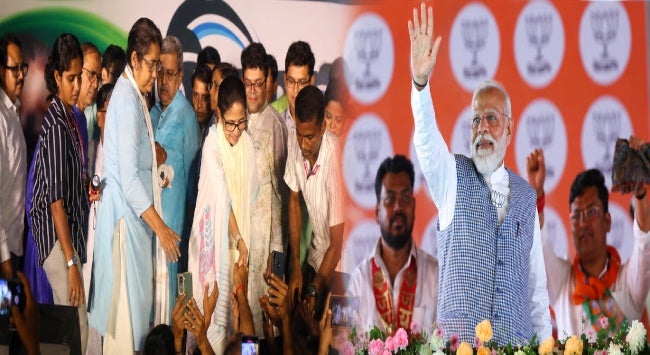
West Bengal will see by-elections in two constituencies on 6 October 2026. The two Assembly constituencies going to elections are Nandigram and Rejinagar. The opposition candidates have faced acute pressure from state agencies in the run-up to the elections.
Nearly five months after the historic formation of the Bharatiya Janata Party (BJP) government for the first time ever in West Bengal, the BJP will face by-elections in two Assembly constituencies on 6 October 2026. However, the run-up to the elections has been marred by the withdrawal and arrest of opposition candidates. The elections will also be held against the backdrop of the Election Commission of India (ECI) freezing the ‘grass and leaves’ party symbol of the Trinamool Congress (TMC) and allotting alternative symbols to the two rival factions of the party. The faction led by former West Bengal Chief Minister Mamata Banerjee will be known as the Mamata All India Trinamool Congress and has been allotted a ‘football player’ symbol. The rival faction has been handed the name Democratic Trinamool Congress and will contest on an ‘envelope’ symbol. The ECI’s order has been challenged in the Supreme Court but the court is unlikely to decide before the bypolls.
The two constituencies going to elections are Nandigram in Purba Medinipur district and Rejinagar in Murshidabad district. In Nandigram, a bypoll became necessary after West Bengal Chief Minister Suvendu Adhikari resigned from the seat and retained the high-profile Bhabhanipur seat, where he had defeated Mamata. In Rejinagar, the Aam Janata Unnayan Party (AJUP) chief Humayun Kabir resigned as a Member of the Legislative Assembly to retain the Nawda seat.
In both constituencies, the opposition has had a tough time fielding candidates and in campaigning. In Nandigram, the candidate of the Mamata-led TMC faction, Sanchita Dey Pradhan, withdrew from the contest. She announced her withdrawal after allegedly meeting Adhikari. Subsequently, Mamata extended her support to the Congress candidate, Milan Pradhan, hinting at the possibility of an alliance between the two parties in future. However, soon after the announcement, Pradhan was arrested in connection with a case dating back to 2007.
In Rejinagar, a similar political drama is playing out. Kabir, a former TMC member who quit the party before the 2026 Assembly polls to form the AJUP, has alleged police harassment of his party workers. For the bypolls, Kabir’s son, Golam Nabi Azad, is the party candidate. Over the past few weeks, several party members have been arrested. The other opposition parties too are facing an uncertain situation. The Mamata faction of the TMC nominated Rabiul Alam Chowdhury, who announced on 19 September 2026 that he would withdraw, citing concerns over fighting the election on the new election symbol allotted by the ECI. However, he retracted his statement within hours, following Mamata’s intervention, and is now contesting the bypolls. The contest will be multicornered, with the other contestants being the BJP’s Sakharav Sarkar, the rival TMC faction’s Safiuzzaman Sheikh, the Congress’ Mohammad Abdullahil Kafi and the Communist Party of India (Marxist)’s Syed Asad Ali.
The Nandigram bypoll is expected to be a relatively easy win for the BJP since it is a Adhikari’s stronghold and a constituency from where he won in 2026. Adhikari’s margin of victory, though, was under 10,000 votes with the undivided TMC’s Pabitra Kar coming in second. Since the election, Kar has quit active politics. The BJP’s candidate is Hasirani Rath, the mother of a former aide of Adhikari who was gunned down in May 2026. All the major opposition parties, except the Mamata faction of the TMC, are also in the fray in Nandigram, which is likely to split the opposition vote and makes things easier for the BJP.
The Rejinagar election is another matter since Muslims comprise around 65 per cent of the constituency’s electorate and traditionally do not vote for the BJP. Adhikari has controversially pitched the by-election as a “test” of the Muslim minority’s support for his government’s agenda. In the 2026 election, Kabir won by a margin of nearly 60,000 votes with the BJP candidate finishing second. The candidate of the undivided TMC came in third with nearly 42,000 votes. In the coming by-election, all the candidates are different and the opposition divided, giving the BJP a window of opportunity.
While the opposition is in disarray in West Bengal, the BJP has consolidated its power since it formed the government in May 2026. The use of state force to pressure opposition parties and candidates in the coming bypolls is part of what political scientist Dwaipayan Bhattacharyya calls a transition in West Bengal from a system of “franchisee politics” under the TMC to the BJP’s “command politics”. The franchisee model positioned Mamata as the “franchisor” who is serving as the “party’s core brand”, while local TMC leaders “functioned as franchisees”. This led to widespread corruption, which was called the ‘syndicate raj’ in popular parlance, and was one of the reasons for the TMC’s downfall. The BJP’s command politics regulates “political mediation, economic activity, and public conduct through directive authority”. This top-down system is far more reliant on hierarchy and the might of the state. This has resulted in a crackdown on ‘illegal’ settlements and structures, disproportionately in minority dominated areas and engineering defections allegedly using the threat of investigating agencies. These tactics are, of course, not restricted to West Bengal.
Some elements of this playbook are on display in the conduct of the by-elections, whose results will be announced on 9 October 2026 along with three constituencies in two other states. Whatever the outcome of the bypolls in West Bengal, the electoral process has raised concerns about a level playing field.
. . . . .
Dr Ronojoy Sen is a Senior Research Fellow and Research Lead (Politics, Society and Governance) at the Institute of South Asian Studies (ISAS), an autonomous research institute at the National University of Singapore (NUS). He can be contacted at isasrs@nus.edu.sg. The author bears full responsibility for the facts cited and opinions expressed in this paper.
Pic Credit: Facebook
https://www.facebook.com/photo/?fbid=1644149863747400&set=pb.100044572053325.-2207520000
https://www.facebook.com/photo?fbid=1419516476889301&set=pcb.1419516733555942
-
 More From :
-
 Tags :
-
 Download PDF