


Managed Interdependence: Lessons for India from China-Southeast Asia Clean Energy Engagement
Karthik Nachiappan
25 September 2026Summary
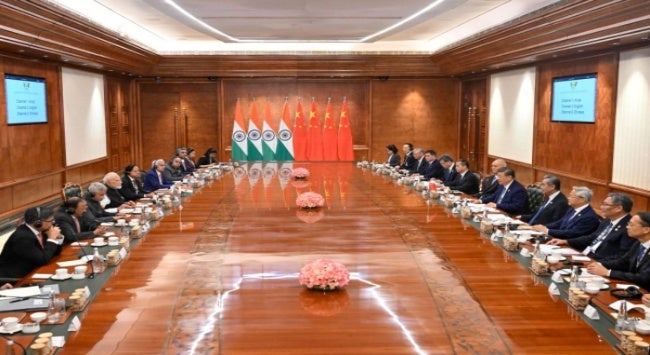
Chinese President Xi Jinping’s recent visit to New Delhi for the BRICS Summit reopened diplomatic channels but largely left intact India’s structural dependence on Chinese goods. Moving forward, India should pursue managed interdependence by engaging China and regional institutions to build up domestic capacity rather than unconditioned dependence or decoupling.
Chinese President Xi Jinping’s visit to New Delhi for the BRICS summit in September 2026 has been read as a resetting of India-China ties: restored flights and visas, a pledge to work toward resolving the border dispute and language on structural trade imbalances. Climate and clean energy cooperation, however, were absent from the outcomes.
The lesson is not that the thaw is meaningless but that it is running on a different track from the underlying economic rivalry. The ongoing detente lowers the temperature in terms of political engagement; it does not resolve the structural tension between India’s dependence on Chinese goods, especially clean energy inputs and its general and overriding wariness of that dependence. Climate cooperation, for it to be durable, needs a separate track of its own, one that can advance specific interests and opportunities in clean energy.
The debate on India-China clean-energy cooperation is often framed as a binary: engage or not. Neither is sufficient. China holds dominant positions across solar manufacturing, battery chemistry, electric vehicles, power electronics and mineral processing that India cannot replace in the near term; attempting to do so quickly would raise costs and delay deployment.
However, wholesale, unconditioned engagement risks converting engagement into a potential vulnerability.
For India, a more useful frame and approach is managed or selective interdependence, advancing commercial engagement on clean energy issues while limiting strategic exposure. In practice, this means differentiated conditions by sector through measures like equity caps, local-content requirements, technology co-development, training, repair and sunset clauses that could be attached wherever infrastructure, data or critical technologies are involved, alongside an effort to nurture and have credible alternative suppliers.
India’s existing investment-screening mechanism also illustrates the gap between the two. It did ostensibly reduce the risk of some investment and acquisitions but did not reduce dependence, since restricted equity simply continued alongside imports of Chinese machinery, components and technical expertise.
Southeast Asia could help navigate this trajectory. Vietnam’s solar and wind boom, built almost entirely on Chinese panels, turbines and engineering services, took installed capacity from negligible to over 16 gigawatts within two years and outran the grid’s capacity to absorb it, producing curtailment and retroactive tariff cuts. Indonesia’s nickel and battery build-out, driven by an export ban that forced Chinese processors to build onshore, created US$ 34 billion (S$43.5 billion) in downstream capacity and with it, a dependency on a technology partner whose processes Indonesia cannot replicate, alongside significant environmental and public-health costs.
Both cases show that Chinese capital and equipment can deliver speed and scale at a pace no domestic pathway could match. Neither, however, shows that capacity converts into capability. The Southeast Asian record should function for India less as a template than as an example to assess and reconfigure. India can institute the safeguards when engaging China through greater ownership, technology transfer, supplier development and enforcement that Southeast Asian countries did not adequately think through.
India-China bilateral clean energy engagement offers scale, but it likely remains hostage to the broader political relationship. This situation calls for engagement through the bilateral and beyond via minilateral platforms such as BRICS and BASIC (Brazil, South Africa, India, China), multilateral development banks, including the Asian Infrastructure Investment Bank and the New Development Bank, city-to-city networks, and Track 1.5 dialogue, among research institutions.
These channels diffuse the political risk that any single government absorbs by engaging China directly, and as Indonesia and the Philippines have shown by coordinating nickel policy give smaller and mid-sized countries more leverage collectively than they would have by negotiating alone. A possible sequence is regional and minilateral engagement first, to build trust, benchmarks and standards, and bilateral second, to deliver cooperation at scale once.
The current window gives India an opening for deepening climate engagement with China. Potential success for India could be measured in terms of whether India has been able to build robust clean energy capabilities at home, found credible alternative suppliers, secured cooperation on grids, storage and energy efficiency that makes a difference.
That outcome depends on Beijing’s intentions and on India’s institutions, the investment screening mechanisms, industrial policy, regional and minilateral partnerships that can add to other engagements. Managed interdependence is not just a strategy; it will be a test of institutional capacity, and one that India must foster.
. . . . .
Dr Karthik Nachiappan is a Non-Resident Senior Fellow at the Institute of South Asian Studies (ISAS), an autonomous research institute at the National University of Singapore (NUS). He can be contacted at knach@visitor.nus.edu.sg. The author bears full responsibility for the facts cited and opinions expressed in this paper.
Pic Credit: X
-
 More From :
-
 Tags :
-
 Download PDF