


India’s 2026 BRICS Chairmanship:
Quiet Diplomacy, Calibrated Outcomes
Karthik Nachiappan
14 September 2026Summary
India’s 2026 BRICS presidency culminated in a declaration securing important diplomatic wins for India, notably a strong condemnation of the 2025 Pahalgam terrorist attack and renewed support for United Nations Security Council reform while carefully sidestepping the Russia-Ukraine war, a notable departure from the 2025 Rio declaration.
India’s decision to keep its BRICS presidency understated, in stark contrast to the spectacle of its 2023 G20 chairmanship, was a calculated choice, not an oversight. The current climate, shaped by United States’s President Donald Trump’s tariff regime, a robust US-India defence and technology partnership and Washington’s hostility toward anything resembling de-dollarisation, made a high-profile BRICS moment strategically fraught. The low-key approach allowed India to host competently, extract bilateral value from the margins, including Chinese Premier Xi Jinping’s first visit to India since 2019, without letting BRICS define India’s global posture.
This restraint extended to the agenda too. An ambitious BRICS programme would inevitably have gravitated toward an ostensibly counter-hegemonic, anti-Western vision that China and Russia favour. India’s path to a permanent United Nations Security Council seat and Global South leadership runs through reforming the existing multilateral system, not building alternatives to it. By focusing the agenda and discussions around innovation, sustainability and digital public infrastructure, India shaped BRICS on its own terms as a cooperative platform rather than a competing bloc. The declaration’s emphasis multilateralism, development finance and institutional reform rather than counter- hegemonic posturing reflects this approach.
The adoption of the New Delhi Declaration was a significant outcome given the divisions that could have derailed it. The declaration addressed conflicts in West Asia, Palestine, Syria, Sudan and Cuba, and included strong counter-terrorism language that condemned the Pahalgam attack and called for action against cross-border terrorism, terrorist financing and safe havens, a notable diplomatic gain for India, particularly given China’s reluctance to condemn the attack when it occurred. However, the declaration’s most striking omission was any reference to the Russia-Ukraine war, a departure from the 2025 Rio declaration which had recalled member states’ national positions on the conflict. The omission likely reflects the price of consensus: naming the conflict risked reopening divisions that would have prevented agreement on the broader document. India managed these trade-offs, securing what mattered most to it while accommodating positions it could not change.
On payment cooperation, the structural impediments remain. China’s dominance of intra- BRICS trade means any alternative payment system risks becoming a yuan- No. 1420 – 14 September 2026 2 internationalisation vehicle, and India has little interest in substituting dollar dependence for yuan dependence. Linking diverse national payment systems without a common clearing mechanism or shared messaging standard like SWIFT remains a challenge. India has stated it does not support a BRICS common currency and values the dollar’s reserve role as a source of global stability. The declaration endorsed continued discussions on cross-border payment solutions and greater use of national currencies but stopped short of any framework that could be read as de-dollarisation, a careful calibration that avoided giving Washington grievance.
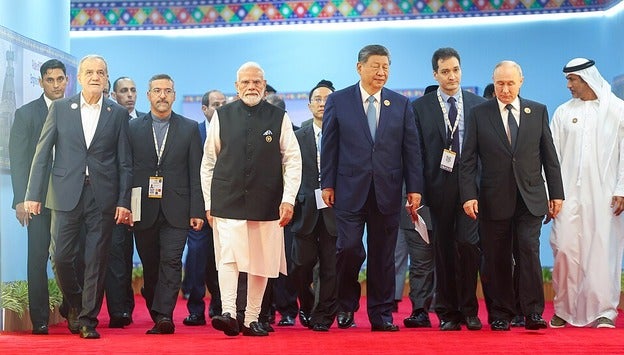
The photograph of India’s Prime Minister Narendra Modi, flanked by Russian President Vladimir Putin, Xi and Iran President Masoud Pezeshkian at BRICS 2026, possibly attracted attention. For the Trump administration, which tends to prioritise optics over substance, the image could be an irritant. However, India framed the summit with an anodyne, developmental agenda that resisted anti-Western characterisation, and the declaration’s language was sufficiently measured to avoid provoking a serious reaction from Washington. The structurally sound US-India relationship has enough ballast to absorb the optics.
The internal divisions within BRICS, between India and Brazil’s preference for an economic coordination platform and China and Russia’s vision of a counter-order, and between Iran and the United Arab Emirates (UAE) on regional questions, are real and structural. However, the New Delhi Declaration suggests that India’s moderate camp has, for now, set the terms. The expanded membership, including Indonesia, the UAE, Egypt and Ethiopia, brought no appetite for a confrontation with the West, and the declaration’s developmental and institutional focus reflects that balance.
The New Delhi BRICS summit confirmed what has been apparent for some time; BRICS is useful precisely because it is modest. India’s chairmanship succeeded not by overstating the platform’s ambitions but by confining them, keeping the agenda developmental, the language measured and the geopolitics manageable. The real test was never whether India could produce a bold declaration but whether it could hold an increasingly unwieldy grouping together without compromising its own strategic position. It did.
The challenge ahead is implementation. With China assuming the BRICS chairmanship in 2027, the question is whether the platform India carefully defines will hold or shift toward the more assertive agenda that hews close to what Beijing wants. The New Delhi summit demonstrated that India could manage the conversation and produce consensus that’s somewhat vague, carefully curated, and deliberately hedged, but consensus, nonetheless. For a grouping this diverse, that may be the most realistic measure of success.
. . . . .
Dr Karthik Nachiappan is a Non-Resident Senior Fellow at the Institute of South Asian Studies (ISAS), an autonomous research institute at the National University of Singapore (NUS). He can be contacted at knach@visitor.nus.edu.sg. The author bears full responsibility for the facts cited and opinions expressed in this paper.
Pic Credit: Wikimedia Commons
-
 More From :
-
 Tags :
-
 Download PDF