


ASEAN-India Digital Cooperation:
Progress, but with Limited Ambition
Sandeep Bhardwaj
10 September 2026Summary
Digital cooperation between the Association of Southeast Asian Nations and India has made good progress in the last few years but remains constrained by limited scope and vision.
The Association of Southeast Asian Nations (ASEAN) digital integration process, underway for many decades, recently gained increased momentum with the conclusion of the Digital Economy Framework Agreement (DEFA). An offshoot of the process has been greater interest in ASEAN’s digital cooperation with its summit partners. Historically, India has been a major digital partner of the region, as evidenced in their burgeoning services trade. In the last couple of years, India and ASEAN have also sought to reinvigorate the institutional cooperation in the field of information and communication technologies (ICT). The two partners unveiled a new cooperation agenda through the Joint Statement on Advancing Digital Transformation announced in Laos in 2024.[1]
Although India and ASEAN have been able to make significant progress in some of their stated goals, their cooperation remains stymied by limited ambitions. The cooperation agenda revolves around only a few issues, while ignoring many of the most significant aspects of digital economy today. Furthermore, ASEAN-India digital cooperation has significantly fallen behind other similar projects such as ASEAN-China digital cooperation.
ASEAN-India Digital Cooperation Agenda
While the 2024 Laos Joint Statement promises deeper cooperation in several fields such as artificial intelligence (AI) and cybersecurity, many such goals remain nascent and ill-defined as of now. It is evident from the statement that the three central pillars of the ASEAN-India digital cooperation are sharing of the Digital Public Infrastructure (DPI), instituting cross-border digital payment systems, and capacity building.
Promotion of the DPI has emerged as a key aspect of Indian foreign policy in the last few years, building on the success of India Stack – a collection of digital public goods that help finance, identity verification, e-commerce, governance and data sharing, among others. India has offered to export various technologies and technical know-how associated with India Stack to countries across the world, especially in the Global South.
The offer of India’s DPI as “models and templates for developing countries”, in the words of Prime Minister Narendra Modi, is a means to burnish its credentials as a Global South leader.[2] New Delhi has stressed that the offer is not to gain commercial advantages for India but to provide global public goods.[3] Nevertheless, such a push will conceivably provide opportunities to Indian companies with deep familiarity with India Stack.
Many countries find Indian DPI useful as an alternative to solutions offered by China or the United States (US). Chinese solutions – promoted as part of its Digital Silk Road (DSR) initiative – are sometimes viewed with geopolitical or security concerns.[4] On the other hand, American solutions are often too expensive, and Washington has become increasingly willing to weaponise them for geopolitical purposes.[5]
A good example of DPI sharing, highlighted during Modi’s visit to Indonesia last month, is Indonesia Open Network (ION).[6] The network was modelled after an Indian initiative called Open Network for Digital Commerce (ONDC) and relied on advice from Indian experts. Both ONDC and ONI are a suite of open protocol and technical specifications to promote a decentralised network to connect buyers and sellers in a way that does not lock them on a single e-commerce platform.
India’s efforts to share its DPI technologies is a novel diplomatic manoeuvre that is likely to earn it goodwill at the world stage. Nevertheless, the initiative faces at least four significant challenges. First, India Stack has a variable track record. While the projects such as Aadhaar digital identity programme and the Unified Payments Interface (UPI) have been hugely successful, others have not delivered to the same degree. For instance, ONDC has reportedly struggled to compete with established e-commerce platforms. Second, although India Stack is promoted as indigenously developed, it depends on key technologies sourced from abroad. For instance, Aadhaar relies on the Japanese NEC Corporation for its biometric system.[7] Countries adopting India DPIs may discover that they need the involvement of third countries in the process. Third, the Indian initiative is limited in scope when compared to, say, China’s DSR. Whereas India Stack is only in the realm of software, the DSR involves considerable investment physical hardware including 5G networks, fibre-optic cables, data centres and smart-city systems. Finally, going forward, Indian DPI export strategy risks losing its sheen unless it also involves AI, which is becoming a major area of focus for most governments. However, India has so far lagged behind in the AI race.
Closely associated with the DPI export strategy is India’s promotion of cross-border digital payments. After all, the UPI is one of most successful aspects of India Stack. India has been an early mover in seeking out partners to operationalise international transfers through digital payments. In Southeast Asia, it has successfully linked UPI to the digital payment systems of Singapore and Cambodia, and is working to expand connectivity to Malaysia, Indonesia and Vietnam. India is also the first country outside Southeast Asia to join Project Nexus, a multilateral cross-border instant payment network consisting of Indonesia, Malaysia, Singapore, the Philippines and Thailand.
India’s bilateral and multilateral efforts have given it significant lead in the digital payments space over other ASEAN Summit Partners such as China, Japan and the US. In fact, India’s digital payment integration with the ASEAN member countries is at pace with intra-ASEAN integration. Cross-border digital payments are expected to offer a win-win for India and ASEAN, building on their comparative advantages. They lower transaction costs for the large Indian migrant worker population in the region to send small-scale remittances back home; and they ease the onsite microtransactions for the huge numbers of Indian tourists visiting Southeast Asia. Some proponents have also touted cross-border digital payments as boost for small and medium enterprises (SMEs). However, such a boost is likely to face hard ceiling unless it supported by other measures to ease trade between India and ASEAN such as tariff reduction, low compliance costs and digital invoicing, among others.
The third pillar of ASEAN-India digital cooperation – capacity building – is also its oldest. For more than two decades, India has offered to support capacity building efforts in the ICT sector for Southeast Asian countries, particularly Cambodia, Laos, Myanmar and Vietnam. For instance, India offers 50 ASEAN-India Research Training Fellowships annually for Southeast Asian scientists and researchers to work in Indian research and development (R&D) institutions. The prestigious Indian Institutes of Technology have launched doctoral programme for ASEAN students. To support such capacity-building efforts, India and ASEAN established ASEAN-India S&T Development Fund in 2008 and ASEAN-India Fund for Digital Future in 2024. Notably, the ASEAN-India capacity-building ambitions have significantly shrunk in the last two decades, when we compare the current programmes with their plans in the early 2000s to promote joint R&D, set up technology transfer networks and for India to support the establishment of advanced information technology (IT) institutes in CLMV.
Bilateral Cooperation
India’s digital cooperation with ASEAN is complemented by its collaboration with Southeast Asian countries at the bilateral level. India has signed broadly-phrased digital cooperation Memorandums of Understanding with Singapore, Malaysia, Philippines, Indonesia, Thailand and Vietnam. These documents promise cooperation on wide-ranging issues, including DPI export, R&D, AI, semiconductors, technology regulation, cybersecurity, Internet of Things and high-performance computing. However, the on-the-ground progress has varied from country to country.
India’s deepest bilateral digital cooperation in the region is with Singapore. The cooperation is undergirded by a well-developed institutional infrastructure. Digital ministers of the two countries meet regularly under India-Singapore Ministerial Roundtable framework. Digitalisation is an important pillar of India-Singapore Comprehensive Partnership, backed up by several agreements on specific issues. Moreover, the India-Singapore Comprehensive Economic Cooperation Agreement is India’s only free trade agreement (FTA) in the region that addresses digital issues, after its 2018 review introduced a chapter on e-commerce.[8]
In 2023, the two countries launched a digital trade corridor underpinned by Singapore’s TradeTrust Blockchain Framework that allows for interoperable electronic Bills of Lading for Letter of Credit processing.[9] The first transaction was a container of scrap metal shipped by a Singapore company from Miami to an Indian company in Gujarat. The ownership of the electronic Bill of Lading was transferred digitally and became the basis for an Indian bank to issue a letter of credit. This was the first shipment to undergo paperless transaction in the world.
Malaysia is also trying to institutionalise its digital cooperation with India, as evident by the establishment of Malaysia-India Digital Council in 2025.[10] The Council, comprising digital ministries of the two countries, will share technical expertise and regulatory approaches, explore on business-to-business partnerships, especially among start-ups and SMEs, and focus on upskilling and reskilling. Notably, the Council will also look to drive talent mobility between the two nations. Mobility of people is a high priority for Indian foreign policy. Its inclusion in the Council’s mandate signals the substantive nature of the initiative.
India’s bilateral digital cooperation with Indonesia and the Philippines largely revolves around DPI sharing. As discussed above, Indonesia used India’s ONDC as a model to develop its own ION. The Philippines has developed its national identification (ID) system called PhilSys, based on Modular Open-Source Identity Platform (MOSIP) developed by the International Institute of Information Technology, Bangalore (IIIT). MOSIP is a technology bundle developed by IIIT researchers to allow governments to create customized national ID systems. It is available to all countries free of cost. India has recently announced that it will assist the Philippines in developing a sovereign data cloud.[11] India’s plans of digital cooperation with Thailand and Vietnam are yet to yield substantive outcomes.
Limitations of ASEAN-India Digital Cooperation
In the last two decades, India’s engagement with ASEAN has fallen behind its peers. At the beginning of the millennium, the Southeast Asian countries viewed India as an IT powerhouse and were eager to harness that power. Leaders from the region such as Singapore’s then Prime Minister Goh Chok Tong often spoke of the country’s strength in digital technologies.[12]
Thailand’s then Prime Minister Thaksin Shinawatra was so enamoured by Indian IT industry that he recruited the Infosys Chief Executive Officer, Narayana Murthy, as his technology adviser. New Delhi also saw potential for collaboration with Southeast Asia based on the complementarity between “India’s software skills” and “hardware capabilities” in the region.[13]
This interest was reflected in the early Plans of Action (PoAs) developed by India and ASEAN to implement their partnership. The 2003 PoA called for harnessing hardware-software synergies between the two partners. It aimed to institutionalise regular digital ministers meetings.[14] It envisaged extensive knowledge sharing through technology transfer networks, expert exchanges, workshops and other capacity building efforts. In particular, it declared the intention of setting up Advanced Institutes of Information Technologies in different ASEAN member countries, in particular CLMV. It also spoke of strengthening the physical connectivity infrastructure between India and Southeast Asia through high-speech fibre optic cables. It looked to boost IT trade. Parallel to ASEAN-India discussions, India also developed ambitious plans of digital cooperation with the Southeast Asian countries on a bilateral level. New Delhi and Bangkok signed an agreement in 2001 that promised intense IT collaboration, including harmonisation of digital signatures, joint start-up incubation and collective exploration third-country markets.[15]
In the ensuing years, ASEAN-India digital trade grew rapidly. India’s exports of ICT services to the region grew from US$640 million (S$809.1 million) in 2005 to US$6.3 billion (S$7.96 billion) in 2024, while its imports grew from US$133.08 million (S$168.25 million) to US$1.75 billion (S$2.21 billion) in 2024. Southeast Asia now absorbs 8.5 per cent of India’s total ICT services exports, making it the second largest market for India after the US.[16]
However, the ambition of ASEAN-India digital cooperation has not kept up with the growing trade. In fact, it has shrunk significantly. The trend is evident in the ICT section of the successive five-year PoAs becoming progressively shorter.
Notably, the ASEAN-India digital trade is underpinned by their services FTA which has not been reviewed since it was signed in 2014.[17] The coverage of computer services in the FTA is patchy. For instance, under the agreement, Indonesia does not allow local presence of Indian IT companies except as joint ventures, and Vietnam places several restrictions on the services exports. The FTA also does not address several new aspects of ICT services trade which have now become part and parcel of such FTAs. Moreover, digital economy today is not just about the services trade but also the utilisation of ICT to boost merchandise trade through measures such as e-invoicing, paperless trade and digital regulatory compliance, among others. The ASEAN-India Trade in Goods Agreement (AITIGA), signed in 2009 and stuck in review negotiations since 2020, does not address such issues as of now.
In the last two decades, ASEAN’s internal digital integration and cooperation with other external partners have leapfrogged India. Southeast Asia was put on a path of digital integration with the signing of e-ASEAN Framework Agreement in 2000, a far-reaching document that addressed issues, ranging from e-commerce, ICT services trade and investments to regional information infrastructure and e-governance. The integration efforts have deepened and expanded since then with the recent DEFA as the latest major milestone.
Another point of comparison is ASEAN-China digital cooperation. The earliest foundations of this cooperation were laid in the beginning of the millennium with a 2003 Memorandum of Understanding (MoU) on ICT and 2005 Beijing Declaration on ASEAN-China ICT Cooperative Partnership. In contrast to India’s approach, China was heavily focused on the development of an ICT infrastructure. It was also attentive to developing strong institutional mechanisms and cybersecurity cooperation. In the 2010s, China’s commercial presence in Southeast Asia rapidly expanded through the DSR and growing dominance of its companies (China’s e-commerce giants today hold more than half the market share in Indonesia, Thailand and the Philippines).[18] However, the government-to-government digital cooperation slowed down.
The 2020s witnessed renewed focus on China-ASEAN digital cooperation. The two sides committed to using digital technologies to boost trade through the 2020 Regional Comprehensive Economic Partnership agreement and the 2025 ASEAN-China FTA 3.0 Upgradation, both of which inserted chapters on digital economy.[19] The two sides also signed a fresh MoU on communications and digital technology in 2024. They are currently developing a five-year action plan on joint digital transformation.[20]
Why has ASEAN’s digital cooperation with China moved with much greater momentum than India despite India’s natural strengths in the IT sector and its obvious interest pursuing this kind of cooperation? It is likely the result of a combination of factors: India’s experience with AITIGA, which was followed by a sharp increase in deficit in its trade with Southeast Asia, has made New Delhi hesitant to commit to major economic deals with the ASEAN. The Indian IT industry is largely focused on the export of software services and consultancy, with limited interest in ICT infrastructure construction, manufacturing of ICT goods or e-commerce. India is, therefore, not incentivised to seek out cooperation in those domains. Furthermore, much of Indian digital services exports is tied to mobility of its people, while several Southeast Asian countries remain reluctant to open up their borders.
Despite India’s successes in DPI sharing or digital payments connectivity, its cooperation with ASEAN remains narrow and lags behind other summit partners. However, the digital economy is increasingly becoming one of the most important areas of interest for ASEAN. Moreover, international digital cooperation is gaining salience today, not just within the economic context but also for security reasons. Issues ranging from cyber security and scam centres to AI regulations can only be tackled through bilateral and multilateral cooperation. ASEAN and India need to revisit their digital cooperation agenda and rapidly infuse it with much greater ambition and energy.
. . . . .
Dr Sandeep Bhardwaj is a Research Fellow at the Institute of South Asian Studies (ISAS), an autonomous research institute at the National University of Singapore (NUS). He can be contacted at sbhardwaj@nus.edu.sg. The author bears full responsibility for the facts cited and opinions expressed in this paper.
[1] “ASEAN-India Joint Statement on Advancing Digital Transformation”, ASEAN Secretariat, 10 October 2024, https://asean.org/wp-content/uploads/2024/10/9.-2024-ASEAN-India-Joint-Statement-on-Advancing-Digital-Transformation-FINAL.pdf.
[2] “English Translation of Prime Minister Shri Narendra Modi’s remarks at the unveiling of logo, theme and website of India’s G20 Presidency”, Ministry of External Affairs, Government of India, 8 November 2022, https://www.mea.gov.in/speeches-statements?dtl/35863/English_Translation_of_Prime_Minister_Shri_Narendra_Modis_remarks_at_the_unveiling_of_logo_theme_and_website_of_Indias_G20_Presidency_via_video_confer.
[3] “Special Briefing by Foreign Secretary”, Ministry of External Affairs, Government of India, 25 August 2023, https://www.mea.gov.in/media-briefings?dtl/37049.
[4] Jiaman Hu, “What Critics Get Wrong About China’s Digital Silk Road”, The Diplomat, 6 May 2026, https://thediplomat.com/2026/05/what-critics-get-wrong-about-chinas-digital-silk-road/; and Wang Zheng, “China’s Digital Silk Road (DSR) in Southeast Asia: Progress and Challenges”, Fulcrum, 23 January 2024, https://fulcrum.sg/chinas-digital-silk-road-dsr-in-southeast-asia-progress-and-challenges/.
[5] Henry Farrell and Abraham Newman, Underground Empire: How America Weaponized the World Economy (Henry Holt & Company: 2023).
[6] “Time to further strengthen our collaboration: Indonesia Open Network President Director ahead of PM Modi’s visit”, ANI, 6 July 2026, https://www.aninews.in/news/world/asia/time-to-further-strengthen-our-collaboration-indonesia-open-network-president-director-ahead-of-pm-modis-visit20260706140701/.
[7] Meg Kitamura, “India’s Aadhaar Shows Foreign Dependencies Reach Beyond US-China”, Tech Policy Press, 8 July 2026, https://www.techpolicy.press/indias-aadhaar-shows-foreign-dependencies-reach-beyond-uschina/.
[8] Singapore-India Comprehensive Economic Cooperation Agreement (CECA), https://www.mti.gov.sg/trade-international-economic-relations/agreements/free-trade-agreements-fta/ceca/.
[9] “Singapore and India kick off interoperable eBills of Lading for Trade Finance”, Press Release: TradeTrust, 25 August 2023, https://www.tradetrust.io/happenings-and-resources/press-release-singapore-india-kick-off-interoperable-ebills-of-lading-for-trade-finance/.
[10] “Malaysia-India Digital Council Formalised, To Serve As Catalyst For Bilateral Digital Trade”, Ministry of Digital, Malaysia, 10 January 2025, https://www.digital.gov.my/en-GB/siaran/Malaysia-India-Digital-Council-Formalised,-To-Serve-As-Catalyst-For-Bilateral-Digital-Trade.
[11] “Special briefing by MEA”, 5 August 2025, Ministry of External Affairs, Government of India, https://www.mea.gov.in/media-briefings?dtl/39942.
[12] “Keynote Address By Senior Minister Goh Chok Tong of the Republic Of Singapore at the Singapore Conference”, London, United Kingdom, 15 March 2005, Singapore Government Media Release, 15 March 2005, https://www.nas.gov.sg/archivesonline/data/pdfdoc/20050315991.htm.
[13] “Address by the Prime Minister Shri Atal Bihari Vajpayee”, 10 October 2003, Ministry of External Affairs, Government of India, https://www.mea.gov.in/speeches-statements?dtl/5374/Address_by_.
[14] “Plan of Action to Implement the ASEAN-India Partnership for Peace, Progress and Shared Prosperity”, ASEAN Secretariat, 30 November 2003, https://asean.org/plan-of-action-to-implement-the-asean-india-partnership-for-peace-progress-and-shared-prosperity/.
[15] “Memorandum of Understanding between the Government of the Republic of India and the Government of the Kingdom of Thailand on the Collaboration on Information Technology And Services”, Ministry of External Affairs, Government of India, 28 November 2001, https://www.mea.gov.in/bilateral-documents?dtl/7530/Memorandum_Of_Understanding_Between_The_Government_of_The_Republic_of_India_And_The_Government_of_The_Kingdom_of_Thailand_On_The_Collabration_on_Information_Technology_And_Services.
[16] Author’s calculations from Balanced Trade in Services Dataset, OECD-WTO. Accessed on 6 September 2026.
[17] ASEAN India (AIFTA) Legal Text, https://www.enterprisesg.gov.sg/-/media/esg/files/non-financial-assistance/for-companies/free-trade-agreements/asean-india-fta/aifta_legal_text.pdf.
[18] “China’s Global Push in Retail: What Executives Need to Know”, Bain and Company, 30 October 2025, https://www.bain.com/insights/chinas-global-push-in-retail-what-executives-need-to-know/.
[19] Ma Hui and Du Xiaoxue, “Digital Economic Integration Under RCEP: China-ASEAN Collaboration Opportunities, Challenges, and Pathways”, International Relations and Diplomacy, March-April 2025, Vol. 13, No. 2, 96-106; and Rashvinjeet S Bedi, “China, ASEAN ink upgraded free trade pact covering digital, green economies, supply chain connectivity”, CNA, 28 October 2025, https://www.channelnewsasia.com/asia/asean-china-free-trade-agreement-5428731.
[20] “Secretary-General of ASEAN participates in the 6th ADGMIN + China Meeting”, ASEAN Secretariat, 16 January 2025, https://asean.org/secretary-general-of-asean-participates-in-the-6th-adgmin-china-meeting/.
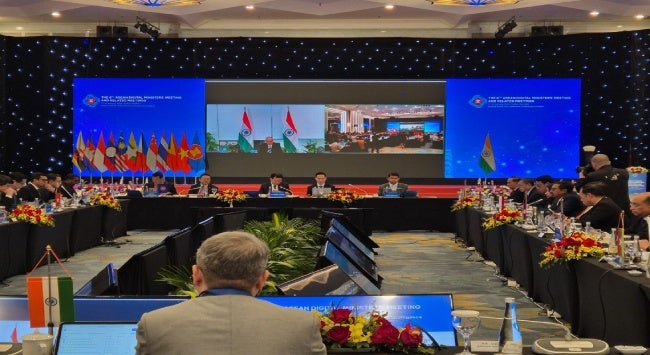
Pic Credit: Secretary-General of ASEAN attends the 6th ADGMIN + India Meeting – ASEAN Main Portal
-
 More From :
-
 Tags :
-
 Download PDF