


BRICS Beyond the Declaration:
Assessing the Significance of the New Delhi Summit
Vinod Rai
23 September 2026Summary
The BRICS Summit in New Delhi in September 2026 demonstrated the evolving significance of an expanded grouping whose members possess diverse political, economic and strategic interests. While the unanimous declaration reflected the possibility of consensus on global governance, security and development, the summit’s broader value lay in its bilateral engagements and commercial opportunities. Discussions on trade, investment, financial cooperation, technology, energy and institutional reform highlighted the potential for practical collaboration among emerging economies. The summit also provided avenues for dialogue between countries facing regional tensions. Its long-term relevance will depend on translating diplomatic consensus into implementable agreements, stronger institutions and tangible economic benefits for its diverse membership.
The recently concluded BRICS Summit in New Delhi needs to be assessed in the context of the considerable changes that have taken place in the grouping since its creation. What began as an association of Brazil, Russia, India and China has evolved into a substantially broader grouping, incorporating major economies and influential regional powers from Asia, Africa and the Middle East. This expansion has increased the economic and geopolitical weight of BRICS, but it has also made consensus more challenging because the members differ considerably in their political systems, strategic priorities and regional interests.
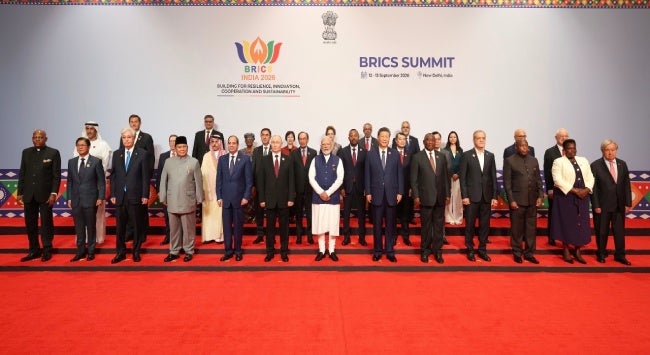
The New Delhi summit was consequently significant not only because it produced a unanimous declaration, but because it demonstrated that countries with divergent interests continue to find value in maintaining a common institutional framework. The 140-point New Delhi Declaration[1] covered a wide range of issues, including terrorism, international security, trade, finance, development, technology, energy and reform of global institutions. Its unanimous adoption was itself an indication that the enlarged grouping remains capable of negotiating areas of common understanding despite substantial differences among its members.
At the same time, the declaration should not be regarded as the sole or, even necessarily, the most important outcome of the summit. Multilateral meetings of this nature serve several purposes simultaneously. The formal sessions establish broad political positions; bilateral meetings provide an opportunity to address specific relationships; and interactions among business and government representatives create possibilities for commercial cooperation. In many instances, the latter two processes can have more direct and enduring consequences than the formal communiqué.
The Importance of Consensus
The ability of BRICS to reach consensus is becoming increasingly important as the organisation expands. Its members do not constitute a conventional political alliance and are unlikely to develop uniform positions on all major international questions. Their interests frequently overlap on economic issues while diverging on security and geopolitical matters.
The New Delhi Declaration illustrates this characteristic. On several sensitive issues, including the situation in West Asia, the language had to accommodate substantially differing perspectives. The final formulation emphasised restraint, dialogue and diplomatic engagement rather than adopting language that would have made consensus difficult. Reporting on the negotiations indicated that the West Asia provisions required considerable discussion among participating countries.
The importance of this should not be exaggerated into suggesting that BRICS has resolved the underlying disputes. It has not. The significance is rather that the organisation provides an institutional setting in which countries with different positions can continue to communicate. In an international environment characterised by increasing geopolitical fragmentation, maintaining such channels has practical value.
This is particularly relevant to West Asia. The presence of both Iran and the United Arab Emirates (UAE) within the expanded BRICS framework provides an additional setting in which regional issues can be discussed. The reported interaction between the delegation, led by Iran’s President Masoud Pezeshkian and Abu Dhabi Crown Prince Sheikh Khaled bin Mohamed bin Zayed Al Nahyan, on the margins of the summit illustrates the wider diplomatic utility of such gatherings. While the meeting did not represent a resolution of differences between the two countries, it demonstrated the capacity of a multilateral forum to facilitate direct engagement between countries whose bilateral relationships are complicated by broader regional tensions.
Bilateral Diplomacy as an Important Component
The extensive bilateral programme accompanying the summit deserves particular attention. India’s Prime Minister Narendra Modi held a large number of bilateral meetings with participating leaders, while other delegations similarly used the occasion to advance their own diplomatic and economic priorities. These meetings should not be regarded merely as supplementary to the summit. They are an integral part of contemporary summit diplomacy.
For China, the engagement with India provided an opportunity to maintain dialogue on a relationship that combines substantial economic interdependence with unresolved strategic and border issues. For India, continued engagement with China is important irrespective of the competitive aspects of the relationship. For the wider BRICS membership, maintaining communication between two of Asia’s largest economies contributes to the stability of the broader regional environment.
Russia’s participation at the highest level was similarly significant. The BRICS framework provides Moscow with an important channel of engagement with major economies outside the Western grouping. At the same time, other BRICS members can maintain relations with Russia without necessarily adopting identical positions on the Russia-Ukraine conflict or other international issues. This illustrates one of the principal characteristics of BRICS in that membership does not require uniformity on every geopolitical question.
The same principle applies to Iran and the Gulf countries. Their participation provides opportunities to discuss energy security, investment, connectivity and regional stability in a setting that includes some of the world’s largest emerging economies. For countries such as the UAE, BRICS provides access not only to political dialogue but also to investment opportunities in large Asian and African markets. For Iran, participation provided another avenue for economic engagement at a time when its international economic relationships are constrained by wider geopolitical circumstances.
The Economic Dimension
The economic dimension of BRICS may ultimately prove more significant than some of its political declarations. The participating countries collectively represent a substantial share of global population, production, energy resources, commodities and consumer markets. Their economic interests are nevertheless complementary in many respects.
The summit, therefore, placed considerable emphasis on trade, investment, financial cooperation, supply chains and cross-border payments. Food security and agricultural cooperation was emphasised, giving fresh momentum to a Russian proposal for a grain trading platform. Though the declaration, adopted at the summit, did not create an exchange, but it does mark the idea as a formal item of discussion among the bloc’s members. Russia wants the platform to begin as a pilot this year and move to full-scale operations in 2027.
The discussion of local currencies deserves a measured assessment. There has periodically been speculation about the creation of a common BRICS currency. The more practical issue is the development of mechanisms that enable the members to conduct a greater proportion of bilateral trade in their own currencies and reduce transaction costs and dependence on intermediary currencies. Such an objective will not be achieved through political declarations alone. It requires compatible payment systems, adequate liquidity, reliable settlement arrangements, regulatory cooperation and confidence among financial institutions. Nevertheless, incremental progress in these areas could have considerable significance for emerging economies.
For countries that depend heavily on international trade, reducing transaction costs and improving payment mechanisms can have tangible benefits. It can facilitate trade between smaller businesses, reduce exposure to currency volatility and make cross-border commercial relationships more predictable. The long-term value of BRICS financial cooperation should, therefore, be assessed through the institutions and mechanisms it develops rather than through the rhetoric surrounding a possible common currency.
Investment and Commercial Cooperation
The business dimension of the summit is equally important. International summits increasingly serve as platforms through which governments can facilitate commercial relationships that would otherwise require lengthy bilateral processes. The proposed UAE investment in an integrated aluminium project in Odisha provides one example of this relationship between diplomatic engagement and commercial activity. The investment, reportedly valued at approximately US$11.5 billion (S$14.68 billion), reflects the growing interest of Gulf capital in long-term industrial opportunities in India.[2] It also illustrates how BRICS-related diplomacy can create an environment for commercial partnerships extending beyond traditional trade.
Similar opportunities exist across the wider grouping. African members have an interest in attracting infrastructure finance, technology and investment while obtaining improved access to large consumer markets. Gulf economies are seeking diversification of their investments and broader economic relationships. Asian members are interested in supply-chain integration, manufacturing, energy security and technology. Latin American economies possess significant agricultural, mineral and energy resources that can support greater trade with Asian and African markets.
Consequently, the economic importance of BRICS should not be measured solely by aggregate gross domestic product or trade statistics. The more relevant question is whether the organisation can facilitate specific transactions, investment flows, technology partnerships and supply-chain relationships among its members.
The Global South Dimension
Another important feature of the summit was the continued emphasis on reform of international institutions. BRICS members have consistently argued that the structure of institutions such as the United Nations Security Council and international financial institutions does not adequately reflect the contemporary distribution of economic and demographic weight.
This is a significant area of common interest, although the members do not necessarily have identical views on the precise nature of reform. The advantage of the BRICS framework is that individual countries can reinforce one another’s arguments by articulating broadly shared concerns. In the context of many developing countries, questions of representation are closely connected with access to finance, technology and markets. Their interest in BRICS is, therefore, not necessarily ideological. It can be quite pragmatic as a greater influence in international institutions may translate into greater consideration of their developmental priorities.
The expansion of BRICS has strengthened this dimension. With additional members from Africa, the Middle East and Southeast Asia, the grouping now represents a wider cross-section of the developing world. This increases its potential influence, although it simultaneously makes internal consensus more difficult.
Energy, Technology and Development
The agenda has also broadened beyond conventional questions of trade and geopolitics. Energy security, climate change, artificial intelligence, digital technologies, agriculture, healthcare, education and women’s economic participation have increasingly become part of BRICS discussions. This expansion is important because the future relevance of the organisation will depend partly on whether it can translate its political relationships into cooperation in areas that directly affect economic development.
Technology provides a particularly important example. Many BRICS members are seeking to expand their digital economies while simultaneously reducing dependence on external technology suppliers. Cooperation in artificial intelligence, digital public infrastructure, cybersecurity, data governance and technological skills could, therefore, become an important component of the organisation’s future agenda.
Similarly, cooperation in renewable energy and energy transition has a particular relevance for BRICS because its members include both major fossil-fuel producers and some of the world’s largest energy consumers. This diversity creates differences of interest but also creates opportunities for complementary economic relationships.
The emphasis on women-led enterprises and access to finance and technology is another example of the effort to connect the BRICS agenda with broader development objectives. If such initiatives result in practical financing, market access and skills programmes, their impact could be more substantial than the formal commitments contained in summit declarations.
India’s Role as Host and Chair
India’s role in bringing together such a diverse group cannot be ignored, although the significance of the summit should not be reduced to an assessment of Indian diplomacy alone. As chair, India had to reconcile different interests while ensuring that the organisation remained focused on areas of practical cooperation.
Its diplomatic challenge was particularly complex because India’s relationships with individual BRICS members vary considerably. China is simultaneously an important economic partner and strategic competitor; Russia remains a longstanding defence and energy partner; the UAE is an important investment and commercial partner; and Iran is significant for India’s regional connectivity and energy interests. At the same time, India maintains extensive relationships with the US, Europe, Japan and other countries outside BRICS. The fact that the summit produced consensus despite these competing relationships indicates a degree of artful diplomacy on the part of the host. More importantly, it demonstrates that BRICS itself can accommodate countries that maintain extensive relationships outside the grouping.
This is an important distinction. The future of BRICS is unlikely to depend on its becoming an exclusive geopolitical alternative to existing institutions. Its greater utility may lie in its ability to operate alongside them.
A Broader Assessment
The New Delhi summit should consequently be viewed neither as the emergence of a new geopolitical bloc nor simply as another multilateral conference. It represents an evolving institutional experiment involving countries with different political systems, economic structures and strategic interests but with a number of shared concerns about global governance and economic development.
Its immediate achievement was the ability to reach consensus on a substantial declaration covering contentious international and economic issues. Its potentially greater achievement lies in maintaining channels of communication among countries that do not always agree, while simultaneously expanding opportunities for trade, investment and economic cooperation.
For India, the summit demonstrated the advantages of diplomatic convening and careful consensus-building. For China and Russia, it provided a significant platform for engagement with major emerging economies. For the Gulf members, it offered access to a wider network of markets and investment opportunities. For African members, it created another channel for development finance, infrastructure, technology and trade. For Latin American participants, it provided opportunities for deeper engagement with the rapidly growing Asian and African economies. For the newer Asian members, it offered access to a wider economic and diplomatic network.
The larger significance of the summit, therefore, lies in its collective rather than national dimension.
The formal declaration provides the political framework. The bilateral meetings address specific relationships. The business interactions identify commercial opportunities. The institutional discussions seek to create mechanisms through which those opportunities can be sustained.
Whether these elements eventually reinforce one another will determine the long-term relevance of BRICS.
The New Delhi summit has demonstrated that, despite the considerable differences among its members, there remains sufficient common interest to keep the organisation moving forward. The next stage will be more demanding such as converting consensus into institutions, institutions into economic cooperation, and economic cooperation into tangible benefits for the increasingly diverse membership.
In that sense, the most important outcomes of the summit may not be contained in the declaration at all. They may emerge gradually from the agreements, investments, relationships and conversations that began around it.
. . . . .
Mr Vinod Rai is an Honorary Senior Fellow at the Institute of South Asian Studies (ISAS), an autonomous research institute at the National University of Singapore (NUS). He is also a former Comptroller and Auditor General of India. He can be contacted at raivinod@hotmail.com. The author bears full responsibility for the facts cited and opinions expressed in this paper.
[1] “BRICS New Delhi Declaration: Building for Resilience, Innovation, Cooperation and Sustainability”, Press Information Bureau, Government of India, 12 September 2026, https://www.pib.gov.in/PressReleasePage.aspx?PRID=2309505®=48&lang=2.
[2] “Prime Minister meets with the Crown Prince of Abu Dhabi on the sidelines of the BRICS Summit in New Delhi”, Press Information Bureau, Government of India, 12 September 2026, https://www.pib.gov.in/PressReleasePage.aspx?PRID=2309424®=3&lang=1.
Pic Credit: X
-
 More From :
-
 Tags :
-
 Download PDF