


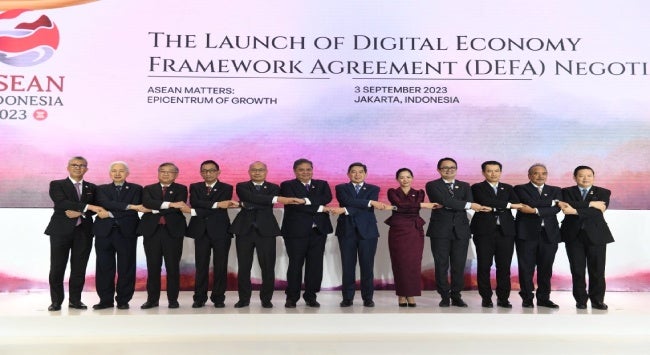
The Digital Economy Framework Agreement:
Connecting India and ASEAN
Karthik Nachiappan, Atyantika Mookherjee
11 August 2026Summary
The Association of Southeast Asian Nations (ASEAN) Digital Economy Framework Agreement gives India a model for deeper digital engagement with Southeast Asia. New Delhi should pursue a two-track strategy: digitise goods trade through the ASEAN-India Trade in Goods Agreement while negotiating a related framework for payments, data, cybersecurity and emerging technologies.
The DEFA’s Real Innovation: Managed Interoperability
The Association of Southeast Asian Nations (ASEAN) concluded negotiations on the Digital Economy Framework Agreement (DEFA) in Manila in May 2026. The agreement is ASEAN’s first region-wide digital economy instrument. Its negotiating agenda spans nine areas, including digital trade, cross-border e-commerce, payments and e-invoicing, digital identity, cross-border data flows and data protection, online safety, cybersecurity and emerging technologies. The DEFA, therefore, marks a shift from a collection of sectoral initiatives towards a more integrated regional framework.
That shift rests on precedent. The ASEAN Agreement on Electronic Commerce, signed in 2019 and in force since 2021, already committed the ASEAN member states to facilitate electronic transactions while recognising their different laws and levels of regulatory development. ASEAN has since advanced interoperable payments, electronic documents, digital identities and voluntary guidance on artificial intelligence. The DEFA consolidates and extends this architecture rather than creating it from scratch.
That said, the DEFA does impose some obligations. ASEAN’s goal is to reduce regulatory friction, and the negotiated text is not yet public; the depth, exceptions and enforceability of individual commitments can only be seen after signature. The more defensible claim is that ASEAN has achieved managed interoperability: common commercial outcomes and compatible systems without requiring states to have similar domestic laws. Flexibility phased implementation and capacity building make integration possible across economies with markedly different institutional capabilities.
Why the AITIGA May Not be Enough
This distinction matters for India because the ASEAN-India Trade in Goods Agreement (AITIGA) is still a trade-in-goods agreement. Its review has focused on market access, rules of origin, customs and trade facilitation, standards, sanitary and phytosanitary measures, trade remedies and legal and institutional provisions. ASEAN and India aim to conclude the review in 2026, but the negotiations remain shaped by New Delhi’s concern over its goods deficit and ASEAN’s demand for a simpler and more trade-facilitative agreement.
Incorporating the DEFA into the AITIGA would be counterproductive, broadening a goods-focused negotiation at a late stage while drawing in unresolved questions concerning data governance, privacy, competition and online regulation. Yet reducing the digital economy to an aspiration would be equally misguided.
ASEAN’s internal framework is advancing, and the ASEAN-China Free Trade Area 3.0 Upgrade Protocol already includes commitments on the digital economy, alongside supply-chain connectivity, competition, and support for micro, small and medium-sized enterprises. Without a sufficient and necessary response, India will remain commercially open to ASEAN but disconnected from the region’s new digital rules.
India-DEFA Compatibility
India’s general caution on unrestricted cross-border data flows does not prevent digital integration. The Unified Payments Interface-PayNow linkage with Singapore shows that two jurisdictions can connect payment systems, lower remittance friction and expand participation while retaining separate regulatory regimes. The arrangement did not require India to abandon the Reserve Bank of India’s payment-data localisation rules or its broader preference for regulatory autonomy.
India’s recent trade agreements further reinforce this point. The United Kingdom-India Comprehensive Economic and Trade Agreement recognises electronic contracts and authentication, promotes compatible digital trading systems and protects consumers while postponing stronger disciplines on cross-border data flows and localisation. The just concluded European Union-India Free Trade Agreement combines digital-trade rules with an exception to regulate for public policy, privacy and security. These precedents reveal a workable and perennial Indian negotiating stance: accept binding rules where the economic interest is clear and preserve safeguards where domestic governance remains sensitive or unsettled.
A Two-Track ASEAN-India Digital Agenda
How should ASEAN and India move? One approach could be to use the AITIGA to digitise trade in goods. Negotiators should prioritise the legal recognition of electronic trade documents and signatures, interoperable customs and single-window systems, e-invoicing, digital certificates of origin, and faster low-cost payments for firms. These provisions fall squarely within a modern goods agreement and could make the AITIGA amenable, particularly for smaller businesses.
Another track could establish a separate ASEAN-India Digital Economy Partnership. Its initial agenda should cover interoperable fast payments and digital identity, trusted cross-border data flows, privacy and cybersecurity cooperation, online consumer protection, regulatory dialogue on artificial intelligence, and digital-skills development. The objective should be compatibility, not uniformity. Commitments can be outcome-based, accompanied by legitimate public-policy and security exceptions, and phased according to implementation capacity.
Sequencing is crucial. When the AITIGA review concludes, ASEAN and India could mandate a dedicated digital-economy negotiating group with a fixed timetable. India and Singapore can use their payments linkage and wider digital partnership as a pilot, but the regional framework must include capacity support for less developed economies and consultation with small firms.
The DEFA could be seen as a model, not a blueprint. India’s choice is not between accepting ASEAN-wide regulatory convergence and remaining outside the region’s digital economy. It is whether to negotiate an interoperability-based pact that connects markets while protecting policy autonomy. A two-track approach would do that better than mainstreaming a digital agreement into the AITIGA and better than leaving digital cooperation to bilateral pilots.
. . . . .
Dr Karthik Nachiappan is a Research Fellow at the Institute of South Asian Studies (ISAS), an autonomous research institute at the National University of Singapore (NUS). He can be contacted at karthik@nus.edu.sg. Ms Atyantika Mookherjee was a Research Intern at the same institute. She can be contacted at atmookherjee@davidson.edu. The authors bear full responsibility for the facts cited and opinions expressed in this paper.
Pic Credit: X
-
 More From :
-
 Tags :
-
 Download PDF