


India in the Indo-Pacific: Matching External Ambition with Internal Reform
C Raja Mohan
13 July 2026Summary
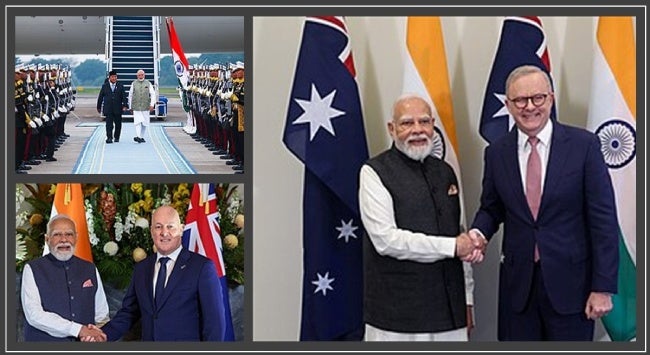
Indian Prime Minister Narendra Modi’s July 2026 visits to Indonesia, Australia and New Zealand mark an important step in the evolution of India’s Indo-Pacific strategy. The visits reflect India’s determination to strengthen its independent regional role amid growing uncertainty over the future of American strategy in Asia. The tour’s long-term significance, however, will depend on New Delhi’s ability to implement the agreements reached and initiate the domestic reforms needed to sustain a larger regional role.
Coming amid uncertainty over United States (US) President Donald Trump’s commitment to a balanced Asian order, his renewed talk of a possible US-China ‘G-2’ and the Pentagon’s decision to move away from the Indo-Pacific terminology, Indian Prime Minister Narendra Modi’s six-day tour of Indonesia, Australia and New Zealand underlines New Delhi’s eagerness to strengthen its own role in Asia and the Indo-Pacific. At one level, the tour reaffirmed India’s commitment to the Indo-Pacific idea even as Washington appears less inclined to use the term. At another, it marked a new stage in India’s post-Cold War engagement with the East.
India’s eastern policy has evolved steadily over the last three decades. Then Prime Minister P V Narasimha Rao’s ‘Look East’ policy, launched in 1991, sought primarily to reconnect India with the dynamic economies of Southeast Asia after the Cold War. Modi’s ‘Act East’ policy expanded that agenda by adding strategic cooperation, maritime security, defence partnerships and regional connectivity. Over the last decade, India’s engagement has intensified to cover the wider geography of the Indo-Pacific.
The progress has nevertheless been uneven, with India’s internal structures unable to fully utilise the opportunities opened by Indian diplomacy and the more inviting regional environment. Trade with the Association of Southeast Asian Nations (ASEAN) member states grew from about US$7 billion (S$9.1 billion) in 2000 to roughly US$125 billion (S$161.6 billion) in 2025; China’s trade with ASEAN in 2025 stood at nearly US$1,000 billion (S$1.29 trillion). Although New Delhi has expanded political engagement across East Asia, it has struggled to match that diplomacy with comparable advances in trade, connectivity, technology partnerships and defence cooperation. The three-nation tour must be seen as an attempt to narrow this gap.
Jakarta occupies a pivotal position in this effort. Improving ties with resource-rich Indonesia, one of the world’s largest nations and the fourth largest economy in Asia, has become a high priority for New Delhi. Viewed geopolitically, Indonesia sits astride the entrance to the Strait of Malacca and other waterways connecting the Indian and Pacific Oceans. Among the many important outcomes from Modi’s visit is the decision to accelerate cooperation on Sabang port, close to India’s Great Nicobar Island, which has the potential to strengthen logistics, maritime domain awareness and naval cooperation between the two countries. Progress on Indonesia’s acquisition of the BrahMos cruise missile also points to India’s growing ambition to emerge as a defence supplier in Southeast Asia, with defence exports increasingly complementing traditional diplomacy.
Australia represents a different but equally important pillar of India’s Indo-Pacific strategy. Over the past decade, the relationship has moved from political goodwill to shared strategic and economic interests, and Modi’s visit has significantly expanded the agenda. The decision to begin negotiations on a comprehensive free trade agreement (FTA) builds upon the Economic Cooperation and Trade Agreement already in force, while the completion of administrative arrangements for Australian uranium exports removes an important obstacle to implementing the bilateral civil nuclear agreement. Even more significant in the longer term is cooperation on critical minerals: Australia’s abundant reserves of lithium, cobalt and rare earths can support India’s ambitions in electric mobility, batteries, semiconductors and advanced manufacturing. Stronger maritime cooperation in the eastern Indian Ocean reinforces a partnership now central to India’s eastern strategy.
The results from Modi’s visit to New Zealand completed the geographical logic of the tour. Modi became the first Indian prime minister to visit New Zealand in four decades. The recently concluded FTA provides a stronger commercial foundation for bilateral ties, while expanding maritime cooperation reflects India’s growing interest in the South Pacific. New Zealand is influential in Pacific regional diplomacy and has overlapping interests with India’s own pursuit of close ties to the islands in the region.
Taken together, the three visits demonstrate a more integrated conception of India’s Indo-Pacific strategy. Maritime security, defence production, critical minerals, trade, technology and resilient supply chains are increasingly pursued as mutually reinforcing elements rather than separate policy initiatives, reflecting a wider recognition that economic security and strategic security are becoming inseparable across the Indo-Pacific.
Yet diplomacy is only the first stage of strategic success. The discussions on Sabang port date back almost a decade, as do the negotiations on supplying BrahMos missiles to Indonesia and the arrangements for Australian uranium exports. The problem has not been a lack of political intent or diplomatic initiative in New Delhi. Rather, promising agreements have often been slowed by bureaucratic inertia, a complex business environment and the unfinished agenda of domestic reform. Together, they have prevented India from taking full advantage of the external possibilities that have opened up over the last three decades.
This implementation deficit matters more as India’s international profile grows. Foreign governments today judge India not only by the number of agreements it signs but by its ability to execute projects, deliver defence equipment, facilitate investment and create a predictable policy environment. India’s expanding diplomatic reach must, therefore, be matched by stronger institutional capacity at home: faster decision-making, better coordination across ministries, greater involvement of the private sector and continued economic reform will matter as much as summit diplomacy. Modi’s Pacific tour, therefore, represents an important diplomatic advance, but its long-term significance will rest on the speed and purpose with which India implements the outcomes from the visit.
. . . . .
Professor C Raja Mohan is an Honorary Senior Fellow at the Institute of South Asian Studies (ISAS), an autonomous research institute at the National University of Singapore (NUS). He can be contacted at crmohan53@gmail.com. The author bears full responsibility for the facts cited and opinions expressed in this paper.
Pic Credit: Wikimedia Commons
-
 More From :
-
 Tags :
-
 Download PDF