


Summary
Japanese Prime Minister Sanae Takaichi’s visit to India in July 2026 is significant not only because it strengthens bilateral ties but also because it reinforces India’s strategic autonomy and supports United States (US)-India relations. Yet one important question hangs over the visit: Can India effectively counter China in partnership with Japan but without the US?
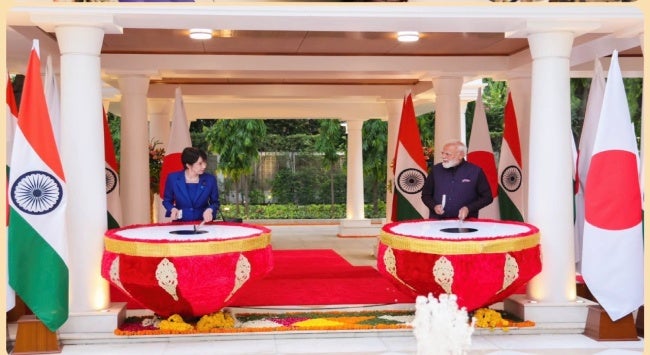
Japanese Prime Minister Sanae Takaichi’s visit to India from 1 to 3 July 2026 was a key but insufficiently appreciated moment for India’s foreign policy. The three-day visit, Takaichi’s first to India, emphasised cooperation in supply chain resilience, investment, joint infrastructure projects, energy security and artificial intelligence (AI), and unveiled the two sides’ inaugural joint defence manufacturing project. Importantly, New Delhi and Tokyo highlighted their shared interest in a “free and rules-based Indo-Pacific” – code to oppose Beijing’s growing power in the region. In this spirit, the two sides agreed to increase defense cooperation, military exercises and maritime cooperation and jointly develop the Andaman and Nicobar and Lakshadweep islands into “smart islands”. As an expression of their growing strategic closeness, the two sides also endorsed each other’s strategic concerns, with Japan denouncing “cross-border terrorism from Pakistan” and India expressing concerns about North Korea and the East China Sea. More broadly, the visit signified Japan’s continued strategic investment in closer relations with India and the two sides’ push to enhance their partnership to offset increasing United States (US) unreliability and growing Chinese power.
However, the visit’s significance extends beyond reaffirming bilateral ties. It delivered two major foreign policy gains for India while also highlighting a crucial strategic question.
Takaichi’s visit represented a victory for India’s strategic autonomy. The continued growth of India-Japan cooperation, given fresh momentum by the visit, strengthens New Delhi’s autonomy in three ways. First, deeper military, technological and economic ties with Japan reduce India’s reliance on the US in balancing China. This is particularly important as Washington’s willingness to actively confront Beijing in Asia has come under question following the recent stabilisation of US-China relations. Second, India’s growing partnership with a reemerging Japan ensures that its Indo-Pacific strategy is not solely dependent on the US’ support. Japan’s expanding regional role, resurgent military capabilities and Indo-Pacific strategic vision – developed under Takaichi’s mentor, Shinzo Abe – provide India with a committed major power partner in Asia and within the Quadrilateral Security Dialogue beyond the US. Third, closer ties with Japan promise much-needed investment, technology and cooperation in critical areas such as critical minerals, Ai, semiconductors and even promote bilateral trade in local currency. These benefits reduce India’s economic and technological dependence on the US, further enhancing its strategic autonomy.
Ironically, Takaichi’s visit also benefits India-US relations, which are recovering from last year’s severe crisis. First, it demonstrates to Washington that India is not free-riding on US efforts to balance China but is actively contributing to that goal with Japan. American concerns that India is unwilling to share the burden of countering Beijing and is instead “passing the buck” to the US have been a major source of bilateral tensions. More broadly, closer India-Japan cooperation helps reassure the skeptical Donald Trump administration that Asian partners and allies are strategic assets rather than liabilities.
Second, the stronger relationship with Japan reflected in the visit enhances India’s position in its inherently unequal partnership with the US, thereby facilitating bilateral ties. This asymmetry has long constrained relations: India has feared American domination, while Washington has often assumed it could pressure New Delhi to align with US policies. Although closer ties with Japan will not eliminate this imbalance, they can reduce it by strengthening India’s strategic leverage, encouraging the US to treat India more as an equal and increasing acceptance of New Delhi’s reluctance to align with Washington on key issues.
So far, it is all good in New Delhi’s relationship with Tokyo. However, one crucial question hangs over India’s strategic partnership with Japan, embodied in Takaichi’s visit: Can India effectively balance China with Japan without the US? While the US-China competition is set to continue, driven by structural factors, US-China relations have been marked by a stabilisation and even budding détente. This, together with the US’ mistrust of its allies and partners, reluctance to bear costs and distractions in other regions, raises doubts about Washington’s willingness to decisively push back against the expansion of Chinese power in Asia and help Asian states do the same.
The answer is most likely negative. At least for now, India cannot effectively balance against Beijing – with its growing power – through cooperation with Tokyo alone and without Washington. The combined relative power of India and Japan remains insufficient to halt the expansion of Chinese influence in the region. Moreover, Indo-Japanese efforts to balance China are constrained by divergent strategic priorities. Would India intervene in a crisis involving Taiwan or the East China Sea? Would Japan support India in a conflict along its border with China or against Chinese-backed Pakistan? However, India has little choice but to partner with Japan. Balancing China with Tokyo is ultimately preferable to attempting to do so alone, particularly given that the costs of Chinese dominance in Asia would be unacceptably high for India.
Takaichi’s visit to India embodied the expanding and increasingly important India-Japan partnership, which is gaining further momentum amid growing concerns over US reliability. This partnership helps India strengthen its balancing of China, support its rise and enhance its strategic autonomy while stabilising ties with Washington. However, in countering China, Japan remains no substitute for the US.
. . . . .
Dr Ivan Lidarev is a Research Fellow at the Institute of South Asian Studies (ISAS), an autonomous research institute at the National University of Singapore (NUS). He can be contacted at ivanlidarev@nus.edu.sg. The author bears full responsibility for the facts cited and opinions expressed in this paper.
Pic Credit: X
-
 More From :
-
 Tags :
-
 Download PDF