


India-Indonesia Relations:
Economics, Not Strategy, is the Real Driver
Sandeep Bhardwaj
10 July 2026Summary
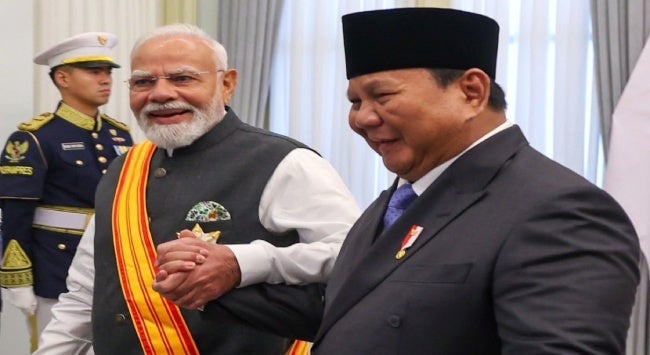
During Indian Prime Minister Narendra Modi’s recent visit to Indonesia, media attention focused largely on strategic issues. Yet the visit was fundamentally driven by economic interests.
India’s Prime Minister Narendra Modi’s visit to Indonesia from 6 to 8 July 2026 has set the media abuzz with speculations over the strategic nature of the bilateral relationship. Various commentators have suggested that the two are drawing up a new Indo-Pacific security architecture, establishing a strategic maritime partnership or shaping the global order. Such analyses overstate the security aspects of the relationship while ignoring the fact that the main driver of the relationship is economics.
The outcomes of the latest visit are case in point. Two major accomplishments of the visit were agreements on the BrahMos missile system and the Astra air-to-air missile. Jakarta has been exploring a deal for the BrahMos system, jointly developed by India and Russia, for over a decade. The announcements this week suggest that the deal has reached the finish line, although the contents of the agreement have not been made public yet. Reportedly, the two sides have yet to agree on the details of the contract.
Although the Brahmos deal carries some geopolitical implications, India’s primary motivation is commercial. The Modi government has made concerted efforts to develop India’s defence export industry as a means to spur domestic production and offset the country’s enormous arms import bill. Thanks to India’s multi-alignment foreign policy, it is largely agnostic about who purchases its weapons (with some obvious exceptions). New Delhi’s main interest in the sale of Brahmos is not to serve some strategic goal but to boost the domestic defence industry.
Most other agreements are also aimed to expand commercial opportunities for India. A memorandum of understanding (MoU) on Space facilitates the use the Indian Space Research Organisation by Indonesia to launch satellites for environmental monitoring. An agreement between the medical regulators of the two countries is meant to pave the way for Indian pharmaceutical companies to expand into Indonesia. The Indian Institute of Management, Bangalore, will set up branch campus at Singhasari Special Economic Zone in Indonesia, creating opportunities in the education sector. India promised to provide indigenously developed DWR-160 wheat seeds to Indonesia, an opening for the agrobusiness. Modi and Indonesia’s President Prabowo Subianto also highlighted Indonesia Open Network, an e-commerce platform based on Indian technology, as a showcase for the Indian information technology sector and the “India Stack”.
Government-owned steel companies of the two countries will explore a joint venture to establish a stainless-steel slab manufacturing facility in Indonesia. Another MoU allows for a public-private Indian consortium to explore “potential collaboration across rare earth value chain in Indonesia”. Much has been made of the rare earth mineral deal in the media, labeling it as India’s “foothold in Indonesia’s nickel industry”. In fact, Indian steel giant Jindal Steel already commissioned a Nickel Pig Iron facility in Indonesia in 2024.
It is the economic ties that bind the India and Indonesia together. India has been Indonesia’s fourth-largest export destination since 2017. Indonesia enjoys lager trade surplus with India than any other trading partner. Despite the enormous trade deficit, New Delhi prizes its economic relationship with Indonesia because the country is source of important raw material. More than 60 per cent imports from Indonesia are coal, palm oil and steel. Crucially, Indonesia does not threaten India’s domestic manufacturing through its exports unlike many other Southeast Asian countries. In fact, India views Indonesia as a vast potential market for Indian manufactures and investments. Between 2019 and 2025, India invested nearly US$1 billion (S$1.28 billion) in Indonesia.
On the other hand, India-Indonesia strategic relationship has a hard ceiling. The two countries have little common ground to build on. Although both argue that their strategic vision encompasses the entire Indo-Pacific, their geographical priorities are quite different. While both India is focused on South Asia and the Indian Ocean islands whereas Indonesia’s attention is affixed to Southeast Asia and the South China Sea. They also have differing approaches towards China. While New Delhi remains suspicious of its northern neighbour, Jakarta has moved close to Beijing, particularly under Prabowo.
Both India and Indonesia are huge nations with ambitions to be seen as great powers. This makes for poor dynamics in strategic partnership. Neither would be comfortable taking the other’s lead or allowing the other to free-ride in a partnership. Neither would welcome the other in its backyard. It would take extraordinary geopolitical circumstances and diplomatic finesse to bring New Delhi and Jakarta into a close strategic relationship.
Undue emphasis on the strategic angle obscures what is important in the India-Indonesia relations. As a result, the focus tends to get pulled away from important issues. For instance, any mention of the proposed India-Indonesia Comprehensive Economic Partnership Agreement (CECA) was conspicuously absent from the latest joint statement. The CECA negotiations, which started in 2011, have been stuck for years now.
Another issue of note was the absence of private companies in the Indian delegation. Almost all the deals announced were made by Indian state-owned enterprises and government institutions. In Modi’s 2018 visit to Indonesia, several private players had signed deals in Indonesia, including the Tatas, Himalayan Drug Company and the Confederation of Indian Industry. The lack of enthusiasm from Indian companies may be owing to the procedural roadblocks and the difficulty of doing business in Indonesia.
In order to boost India-Indonesia relationship, there is need to identify specific and detailed measures that can improve the trade and investment flows between the two countries. It does not require excessive emphasis on the strategic cooperation, which is unlikely to yield major dividends for the foreseeable future.
. . . . .
Dr Sandeep Bhardwaj is a Research Fellow at the Institute of South Asian Studies (ISAS), an autonomous research institute at the National University of Singapore (NUS). He can be contacted at sbhardwaj@nus.edu.sg. The author bears full responsibility for the facts cited and opinions expressed in this paper. The author bears full responsibility for the facts cited and opinions expressed in this paper.
Pic Credit: X
-
 More From :
-
 Tags :
-
 Download PDF