


Summary
Bangladesh’s Prime Minister Tarique Rahman’s visit to Malaysia in June 2026 is the latest step in enthusiastic diplomatic engagement between Dhaka and Putrajaya which has been ongoing for the last two years. While the two have drawn up an ambitious bilateral agenda, fundamental challenges still persist.
The first-ever foreign trip of Bangladesh’s new Prime Minister Tarique Rahman concluded last week after stops in Malaysia and China. Rahman’s decision to visit Beijing, while bypassing New Delhi, has drawn considerable attention. India and Bangladesh are experiencing rocky relations since the fall of Prime Minister Sheikh Hasina in 2024, who was perceived to be too close to New Delhi. The controversy has overshadowed the significance of Rahman’s visit to Malaysia.
The Joint Statement to emerge from the visit demonstrates the remarkable depth and scope of the bilateral relationship. The two sides promised to commence negotiations on the free trade agreement (FTA) and the thorny migrant worker issue. They furthered defence cooperation through training exchanges. Malaysia extended support to Bangladesh’s aspiration to join the Regional Comprehensive Economic Partnership (RCEP) and become a Sectoral Dialogue Partner of the Association of Southeast Asian Nations (ASEAN). The statement also floated some innovative ideas, including cooperation on the Halal food ecosystem, gas exploration in the Bay of Bengal and developing Bangladesh’s digital economy.
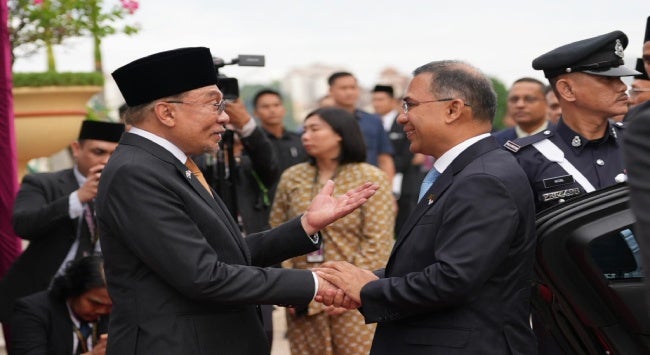
Rahman’s visit is third such exchange in the last two years. Malaysia’s Prime Minister Anwar Ibrahim visited Dhaka in October 2024, two months after the fall of Hasina’s government. As the first head of government visit to Bangladesh since the July Uprising, his presence lent international credibility to the interim government led by Muhammad Yunus. Furthermore, Anwar’s visit was the first time in a decade the prime minister of either country had visited the other. Anwar’s visit injected momentum to the relationship which Yunus reciprocated by visiting Malaysia in August 2025.
A deeper relationship with Malaysia allows Bangladesh to diversify its economic and strategic interests while sidestepping the Sino-Indian rivalry. Bangladesh’s rapidly growing economy represents a potentially enormous market for Malaysia. Whereas Malaysia has to compete with other Southeast Asian countries for the neighbouring Indian market, Bangladesh is, so to speak, a virgin territory.
Although Dhaka and Putrajaya have developed an ambitious agenda for their bilateral ties in the last three years, it remains to be seen whether they can overcome the inherent challenges of the relationship. The most pressing issue is the flow of Bangladeshi migrant workers into Malaysia. In the last few years, Bangladesh workers have overtaken Indonesia as the main source of foreign labour for Malaysia. The estimated 800,000 Bangladeshis currently in Malaysia make up nearly 40 per cent of its total foreign worker population. Malaysia has repeatedly complained of extreme corruption in the recruitment of migrant workers, leading it to freeze the migration flow in 2001, 2012 and, most recently, in 2024, which is still in place. The freeze is also connected to the fact that Malaysia has set a ceiling on the number of foreign workers at 15 per cent of the country’s population, which it is close to touching. While Dhaka has pressed Putrajaya to repeal the freeze, the two sides have yet to agree on a worker protection mechanism despite several negotiating rounds. Bangladesh relies heavily on the remittances from migrant workers to manage its Balance of Payments.
The FTA is another uphill climb. Although the two sides have been discussing the idea since 2004, no formal negotiations have taken place until now. Malaysia offered duty-free entry of 300 items from Bangladesh in 2011 to entice Dhaka into FTA negotiations. Bangladesh has been reticent because it runs a massive trade deficit with Malaysia. However, it has become more open to the idea in recent years. It is slated to graduate from the Least Developed Country status later this year, which would result in the loss of various kinds of tariff exemptions it enjoys around the world. Moreover, it recognises that its products are unable to compete with similar products from India and Pakistan which enjoy better tariff rates because of its South Asian neighbours do have FTAs with Malaysia.
Bangladesh’s bid for sectoral partnership with ASEAN has been in talks for over a decade. In the past few years, Dhaka has stepped up its efforts to canvas support from the entire region. Bangladesh hopes that the ASEAN partnership can help it diversify its foreign policy by stepping beyond the India-centric framework. It has offered itself as a ‘bridge’ between ASEAN and South Asia. The ASEAN member states have yet to reach a decision on the issue.
Some aspects of Bangladesh-Malaysia agenda may be affected by the ‘India factor’. Despite the frosty relations between the two South Asian neighbours, New Delhi still looms large in Dhaka’s foreign policy. For instance, Bangladesh’s bid to join the RCEP may be complicated by the fact that India sees it as a vehicle for Chinese economic penetration and has refused to join it. New Delhi may be uncomfortable with the RCEP’s expansion into its neighbourhood.
Dhaka and Putrajaya have managed to revitalise what was a relatively languid relationship before. It remains to be seen whether they can manage to lock in some concrete gains before the momentum fizzles out.
. . . . .
Dr Sandeep Bhardwaj is a Research Fellow at the Institute of South Asian Studies (ISAS), an autonomous research institute at the National University of Singapore (NUS). He can be contacted at sbhardwaj@nus.edu.sg. The author bears full responsibility for the facts cited and opinions expressed in this paper.
Pic Credit: X
-
 More From :
-
 Tags :
-
 Download PDF