


Summary
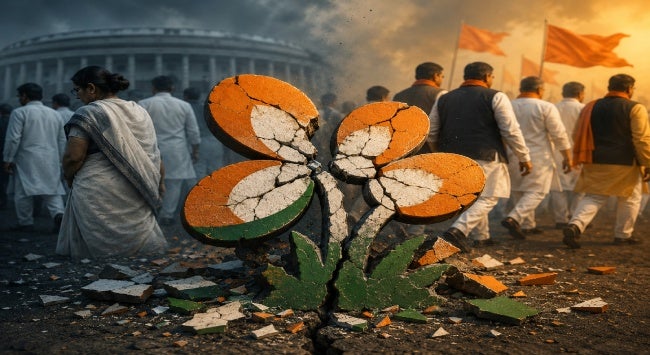
The Trinamool Congress (TMC) has unravelled barely a month since the West Bengal election results were announced. On 8 June 2026, a rebel group claimed the support of 20 TMC members of parliament from the Lok Sabha (Lower House of Parliament) and decided to support the Bharatiya Janata Party-led National Democratic Alliance. The defections in parliament came soon after 58 of the newly-elected 80 TMC members of the West Bengal legislative assembly went against the party’s wishes on the nomination of the leader of the opposition.
The implosion of the Trinamool Congress (TMC), which had governed West Bengal for 15 years and was defeated in the 2026 assembly election, has happened more rapidly than many had anticipated. There is a history of political parties fading away in Bengal in the aftermath of an electoral defeat despite having a long run in government. The Left Front, which governed Bengal for 34 years, is a stark example of that. From 176 of 294 seats in 2006, the Left declined to 40 in 2011 when it was defeated by the TMC. Since then, it has been reduced to one seat in 2026.
The unravelling of the TMC is somewhat different though. The Left Front did not suffer a split in its senior leadership though it lost most of its cadre to the TMC. For the TMC, both seems to be happening and with an extraordinary rapidity. On 8 June 2026, a rebel group claimed the support of 20 TMC members of parliament (MPs) from the Lok Sabha (Lower House of Parliament) and aligned itself with the Bharatiya Janata Party (BJP)-led National Democratic Alliance (NDA). Since the number of MPs in the rebel camp is more than two-thirds of the TMC’s strength of 28 MPs in the Lok Sabha, the provisions of the anti-defection law will not apply. The rebel group is led by four-time TMC MP Kakoli Ghosh Dastidar. In the Rajya Sabha (Upper House), two TMC members – Sukhendu Sekhar Ray and Sushmita Dev – have also resigned.
The defections in parliament come close on the heels of 58 of the newly-elected 80 TMC members of the legislative assembly (MLAs) – more than two-thirds of the party’s strength – submitting a letter on 3 June 2026 to the speaker of the West Bengal legislative assembly nominating the MLA, Ritabrata Banerjee, to the post of the leader of the opposition in the assembly. The assembly speaker accepted the claim and appointed Ritabrata as the leader of the opposition. Ritabrata had earlier been expelled from the TMC, along with another MLA, Sandipan Saha, for alleging that the TMC’s official letter to the speaker nominating Shobandeb Chattopadhyay as the leader of the opposition had forged signatures. The rebels have claimed that their numbers have since increased to 64 MLAs.
The situation with the TMC’s rebel MLAs is somewhat different from its MPs in that the former have not as yet defected to any other party or announced a new outfit. Ritabrata has said that the faction led by him is the ‘real’ TMC legislature party and will function as a constructive opposition in the West Bengal assembly. In fact, despite having criticised the TMC’s general secretary Abhishek Banerjee, the rebel faction has declared its loyalty to the party’s founder and former chief minister, Mamata Banerjee, and requested her to be their adviser.
There are certain parallels with the TMC’s predicament and what had happened in Maharashtra in 2022. At the time, the Shiv Sena’s Eknath Shinde, who is currently the deputy chief minister of Maharashtra, rebelled against then Chief Minister Uddhav Thackeray, son of the Sena founder Bal Thackeray, leading to the collapse of the government. The newly-elected speaker of the Maharashtra legislative assembly had then appointed a member of the Shinde faction as the chief whip of the party instead of the Uddhav group’s nominee. When the matter went to the Supreme Court, it ruled that the speaker’s actions were unlawful and that whip could only be nominated by the political party and not the legislative party. Going by that precedent, the original TMC, headed by Mamata, might have the prerogative to appoint the leader of its legislative party.
However, in Maharashtra, India’s Election Commission in 2023 awarded the Shinde faction the official name and party symbol of the Sena based on the group enjoying majority support. The Nationalist Congress Party, founded by Sharad Pawar, also faced similar circumstances when Sharad’s nephew, Ajit Pawar, split the party in 2023 and was handed the official name and party symbol by the EC. The same could well happen with the TMC when the matter is taken up by the courts.
Mamata finds herself isolated after a remarkable political career that saw her being elected in 1984 as a Congress MP at the age of 29, leaving the Congress and founding the TMC in 1998, being appointed Union railway minister in 1999 in the Atal Bihari Vajpayee cabinet and finally ending the Left Front’s rule in Bengal in 2011 to become the state chief minister for three successive terms. The unravelling of the TMC is partly the outcome of political parties that are organised around a charismatic personality like Mamata combined with a weak institutional structure and absence of any ideology. Such parties tend to rise and sink with the fortunes of their supremo. Dynastic politics too play a role. The rapid rise of Mamata’s nephew, Abhishek, within the party ranks and the possibility of him succeeding Mamata caused discontent within the party. The TMC’s predicament is also a pointer to the lack of ideological commitment and the naked pursuit of power by many of India’s political leaders.
While the odds are stacked against Mamata, the BJP’s position in Bengal has been greatly strengthened by the attrition within the TMC. At the national level, the possible addition of 20 TMC MPs to the NDA will be crucial if and when the government takes up initiatives that require a two-thirds majority in parliament.
. . . . .
Dr Ronojoy Sen is a Senior Research Fellow and Research Lead (Politics, Society and Governance) at the Institute of South Asian Studies (ISAS), an autonomous research institute at the National University of Singapore (NUS). He can be contacted at isasrs@nus.edu.sg. The author bears full responsibility for the facts cited and opinions expressed in this paper.
Pic Credit: ChatGPT
-
 More From :
-
 Tags :
-
 Download PDF