


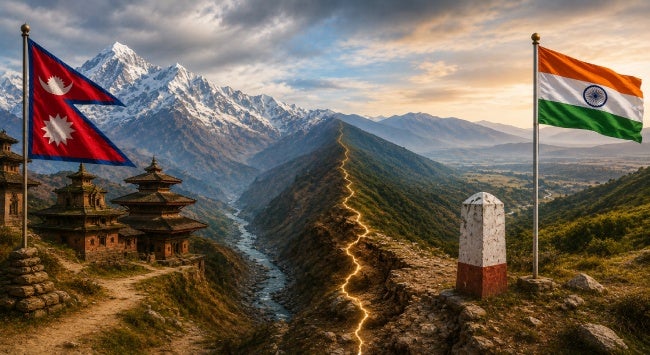
Summary
India and Nepal are close neighbours with strong bilateral ties, but unresolved boundary disputes and competing territorial claims periodically create tensions. Recent developments have renewed attention to these issues, underscoring the need for continued diplomatic dialogue between the two countries.
On the invitation from India’s ruling party, the Bharatiya Janata Party, Rabi Lamichhane, head of Nepal’s ruling Rastriya Swatantra Party, arrived in New Delhi on 1 June 2025 to establish dialogue between the two political parties. During the trip, Lamichhane met Indian Prime Minister Narendra Modi, Home Minister Amit Shah and External Affairs Minister S Jaishankar. Following Lamichhane’s visit, Nepal’s Foreign Minister Shisir Khanal made an official three-day trip to India from 5 to 7 June 2026.
The visits by Lamichhane and Khanal to India come against the backdrop of renewed attention to India-Nepal boundary issues. On 31 May 2026, responding to a question from Aaren Rai of the Shram Sanskriti Party in Nepal’s parliament, Prime Minister Balendra Shah stated, “After becoming prime minister, I came to know that not only has India encroached on Nepal’s land, but Nepal has also encroached on India’s land in multiple places.” He added that Nepal sent a diplomatic note to India on the matter and received a response stating that “both governments will form teams comprising historians, surveyors and experts familiar with the territory and seek a resolution through table talks”. Shah further stated that Nepal has engaged not only with India and China but also with the United Kingdom (UK), arguing that the origins of the boundary dispute can be traced to the period of British rule in India.
Shah’s statement on Nepal encroaching on Indian territory was not well received by many in the country. Nepal Communist Party Chief Whip Yubaraj Dulal stated, “It is our national claim that India has encroached on about 60,000 hectares of Nepal’s land, including Lipulekh, Limpiyadhura and Kalapani.” However, Randhir Jaiswal, spokesperson of India’s Ministry of External Affairs, said, “While close to 98 per cent of the India-Nepal boundary has been demarcated, there are some unresolved segments.”
Clarifying Shah’s statement, Nepal’s foreign ministry said that he was mainly referring to encroachment in the Dasgaja area and “cross-border occupation”. Earlier, on 3 May 2026, Nepal objected to India using the Lipulekh pass as a pilgrimage route to Kailash Mansarovar. According to Jaiswal, “Lipulekh Pass has been a long-standing route for the Kailash Mansarovar Yatra since 1954, and the Yatra through this route has been going on for decades” and that “such unilateral artificial enlargement of territorial claims is untenable”. On Shah’s call to engage China and the UK on the matter, Jaiswal also said, “We have established bilateral mechanisms to deal with all aspects of boundary matters. It should be clear to all concerned that there is no role for any third parties in a bilateral matter between India and Nepal.”
Writing for Scroll.in, Kanak Mani Dixit and Tika P Dhakal observed that both King Mahendra and his son, King Birendra, “seem[ed] to have decided to keep quiet” on the border issues with New Delhi. The “Kalapani agenda”, as some in Nepal term it, was raised by Nepal’s elected governments post-1990. In July 2000, Nepal’s then Prime Minister Girija Prasad Koirala and India’s then Prime Minister Atal Bihari Vajpayee agreed to conduct a field survey to demarcate Kalapani. A Joint Boundary Committee was to provide reports using new strip maps. However, the issue could not be addressed.
In 2015, Nepal’s then-Prime Minister Sushil Koirala protested the India-China agreement on Lipulekh Pass. In 2019 and 2020, tensions erupted over the border demarcation matter. In 2020, Nepal published a new map that included Kalapani, Lipulekh and Limpiyadhura. In 2023, when India installed a mural of Akhand Bharat (Undivided India), which included Lumbini and Kapilvastu, in the new parliament, Nepal’s embassy in New Delhi raised the issue with India. At that time, Shah, then mayor of Kathmandu, hung a map of Greater Nepal that included parts of Indian territory. Jaishankar clarified that the mural showed the spread of the Ashokan empire in ancient India.
The root of the India-Nepal boundary disputes lies in the Treaty of Sugauli of 1816. Under Articles III and V of the Sugauli Treaty, Nepal ceded territories to the East India Company and surrendered all its future claims. Before the treaty was signed, in 1815, British General Sir David Ochterlony evicted Nepalese from the Garhwal and Kumaon region of the present Indian state of Uttarakhand. Unfortunately, the Treaty of Sugauli did not include a map. British surveyors produced various maps between the 1820s and 1879. After India’s independence in 1947, the UK released another map of the region in 1967.
All the maps are interpreted differently – Nepal’s claim on Kalapani, Lipulekh and Limpiyadhura area is based on maps published in 1850 and 1856 while India’s claim is based on the map published in 1879. For some, such as former Indian Foreign Secretary Shyam Saran, who, based on his experience, including as India’s Ambassador to Nepal, wrote in 2019 that the border and other confronting issues are mainly raised for “rhetorical purposes” and that there is no “following up through serious negotiations”.
The manner in which border issues are raised and the reasons for their periodic resurgence may be interpreted differently in Kathmandu and New Delhi. Nevertheless, unresolved disputes continue to affect bilateral relations. Addressing these challenges will require sustained political commitment and constructive diplomatic engagement from both sides.
. . . . .
Dr Amit Ranjan is a Research Fellow at the Institute of South Asian Studies (ISAS), an autonomous research institute at the National University of Singapore (NUS). He can be contacted at isasar@nus.edu.sg. The author bears full responsibility for the facts cited and opinions expressed in this paper.
Pic Credit: Chatgpt
-
 More From :
-
 Tags :
-
 Download PDF