


Competitive Populism in Indian Elections:
Freebies and the Fiscal Vulnerability of States
Vinod Rai
29 May 2026Summary
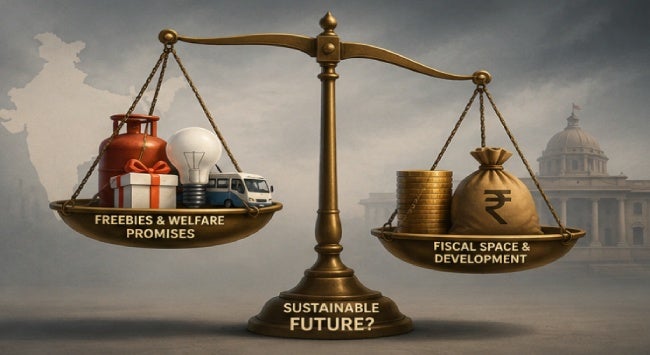
The recent assembly elections in four major states – Assam, West Bengal, Tamil Nadu and Kerala – have highlighted the relentless expansion of ‘freebies’ despite fiscal stress facing each of these states. Across political parties and ideological lines, manifestos resemble competitive announcements of subsidies, cash transfers and free services. The alarming feature is that these promises are being made for states already burdened with high debt, widening fiscal deficits and shrinking fiscal space.
In every election season across India, political parties compete not only through ideology, governance records or developmental visions, but also increasingly through elaborate promises of free or heavily subsidised goods and services. Free electricity, free bus rides, loan waivers, cash transfers, subsidised meals, free liquefied petroleum gas (LPG) cylinders, free consumer appliances and restoration of pension schemes have become familiar features of electoral campaigns. What was once occasional populism has now evolved into an entrenched political culture in which parties seek to outbid one another with increasingly expensive promises.
Across political parties and ideological lines, manifestos increasingly resemble competitive offers of subsidies, cash transfers, free services and income guarantees. What is particularly alarming is that many of these promises are being made for states which are already burdened with high debt, widening fiscal deficits and shrinking fiscal space. The four states of West Bengal, Assam, Tamil Nadu and Kerala already have burgeoning debt burdens and can ill-afford any further subsidies. Among the freebies announced by parties for Tamil Nadu were ₹2,500 (S$35) monthly assistance for women heads of households, six free LPG cylinders annually and free bus travel for women.[1] West Bengal saw announcements enhancing the assistance given under the Lakshmir Bhandar of the Trinamool Congress and the Matri Shakti Vandan Yojana of the Bharatiya Janata Party (BJP). Both schemes involve direct cash transfers.[2] In Kerala, the 2026 elections saw all major alliances outdoing each other with welfare-centric manifestos promising: free or subsidised transport for women, raising welfare pensions to ₹3,000 (S$45) per month and expanded health insurance coverage.[3] In Assam, the state government’s scheme for marginalised women had an enhanced handout under which four million women were paid ₹9,000 (S$125) each, less than a month before the state went to polls. As a poll pitch, the BJP-led coalition government claimed that this was the largest ever direct benefit transfer in the history of the state.[4]
The phenomenon is no longer limited to one region or one political formation. It cuts across party lines and geography. In some states, women receive free bus travel. Elsewhere, governments distribute free electricity up to certain consumption levels, subsidised food through canteens, farm loan waivers, cash doles, free gadgets or highly subsidised cooking gas cylinders. In certain instances, promises such as reverting to the Old Pension Scheme (OPS) have created enormous long-term liabilities for state finances. The cumulative fiscal burden of such commitments has become substantial.
While welfare measures aimed at reducing poverty and inequality are essential in a democratic society, a distinction must be made between carefully targeted social welfare and fiscally reckless competitive populism. The increasing tendency to promise benefits without adequate consideration of financial sustainability threatens to weaken state finances, distort development priorities and burden future generations with debt. India today faces a serious challenge: how to preserve social justice and welfare and maintain fiscal responsibility abjuring reckless announcements from becoming normalised electoral norm.
Rise of Competitive Populism
The roots of this trend lie in democratic competition. Elections in India are intense, frequent and highly competitive. Political parties constantly seek measures that can produce immediate and visible appeal among voters. Large infrastructure projects or institutional reforms may take years to show results, but a free utility connection, a subsidised meal or a direct cash transfer offers instant political visibility.
Over time, this has led to a phenomenon best described as ‘competitive populism’. Once any one party introduces a free scheme, rival parties feel compelled to offer equal or larger benefits to remain electorally relevant. The competition gradually escalates. Free electricity becomes higher free electricity quotas. Subsidised transport becomes entirely free transport. Temporary relief measures become permanent entitlements.
This trend is amplified by modern political communication. Campaigns increasingly revolve around headline-grabbing promises rather than detailed governance plans. Social media, television debates and political rallies reward dramatic announcements. Consequently, prudence and restraint often appear politically unattractive.
The problem is not merely the existence of welfare programmes. India remains a country with substantial poverty, unemployment, nutritional deficiencies and social inequality. Welfare spending on health, education, food security, rural employment and social protection is indispensable. When such spending is carefully calibrated, to reach the targeted population through financially balanced budgetary devolutions, the expenditure is sustainable and inter-temporally equitable. The problem arises when parties announce schemes with little regard for fiscal capacity, economic productivity or long-term sustainability.
Welfare Versus Freebies
Time has come when an important distinction must be drawn between legitimate welfare measures and indiscriminate freebies. Welfare programmes are designed to strengthen human capability and social equity. Public expenditure on schools, healthcare, nutrition, housing, sanitation, irrigation and employment generation creates long-term economic and social returns. Such investments enhance productivity, reduce inequality and contribute to national development. Some such schemes help create much needed rural infrastructure.
Freebies, on the other hand, are often designed primarily for short-term electoral gain rather than structural improvement. They invariably create dependency or entitlement, without generating productive assets or improving institutional capacity. As a consequence of such pre-poll promises, the incoming government is compelled to borrow excessively to finance consumption-oriented giveaways. This weakens their own ability to invest in infrastructure, education, healthcare and economic growth. For example, a subsidised meal programme targeted at the urban poor during periods of distress may serve an important social purpose. However, unlimited and universal subsidies unrelated to financial need can impose unsustainable burdens on the exchequer. Similarly, support for vulnerable groups through direct assistance may be justified, but blanket promises made without identifying funding sources or long-term implications can become fiscally dangerous.
The challenge, therefore, lies not in rejecting welfare altogether but in ensuring that welfare remains responsible, targeted and financially viable.
Fiscal Consequences
The fiscal consequences of excessive populist promises are increasingly visible in many Indian states.
State governments already face enormous expenditure obligations. They must fund education, healthcare, roads, irrigation, policing, urban development, welfare programmes and salaries. Many states have to depend on heavy borrowing because their revenues are insufficient to meet growing commitments.
When expensive populist schemes are added to this burden, fiscal deficits widen sharply. Governments then resort to additional borrowing. Over time, debt servicing itself consumes a large share of revenue, leaving fewer resources for productive investment. Several states in India today face mounting debt burdens. Interest payments and committed expenditures such as salaries, pensions and subsidies occupy a significant portion of state budgets. This reduces fiscal flexibility and leaves little room for capital expenditure. The restoration of the OPS in some states illustrates the dangers of politically attractive but fiscally hazardous commitments. The earlier pension system imposed open-ended liabilities on governments because pension payments were guaranteed regardless of future revenue conditions. The New Pension Scheme shifted toward contributory funding precisely because experts recognized the long-term unsustainability of unfunded pension obligations.
Reverting to the old system may provide immediate political benefits and appeal to government employees, but it transfers enormous liabilities into the future. Pension obligations continue for decades and can eventually crowd out developmental expenditure. States already under financial stress may find themselves trapped in a cycle where a growing share of revenues is spent merely on salaries, pensions, subsidies and debt repayment. Eventually, states may face conditions where they are unable to maintain services without central assistance or emergency borrowing.
A case in point is of the Congress party announcing the restoration of the OPS a cornerstone of its election campaign in Himachal Pradesh in 2022.[5] However, as of early 2026, the state is experiencing severe financial strain, leading to government announcing a temporary deferment of a portion of the monthly salaries of certain categories of government employees for a period of six months.[6] In fact, earlier while presenting the budget for the financial year 2026-27, the chief minister had already announced deferment in the salaries of the chief minister, ministers, members of the legislative assembly and officers. Post these announcements of deferments in salaries or allowances, there does not appear to be any resource mobilisation programme on the anvil which will help generate revenues to restore the temporary deferment. This may well lead to a situation of socio-political unrest.
In some other cases, governments have had to delay payments, reduce developmental spending or curtail capital expenditure because of fiscal stress. Such situations demonstrate how populist commitments can eventually undermine governance itself.
Impact on Development
One of the gravest consequences of reckless freebies is the diversion of resources away from long-term development.
Every rupee spent by the state involves an opportunity cost. There are competing demands for each rupee spent. Excessive expenditure on subsidies and giveaways often comes at the expense of investment in infrastructure, public transport systems, irrigation networks, healthcare facilities, schools and industrial development. Roads, ports, rail connectivity, power infrastructure and digital systems generate long-term economic growth. Good schools and healthcare systems improve human capital. Irrigation and agricultural modernisation enhance rural productivity. Such investments create employment, attract private enterprise and expand future revenues.
In contrast, indiscriminate giveaways may produce immediate consumption without creating enduring economic assets. While they may temporarily improve household finances, they do not necessarily strengthen the productive capacity of the economy. Repeated commitments to such pre-poll giveaways are bound to create severe long-term developmental imbalance. States that consistently prioritise short-term populism may gradually experience deterioration in public infrastructure, declining investment attractiveness and weaker economic growth.
This creates a dangerous cycle. Weak growth reduces government revenue. Reduced revenue increases dependence on borrowing. Eventually only further borrowing can finance populism. Debt rises further. Very soon, fiscal stress constrains even essential public services. As a consequence, budgetary devolutions to schemes for rural infrastructure creation, rural health, drinking water and primary education, among others, have to undergo a decline.
Debt Trap
Public debt is not inherently harmful. Borrowing for productive investment can strengthen future growth and generate returns. However, borrowing to finance recurring consumption expenditure poses serious risks.
When governments borrow heavily to fund subsidies and giveaways, future generations inherit repayment obligations without corresponding productive assets. It introduces unfairness and inter-temporal asymmetry as interest burdens start compounding. States become increasingly dependent on fresh borrowing merely to sustain existing commitments.
This debt trap can have multiple consequences: rising interest payments consume state revenues, creates inadequacy of funds for development expenditure, Credit ratings deteriorate, cost of borrowing increases and economic vulnerability grows.
International experience offers cautionary lessons. Several countries and subnational governments across the world have suffered fiscal crises after prolonged periods of populist overspending. Once investor confidence weakens, recovery becomes extremely painful. India cannot allow its states to drift toward such chronic fiscal fragility.
Political Incentives and Electoral Culture
The persistence of this phenomenon is rooted in electoral incentives. Voters often respond positively to direct and immediate benefits, particularly in conditions of economic stress. Political parties therefore perceive freebies as effective electoral tools. Since elections occur frequently at both state and national levels, the pressure to announce new schemes remains constant. Furthermore, the costs of such promises are often deferred into the future, while political gains are immediate. Governments making promises today may not bear the consequences years later. This creates what economists call a ‘moral hazard’ problem.
Conclusion
The elections in Assam, West Bengal, Tamil Nadu and Kerala reveal how deeply competitive populism has penetrated Indian politics. Despite differing ideologies and economic realities, parties across states increasingly rely on expansive welfare promises to secure electoral advantage.
Yet these promises are being made against the backdrop of rising debt, widening deficits, shrinking fiscal flexibility and growing long-term liabilities. The contradiction is becoming increasingly difficult to ignore.
A democratic state certainly has a responsibility toward social welfare and economic justice. But democracy cannot become an endless competition in promising benefits without regard to affordability. If unchecked, this culture of fiscally imprudent populism risks creating a future where states are trapped under mounting debt burdens, unable to invest adequately in infrastructure, growth or employment generation.
The real measure of governance is not how much is distributed before elections, but whether governments create conditions in which citizens ultimately prosper through opportunity, productivity and sustainable development rather than perpetual dependence on state largesse.
. . . . .
Mr Vinod Rai is an Honorary Senior Fellow at the Institute of South Asian Studies (ISAS), an autonomous research institute at the National University of Singapore (NUS). He is also a former Comptroller and Auditor General of India. He can be contacted at raivinod@hotmail.com. The author bears full responsibility for the facts cited and opinions expressed in this paper.
[1] “Vijay Unveils TVK’s Manifesto, Promises Free Gas Cylinders, 8gm Gold, Silk Saree for Bride”, The Print, 14 April 2026, https://theprint.in/politics/vijay-unveils-tvks-manifesto-promises-free-gas-cylinders-8gm-gold-silk-saree-for-bride/2906861/.
[2] “Schemes Offering Cash Incentive to Women Takes Centre Stage in Bengal Poll Campaign”, The Hindu, 18 April 2026, https://www.thehindu.com/elections/west-bengal-assembly/schemes-offering-cash-incentive-to-women-takes-centre-stage-is-bengal-poll-campaign/article70870246.ece.
[3] “Assembly Elections Kerala, Assam, West Bengal, Tamil Nadu, Puducherry 2026 Live Updates”, The Hindu, 12 April 2026, https://www.thehindu.com/elections/assembly-elections-kerala-assam-west-bengal-tamil-nadu-puducherry-2026-live-updates/article70805616.ece.
[4] “DTE Ground Report: Electoral Freebies for Women Brought Himanta Biswa Sarma to Power in 2021. Can They Rework Their Magic?”, Down To Earth, 20 March 2026, https://www.downtoearth.org.in/governance/dte-ground-report-electoral-freebies-for-women-brought-himanta-biswa-sarma-to-power-in-2021-can-they-rework-their-magic.
[5] “Himachal Pradesh Decides to Restore OPS for Its Employees”, The Hindu, 13 January 2023, https://www.thehindu.com/news/national/other-states/himachal-pradesh-decides-to-restores-ops-for-its-employees/article66373793.ece.
[6] “Himachal Defers 30% of Top Officials’ Salaries for Six Months”, Hindustan Times, 5 April 2026, https://www.hindustantimes.com/cities/chandigarh-news/himachal-defers-30-of-top-officials-salaries-for-six-months-101776625244681.html.
Pic Credit- Chatgpt
-
 More From :
-
 Tags :
-
 Download PDF