


Summary
Contrary to expectations, the mid-May 2026 summit between United States (US) President Donald Trump and Chinese President Xi Jinping turned out relatively well for India. From New Delhi’s perspective, the meeting helped stabilise US-China competition without fundamentally resolving it, while also avoiding the emergence of a G2 condominium. Just as importantly for India, the summit fell short of the expectations of major American businesses seeking a broader economic reset with China.
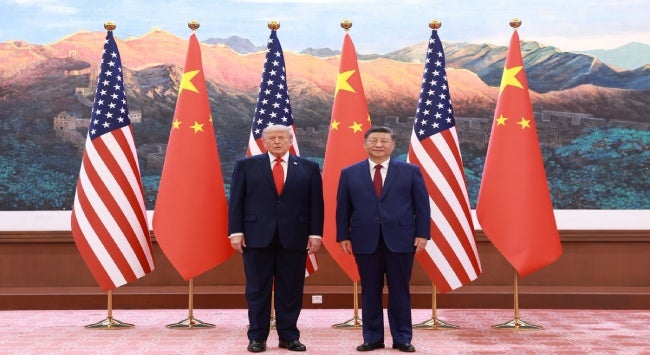
India had long feared the meeting between United States (US) President Donald Trump and China’s President Xi Jinping on 14 May 2026. In Indian eyes, the summit threatened to forge a G2 that would sideline New Delhi and undermine both the Quadrilateral Security Dialogue and the crucial and increasingly shaky US-India relationship. For many Indian observers, the summit constituted, at best, a strategic risk and, at worst, a strategic disaster in waiting. The “remarkably banal” Trump-Xi summit proved these fears wrong, for now. With few confirmed deliverables, underlying mistrust and focus on confidence-building and restoring normalcy in relations, the meeting did not usher a grand bargain between the superpowers at India’s expense. Instead, unexpectedly, the summit turned out to be relatively good for New Delhi. There are four reasons for this counterintuitive conclusion.
First, it stabilised China-US competition. The summit’s emphasis on “strategic stability” is welcome for an India that has much to fear from the potential costs and risks of an escalation of the Beijing-Washington rivalry. Such escalation might lead to New Delhi facing a choice between its partnership with Washington, increasingly shaky but still vital, and its need to preserve a stable, working relationship with Beijing – the importance of which both China and India painfully learned after their 2020 border crisis. An escalation between Washington and Beijing might produce dangerous trade wars which would affect Indian companies, prompt the US to make economic and political demands to India and push China to destabilise the disputed China-India border again. Fortunately for India, the stabilisation introduced by the summit and the partial normalisation of US-China interactions make these outcomes less likely.
Second, the Trump-Xi meeting demonstrated that the US-China competition persists. Despite their superficial and awkward bonhomie, the two sides reached no fundamental agreement on the key issues that divide them, such as Taiwan, nuclear weapons, artificial intelligence and rare earths. China’s reported refusal to buy Nvidia’s most advanced chips offered by Washington suggests that it is catching up with the US and that their chip competition is heating up.
All this is very beneficial to New Delhi. India’s international strategy in the last two decades has been premised on the persistence of the US-China rivalry which raises India’s importance as an actor in the Indo-Pacific, gives it leverage over both superpowers and incentivises Washington to support New Delhi’s rise. While the transactional and ‘short-termist’ Trump administration has diminished the usefulness of this Indian strategy, it has not abolished the powerful strategic logic behind it, which is likely to reassert itself if the rivalry between China and the US continues.
Third, to India’s relief, the summit revealed that the prospects of a US-China G2 remains limited. The summit not only produced no actionable agreements on international issues such as the Iran conflict, the ongoing international energy crisis and the war in Ukraine, but the two sides also reached no broad understanding on how to “manage” Asia or the world. Furthermore, the mistrust between Beijing and Washington was palpable during the summit. All this is good news for India which fears that a G2 arrangement would kick it off the top international table and put many of its interests on the US-China bilateral menu. Importantly, South Asia seems not to have been discussed during the summit; hence, assuaging New Delhi’s old fear that the two superpowers would take decisions for India’s own backyard without consulting New Delhi.
Finally, big US business gained surprisingly little from the summit, despite the presence of an impressive list of American chief executive officers in Trump’s delegation and high expectations. This lack of progress is welcome for India which hopes to attract much greater US investment, particularly in high-technology sectors and in manufacturing, and use it to raise its technological level and accelerate its growth. Continued difficulties for American investment in China and greater Chinese competition in key sectors enhance India’s attractiveness as an investment destination. They also reinforce the geoeconomic logic behind the ‘China Plus One’ strategy, on which India has long pinned its hopes with limited success.
In short, New Delhi had a relatively good Trump-Xi meeting that did not prove India’s worst fears and offered vindication for India’s strategy for navigating the US-China competition. This is a relief for an India that has been shaken by international turbulence during the last one year.
Of course, not all is good. The Trump-Xi meeting revealed Beijing’s growing strategic self-confidence, itself the product of the progressively diminishing power gap between China and the US. A more self-confident Beijing, which is treated by Washington as a near peer, will be even less considerate of India’s interests and less concerned about Delhi’s responses to Chinese influence in South Asia or pressure tactics in bilateral relations. Moreover, Beijing will be less constrained by fears that it might push India closer to the Washington. Significantly, this growing Chinese confidence extends to the Taiwan issue, on which Beijing sees an opportunity to change US policy as Trump considers offering Taiwan concessions to China. Of course, such confidence makes a serious Chinese miscalculation on the explosive Taiwan issue easier, including in the scenario that Beijing’s expectations of changing US policy on Taiwan are dashed. This is a very worrying prospect for India.
The Trump-Xi summit went relatively well for India. This should reassure New Delhi but not put it at ease, as it still needs to grapple with a fast-changing international environment dominated by an uncertain US-China relationship. And, of course, Trump and Xi are likely to meet again in the coming months.
. . . . .
Dr Ivan Lidarev is a Research Fellow at the Institute of South Asian Studies (ISAS), an autonomous research institute at the National University of Singapore (NUS). He can be contacted at ivanlidarev@nus.edu.sg. The author bears full responsibility for the facts cited and opinions expressed in this paper.
Pic Credit: (2) modi china – Search / X
-
 More From :
-
 Tags :
-
 Download PDF