


Summary
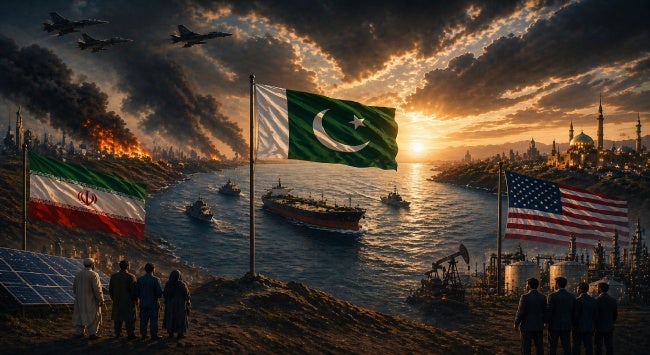
Air strikes by the United States and Israel on Iran in early 2026 sharply escalated tensions, disrupted global energy flows and raised the risk of a wider conflict. In the absence of a unified regional response, Pakistan used its ties with both sides to keep communications open and help ease tensions, even as the crisis placed significant pressure on its own economy and security.
On 28 February 2026, the United States (US) and Israel launched coordinated air strikes on Iran, which marked a sharp escalation in regional conflict. The strikes targeted senior figures within Iran’s political and security establishment and attempted to destabilise the regime through leadership decapitation. Despite the scale of the attacks, Iran moved quickly to restore continuity, appointing Mojtaba Khamenei, the son of Ayatollah Ali Khamenei and a figure embedded within Iran’s clerical and security networks, as leader on 8 March 2026.
What followed was a sustained escalation in tensions, with Iran leveraging the Strait of Hormuz to disrupt maritime traffic. This contributed to rising global energy prices and broader economic instability. It extended the impact of the conflict beyond the immediate region and placed pressure on global supply chains. In this context, the costs of continued confrontation became increasingly difficult to contain and heightened the risks of wider geopolitical escalation.
The fragmentation of the Gulf states’ responses limited the emergence of a unified regional approach to de-escalation, as no single regional actor was able to coordinate a coherent response. This created space for an intermediary to facilitate dialogue between the parties. Pakistan leveraged its relationships with both Iran and the US to assume the role of intermediary during this volatile war. Iran and Pakistan share key cultural, religious, and diplomatic ties. Pakistan’s evolving partnership with the US, shaped often by strategic interests, has allowed it to maintain channels of communications with Washington. By facilitating backchannel dialogue, it has managed to allow negotiations to take place between Iran and the US.
Moreover, Pakistan has much skin in the game. At the onset of the war, Pakistan faced multiple and overlapping pressures that made escalation particularly risky. At the time, the country was already engaged in conflict with the Afghan Taliban. It was also seeking to maintain its mutual defence commitments with Riyadh and manage concerns related to remittances and Pakistani workers in the Gulf states. Domestically, the situation was equally sensitive, as around 15 to 20 per cent of the population identifies as Shia. As Pakistan shares an approximately a thousand-kilometre border with Iran, it faced a heightened risk of the conflict spilling over and intensifying domestic unrest along sectarian lines.
Additionally, mounting domestic pressures arising from the conflict made de-escalation an urgent strategic imperative. Like many countries, Pakistan’s already fragile economy was further strained by the Iran-US-Israel war. The country has sought to lessen its reliance on imported oil and gas by expanding the use of solar energy. This shift has often been described as a bottom-up, “people-led” transition. The move towards renewable energy is aimed at strengthening economic resilience, enhancing energy security and providing a degree of insulation from the disruptive effects of international crises. However, despite these mitigation measures, they were not enough to counter the scale of the economic pressures facing Pakistan.
Consequently, the government introduced measures such as a four day work week for government employees and half the workforce shifting to a work from home arrangement for non-essential industries. Universities have moved their classes online, and there was a closure of schools for 21 days in March 2026. An additional ban on iftar meals during Ramadan was placed by the authorities. Prime Minister Shehbaz Sharif also announced that cabinet ministers and advisers will go without salaries and allowances for roughly two months. Federal and provincial legislatures have been encouraged to take a pay cut of around 25 per cent at their discretion. In April 2026, energy-saving measures remained in place, with Pakistan’s Education Department announcing that both private and public schools would also close on Fridays, affecting 40 million students.
These constraints reinforced Pakistan’s strong interest in de-escalation. Both the US’ 15-point proposal and Iran’s counter 10-point proposal passed through Islamabad. What this showed was Pakistan’s capacity to act as a channel for communication between competing sides at a moment of high tension. With support from countries such as China and Egypt, Pakistan helped sustain dialogue in a fragmented regional environment. In doing so, it established itself as a key intermediary in efforts to manage and contain the conflict.
. . . . .
Dr Imran Ahmed is a Research Fellow at the Institute of South Asian Studies (ISAS), an autonomous research institute at the National University of Singapore (NUS). He can be contacted at iahmed@nus.edu.sg. Ms Tanujja Dadlani is a Research Analyst at the same institute. She can be contacted at tanujjad@nus.edu.sg. The authors bear full responsibility for the facts cited and opinions expressed in this paper.
Pic Credit: Chatgpt
-
 More From :
-
 Tags :
-
 Download PDF