


Summary
The temporary closure of the Tatopani border following a massive wildfire in China’s Nyalam-Khasa corridor may seem like an isolated environmental incident. However, it exposes deeper vulnerabilities in Nepal-China trade. With the Rasuwagadhi crossing already closed after the July 2025 floods, Tatopani had become the main overland trade route, leaving hundreds of containers stranded and supply chains disrupted. The closure highlights Nepal’s heavy reliance on a few fragile Himalayan corridors and the power asymmetry in border management, as decisions on reopening are largely controlled by the Chinese side. Beyond immediate disruptions, the incident also highlights how climate volatility is becoming a structural factor in Himalayan connectivity, complicating trade diversification efforts and revealing the absence of institutionalised Nepal-China mechanisms to manage cross-border environmental risks.
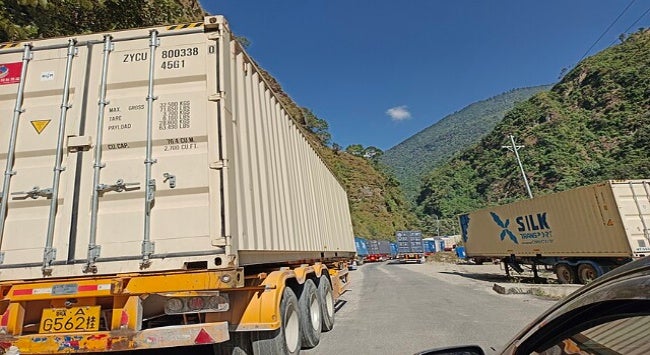
A large wildfire in the forested areas along China’s border near Nyalam and Khasa has forced the temporary closure of the Tatopani border point. The shutdown comes at a particularly sensitive time. With the Rasuwagadhi border shut for half a year from July 2025 until the start of this year due to flood damage, Tatopani effectively became the primary overland trade route between Nepal and China. Due to this closure, containers are stranded on both sides of the border, supply chains are disrupted and costs have increased for traders already accustomed to delays. These incidents highlight how shallow Nepal’s diversification away from India-centric trade remains. Nepal’s trade with China still depends on very few and fragile corridors despite years of policy talks about multiple transit routes and trans-Himalayan connectivity.
What distinguishes this disruption from previous closures is its cause. It did not arise from diplomatic tension, infrastructure failure or administrative friction but from climate-related factors. On the Chinese side, wildfires, smoke, communication breakdowns and evacuations have been sufficient to render customs operations inoperable. In the Himalayan context, this is important. Borders here are no longer disrupted only by earthquakes and landslides. Extreme heat, forest fires and ecological stress are becoming equally potent forces that can paralyse trade. This introduces a new category of risk into Nepal-China relations.
Environmental volatility is inherently unpredictable, difficult to address quickly and largely absent from existing bilateral trade frameworks. The Tatopani incident provides an example that even infrastructures like border posts and customs systems can be rendered inoperable due to ecological events that are beyond Nepal’s control.
The border closure also reiterates a familiar asymmetry in how the Nepal-China border functions. Major decisions such as suspension, reopening and flow of information are almost entirely influenced by the Chinese side. Nepal’s role in this appears largely reactive, involving requests for drone imagery, heightened surveillance on its side and reliance on the restoration of customs systems across the border. This does not demonstrate a diplomatic conflict, but it points out that the border is less a jointly managed space and more of a Chinese-administered gate. If these kinds of interruptions keep happening, people within Nepal might gradually come to see Chinese trade as politically friendly but operationally fragile.
Strategically, the implications go far beyond Tatopani. This incident shows how complicated Nepal’s story of diversification can be. Reducing dependence on India remains a key objective; however, diversification without redundancy merely redistributes vulnerability. If the alternative routes turn out to be no more resilient to climate shocks, then Nepal would be exchanging one form of dependence for another. The incident also reveals that there are no institutionalised mechanisms for cross-border disaster coordination between the two countries. Despite shared ecological systems and interlinked border communities, Nepal and China do not have comprehensive joint early warning, coordinated response or contingency planning frameworks for environmental disruptions. If both sides agree to treat the Himalayan ecology not only as a security issue but also as a shared governance challenge, then climate risk could be a low-politics entry point for deeper cooperation.
Tatopani undercuts some of the more ambitious narratives surrounding seamless trans-Himalayan connectivity. Connectivity exists but it is fragile, episodic and increasingly vulnerable to forces beyond traditional policy control. With climate change impacts becoming more severe, the closure of borders due to environmental events may become less rare and more of a regular occurrence.
The wildfire near Tatopani will eventually go out and the border will be open again. However, the lesson this episode leaves should not be overlooked. For decades, Nepal-China trade was shaped primarily by diplomacy and infrastructure. Today, it is increasingly constrained by climate volatility interacting with concentration risk and power asymmetry. If these structural realities are left unaddressed, the next interruptions might not be unexpected, but they will still come as a shock.
. . . . .
Associate Professor Harsh Mahaseth is an Academic Visitor at the Institute of South Asian Studies at the National University of Singapore (NUS). He is an Associate Professor at Jindal Global Law School, O. P. Jindal Global University, India. He can be contacted at hmahaseth@jgu.edu.in. The author bears full responsibility for the facts cited and opinions expressed in this paper.
Pic Credit: Wikimedia Commons
-
 More From :
-
 Tags :
-
 Download PDF