


Summary
Pakistan’s participation in the United States (US)-led Board of Peace (BoP), a controversial geopolitical project, is an indication of Pakistan’s desire to gain diplomatic visibility and international legitimacy. Notwithstanding its stated mandate of resolving global conflicts, the very structure of the BoP concentrates authority in the hands of US President Donald Trump, leaving Pakistan with practically no control over its functioning and decision-making. Deeper commitment to what appears to be the US hegemonic project might jeopardise Pakistan’s long-term strategic relationship with China and also undermine its future aspirations to play a prominent role in the Middle East.
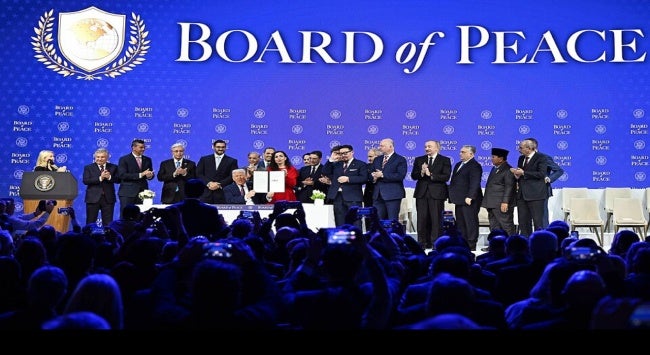
Pakistan, led by its civilian prime minister, Shehbaz Sharif, and with the vigilant gaze of Field Marshal Asim Munir, has become a founding member of the Board of Peace (BoP), an initiative led by the United States (US) in the complex chessboard of contemporary geopolitics. Launched by President Donald Trump with his characteristic flair for grand gestures, the BoP is more of a unipolar, personalised manoeuvre than a serious attempt at resolving global conflicts.
The BoP’s Structure and Agenda
The BoP was first proposed in September 2025 and endorsed in November 2025 by the United Nations (UN) Security Council as an international organisation with a declared purpose of promoting peacekeeping and rebuilding the war-torn Gaza.[1] It was formally created on the sidelines of the January 2026 World Economic Forum in Switzerland, with Trump as chairman for life along with an executive board that also includes his son-in-law and real estate investor, Jared Kushner, the US special envoy, Steve Witkoff, and former British Prime Minister Tony Blair, among others.[2] Kushner’s presence, with his deep connections to the topmost leaders of the Middle Eastern countries and his role in the Abraham Accords, reinforces the perception that the BoP is designed to operate both as a diplomatic entity and an economic engine. Permanent membership will be given to those who contribute more than US$1 billion (S$1.35 billion). The BoP framework has been presented at a critical moment when global actors are deeply engaged in negotiations over the future of the region.
Trump plans to convene the first meeting of the BoP on 19 February 2026 in Washington DC, and the Pakistani prime minister has confirmed his participation.[3] Although the BoP was initially supposed to be dealing with the Gaza conflict, its charter makes no direct reference to Gaza. It clearly implies that the BoP’s ambit is going to widen to other global hotspots, such as Ukraine, Sudan or Syria. The absence of a definite mandate opens up the possibility of multiple interpretations so that Trump and his supporters can intervene in international conflicts at their own discretion. This is in sharp contrast to the inclusive, multilateral structure of the UN.[4] As it exists right now, the BoP does not appear to be a genuine multilateral platform, but rather a top-down project facilitated by the narrow interests of a particular nation.[5] It seeks to enforce a “transactional global order” in a “US-First Trumpian world.”[6]
Apprehensions among the European Allies
The concept of a fast, result-oriented peace process is rather attractive in a world that is exhausted with the UN because of its apparent lethargy and vetoing nature. Yet this superficial appeal fades away after a closer look at the very structure of the BoP initiative, which puts all the power in the hands of Trump. A highly selective and unequal membership mechanism based on personal, political and economic considerations has drawn severe criticism.[7] Leading democratic nations have so far distanced themselves from the BoP, and most of the European allies of the US have rejected the idea. The only European Union (EU) nations to have joined the BoP are Hungary and Bulgaria.
Despite being one of the closest European allies of the Trump-led US, Italy has publicly refused to join the BoP as its charter gives Trump veto authority, conflicting with Italy’s constitutional principle that prohibits participation in organisations where power is not equally distributed among the members.[8] Similarly, German Chancellor Friedrich Merz has also expressed his country’s inability to join the BoP due to its current structure.[9] The French foreign ministry has publicly endorsed solidarity with the UN Charter, arguing that it is “the cornerstone of effective multilateralism, where international law, the sovereign equality of States and the peaceful settlement of disputes prevail over arbitrariness, power relations and war.”[10] To mock French President Emmanuel Macron’s refusal to join the BoP, Trump even threatened to impose a-200 per cent tariff on French wines and champagne. However, the tariff coercion was rejected by Paris as unacceptable.[11] Since the BoP does not appear to have much room for accountability and meaningful oversight, there are serious concerns about the credibility and impartiality of the BoP’s potential activities.
Pakistan’s Involvement
Pakistan’s haste in becoming a member of the Trump-led elite club reflects the vulnerability of the hybrid regime whose legitimacy has come under a cloud. The 27th Constitutional Amendment, passed in November 2025, has effectively concentrated ultimate political power in Munir’s hands. The unique constitutional status of Chief of Defence Forces makes Munir legally unassailable.[12] Such brazen concentration of power has undermined democratic checks and balances in Pakistan. With the change in the global power dynamics, the Sharif-Munir hybrid regime has used this moment to engage with a Trump-dominated initiative. The fact that many countries with competing interests and contradictory agendas have been invited to join the BoP makes Trump’s idea of peace more of a membership campaign than the launch of any serious multilateral forum for peace-building.[13]
In the case of Pakistan, the temptation of international legitimacy is too strong. Pakistan’s domestic political and economic situation has been quite pessimistic, and the hybrid regime might have realised that the BoP was a short-cut to international prominence, however temporary that prominence could be. Despite domestic opposition, the Pakistani government has fiercely defended its decision to join the BoP, claiming that it strengthens global efforts for the Gaza peace and demonstrates Pakistan’s diplomatic success. Planning Minister Ahsan Iqbal argued that if the government had chosen not to join the BoP, the opposition would have criticised the decision on the ground that Pakistan has been sidelined and isolated.[14] Yet Islamabad’s decision continues to draw sharp criticism from within the country. The Khyber Pakhtunkhwa Assembly recently passed a resolution condemning the government’s decision to join the BoP as a “dangerous development”.[15]
Pakistan’s embrace of the BoP aligns with patterns seen in other BoP members with similar authoritarian political structures. As a noted Pakistani security analyst, Muhammad Amir Rana rightly points out that “most countries that have joined Trump’s BoP so far tend to have weak democratic credentials and are predominantly Muslim states that do not prioritise public opinion in foreign policy; their ruling elites often hold worldviews distinct from those of their populations…Pakistan’s hybrid political system behaves at times like a quasi-monarchy, with critical foreign policy decisions taken outside a broad parliamentary consensus.”[16]
Besides the democratic fragility, it also appears that Pakistan had little option but to accept Trump’s offer due to a precarious economic and internal security situation. The International Monetary Fund may squeeze the Pakistani economy any time, and the US holds a huge bargaining power in the trade tariffs and investment flows. Such economic realities may have compelled Pakistan into the BoP fold. As one Pakistani commentator has argued, offending Trump can have “severe political and economic consequences for countries.”[17] Nevertheless, Pakistan’s involvement is not solely driven by economic exigencies.
Unrealistic Expectations
Some overenthusiastic sections in Pakistan appear too optimistic about the potential of the BoP being involved in the Kashmir issue.[18] However, the geoeconomic and geopolitical interests of the Trump-led US, especially his largely positive orientation towards India, as reflected in the latest announcement of interim trade framework,[19] reinforce the perception that the BoP is not going to serve Pakistan’s agenda against Indian interests, particularly regarding Kashmir. Despite the sporadic political rhetoric from the White House, the Kashmir issue is not among those that Trump would give high priority as it does not benefit his personal or his country’s national interests directly or indirectly.[20] Additionally, the overestimation of Pakistan’s international leverage, particularly with Trump, also poses a serious risk for Pakistan. Trump’s track record in conflict mediation has been in plain sight; his idiosyncratic diplomatic style has not created lasting peace anywhere. Thus, the expectations of some in Pakistan that Trump would interfere in Kashmir to change South Asia’s balance of power are naïve.
The Pakistani regime has been aiming to extend its influence in the Middle East and gain the goodwill of key Arab states. Being part of the BoP could be a profitable move indeed and a chance to exercise Pakistan’s geopolitical influence in the region with a seat on the Gaza rebuilding. However, with an impulsive Trump at the helm of affairs, Pakistan’s ability to influence the BoP’s agenda is almost zero. As Trumpian diplomacy is characterised by isolationism, transactionalism and no long-term strategic commitments, the BoP is not intended to be a conflict resolution platform. Instead, it is a continuation of Trump’s whims.
The very structure and logic of the BoP make it impossible for Pakistan to get anything favourable just because its military leadership believes that it has done Trump a favour. The history of many such unilateral ventures in the past indicates that such expectations are misplaced. After all, the BoP can only contribute to strengthening the existing global power configurations. The long-term fear of this kind of hegemonic peace process will likely keep China and Russia away from the BoP as they are aware that it is primarily aimed at cementing the US’ global supremacy. Getting drawn closer to a US-dominated structure in the Middle East would involve many entrapments and compromises that could sow seeds of mistrust in Pakistan’s strategic relationship with China.[21] And whether Pakistan can strike a balance between Saudi and Israeli interests, particularly in such decisive issues as Iran and the future of the Middle East’s security order, will be the crucial test of its political will.
The Trumpian style of US diplomacy, bypassing traditional government institutions and bureaucratic process, is already facing challenges from the middle powers, and Pakistan cannot remain aloof from its undesirable consequences. When the next big move on the Gaza peace plan is taken by the US president, it will be interesting to see whether Islamabad would continue to play the great game or be reduced to a pawn in a game defined by the US’ geopolitical ambitions.
Conclusion
Pakistan’s involvement in the BoP is controversial and a calculated, albeit high stakes move. Although the country is democratically fragile, economically poor and politically unstable, its eagerness to become part of the Trump-led project highlights the military establishment’s desire to deepen Pakistan’s strategic alignment with the US. However, the BoP’s current agenda and structure reflect Trump’s personalised diplomatic ambitions rather than an inclusive multilateral platform. Moreover, if Pakistan’s hybrid regime hopes to instrumentalise the BoP to influence the Kashmir issue, it will be disappointed because notwithstanding Trump’s idiosyncratic diplomatic style, Washington’s long-term geopolitical interests are aligned more with India rather than the narrow interests of Pakistan.
. . . . .
Dr Vinay Kaura is a Non-Resident Fellow at the Institute of South Asian Studies (ISAS), an autonomous research institute at the National University of Singapore (NUS). He is also an Assistant Professor at the Department of International Affairs and Security Studies, Sardar Patel University of Police, Rajasthan, India. He can be contacted at vinay@policeuniversity.ac.in. The author bears full responsibility for the facts cited and opinions expressed in this paper.
[1] “UN Security Council authorizes temporary international force for Gaza”, UN News, 17 November 2025, https://news.un.org/en/story/2025/11/1166391.
[2] “Board of Peace | The chairman’s circle”, The Hindu, 25 January 2026, https://www.thehindu.com/news/international/board-of-peace-the-chairmans-circle/article70544149.ece.
[3] “PM to attend ‘Board of Peace’ meeting in Washington on 19th”, Dawn, 17 February 2026, https://www.dawn.com/news/1972442/pm-to-attend-board-of-peace-meeting-in-washington-on-19th.
[4] Julian Borger, “Trump’s board of peace is an imperial court completely unlike what was proposed”, The Guardian, 20 January 2026, https://www.theguardian.com/us-news/2026/jan/20/trumps-board-of-peace-is-an-imperial-court-completely-unlike-what-was-proposed.
[5] Bruce Jones, “Trump’s ‘Board of Peace’ and the multilateral order”, Brookings, 3 February 2026, https://www.brookings.edu/articles/trumps-board-of-peace-and-the-multilateral-order/.
[6] Hugh Lovatt, “Welcome to the jungle: Trump’s Board of Peace goes global”, European Council on Foreign Relations, 23 January 2026, https://ecfr.eu/article/welcome-to-the-jungle-trumps-board-of-peace-goes-global/.
[7] Tammy Caner and Pnina Sharvit Baruch, “Trump’s Board of Peace: An Initiative for the Gaza Strip or an Alternative to the UN?”, INSS Insight, 4 February 2026, https://www.inss.org.il/publication/bop/.
[8] Lorraine Mallinder, “Italy says cannot join Trump’s ‘Board of Peace’ because of constitution”, Al Jazeera, February 7, 2026, https://www.aljazeera.com/news/2026/2/7/italy-latest-country-not-joining-board-of-peace.
[9] Sean Sinico with dpa, DW, “Merz says Germany won’t join Trump’s ‘Board of Peace’”, DW, 23 January 2026, https://www.dw.com/en/merz-says-germany-wont-join-trumps-board-of-peace/a-75633920.
[10] RFI, “France’s refusal to join Trump’s ‘Board of Peace’ sparks new wine tariff threat”, RFI, 20 January 2026, https://www.rfi.fr/en/international/20260120-france-s-refusal-to-join-trump-s-board-of-peace-sparks-new-wine-tariff-threat.
[11] Ibid.
[12] “Pakistan’s army has always been influential – now its chief has new powers”, BBC News, https://www.bbc.com/news/articles/c9d6w1glz3qo; and “Power grab: On Pakistan’s General Asim Munir”, The Hindu, 18 November 2025, https://www.thehindu.com/opinion/editorial/power-grab-on-pakistans-general-asim-munir/article70290895.ece.
[13] Josh Meyer, “Trump’s new Board of Peace invites ‘controversial people’ like Putin”, USA Today, 24 January 2026, https://www.usatoday.com/story/news/politics/2026/01/24/trumps-board-of-peace-controversial-members/88323560007/.
[14] “‘Diplomatic win’: In joint session, govt again defends decision to join Trump-led Board of Peace”, Dawn, 23 January 2026, https://www.dawn.com/news/1968603.
[15] PTI, “KPK assembly adopts resolution rejecting Pakistan government’s decision to join Trump’s Board of Peace”, The Hindu, 27 January 2026, https://www.thehindu.com/news/international/kpk-assembly-adopts-resolution-rejecting-pakistan-governments-decision-to-join-trumps-board-of-peace/article70558103.ece.
[16] Muhammad Amir Rana, “Staying relevant”, Dawn, 25 January 2026, https://www.dawn.com/news/1968962.
[17] Kamran Yousaf, “Why Pakistan joined Trump’s Board of Peace”, The Express Tribune, 26 January 2026, https://tribune.com.pk/story/2589014/why-pakistan-joined-trumps-board-of-peace?.
[18] News Desk, “PPP demands inclusion of Kashmir issue in Board of Peace”, Daily Times, 2 February 2026, https://dailytimes.com.pk/1445013/ppp-demands-inclusion-of-kashmir-issue-in-board-of-peace; https://www.instagram.com/p/DUObfdICDEd/.
[19] Jarrett Renshaw, David Lawder and Manoj Kumar, “US, India unveil interim trade framework, move closer to broad pact”, Reuters, 6 February 2026, https://www.reuters.com/world/india/us-india-release-framework-an-interim-trade-deal-2026-02-06/.
[20] Sushant Sareen, “Pakistan’s Board of Peace’ Playbook—Should India Worry?”, Observer Research Foundation, 3 February 2026, https://www.orfonline.org/expert-speak/pakistan-s-board-of-peace-playbook-should-india-worry.
[21] “Pakistan’s Trump test”, Dawn, 17 February 2026, https://www.dawn.com/news/1970359.
Pic Credit: Wikimedia
-
 More From :
-
 Tags :
-
 Download PDF