


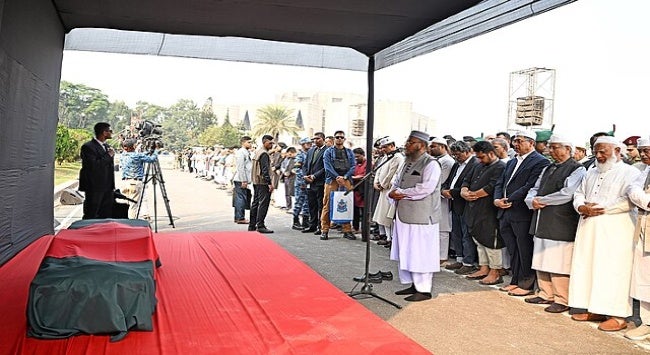
The Death of Sharif Osman Hadi:
Rethinking New Delhi’s Bangladesh Policy
Amit Ranjan
29 December 2025Summary
The death of Sharif Osman Hadi has added to the tensions between India and Bangladesh. Fresh anti-India sentiments in Bangladesh call for a recalibration of New Delhi’s approach towards Dhaka.
The death of a 32-year-old student leader, Sharif Osman Hadi, who succumbed to his injuries in a Singapore hospital on 18 December 2025, has created political unrest in Bangladesh. Hadi was shot by masked men in Dhaka and was brought to Singapore for treatment. He functioned as a spokesperson for Inquilab Mancha (Platform for Revolution) and was critical of India, where the country’s ousted prime minister, Sheikh Hasina, is living after her departure from Dhaka in August 2024.
Following Hadi’s death, his supporters attacked anything they deemed to symbolise or support India. A Hindu worker, Dipu Chandra Das, was lynched by a mob on 18 December 2025 on charges of blasphemy. However, the police has not found any evidence of Dipu making religiously offensive remarks. The protestors also vandalised and looted the offices of Bangladesh’s prominent newspapers – The Daily Star and Prothom Alo. They accused the newspapers of “setting the ground” for Hadi’s killing, calling them “Delhi’s lapdog” and “Sheikh Hasina’s enabler”. The country’s historic cultural institution – Chhayanaut-Sanskriti Bhaban – also came under attack, and the central office of the cultural organisation – Udichi Shilpi Gosthi – was torched by the protestors.
Amidst the anti-India protest, the Indian Ministry of External Affairs summoned Bangladesh’s High Commissioner to New Delhi, Riaz Hamidullah, for the second time since 14 December 2025. Bangladesh also summoned India’s High Commissioner to Dhaka, Pranay Verma, following a protest at the Bangladesh High Commission in New Delhi. Hundreds of supporters of Vishwa Hindu Parishad and Bajrang Dal participated in a protest demanding the safety of Hindus in Bangladesh. Demonstrations against the lynching of Dipu were also held in cities such as Kolkata, Mumbai, Hyderabad, Agartala and in parts of Madhya Pradesh.
In such a grim political situation, India is faced with several challenges and options in its relations with Bangladesh. First, it must accept the new political situation in Bangladesh and be prepared to interact with the country’s new leadership. The political parties in Bangladesh have expressed their willingness to engage with New Delhi. For instance, in April 2025, Bangladesh Nationalist Party’s Assistant Secretary for International Affairs, Rumeen Farhana, said, “India is our friend, and we want to maintain a positive relationship with them”. Similarly, Bangladesh Jamaat-e-Islami supremo, Shafiqur Rahman, said, “India is our neighbour, and we want a good, stable and harmonious bilateral relationship”. Bangladesh’s Finance Adviser Salehuddin Ahmed also stated that his country’s interim administration is taking measures to not turn ties with India bitter and is instead focused on strengthening bilateral relations. Notably, India has shown flexibility in its engagements with Afghanistan and Myanmar that could be replicated in Bangladesh.
Second, the November 2025 judgement by the International Crimes Tribunal on Hasina has led to mixed reactions globally. Leading international human rights organisations, many countries and several individuals have been strongly critical of Hasina’s handling of the situation during the students’ protests in 2024. However, questions have been raised about the way the legal proceeding against Hasina was carried out and on the judgement delivered by the tribunal. Moreover, Hasina is a close friend of New Delhi. India extraditing her to Bangladesh will send a wrong political message to the world. The extradition case can be politically negotiated by the Indian establishment after the February 2026 elections in Bangladesh.
Third, a large number of Bangladeshis view Hasina as an autocrat under whom many people suffered. Her critical statements from New Delhi targeting the interim government, on the rising power of the Islamists and the increased attacks on Hindus, among others, are not welcomed in Bangladesh. Many Bangladeshis are not pleased with India for providing shelter and political space to Hasina. Earlier, the head of the interim government, Muhammad Yunus, said that Hasina must “keep quiet” and asked New Delhi to ensure that she stays silent. In India, Hasina has the freedom to speak her mind. However, strategically, as New Delhi has to deal with the new political actors in Bangladesh, it is rational to not support all her politically overloaded statements.
Fourth, it is convenient to accuse the Islamists and third parties of fostering growing anti-Indian sentiment in Bangladesh. Although one cannot entirely deny the impact of a shift in the internal political dynamics and a change in Dhaka’s relations with New Delhi, many in Bangladesh feel that they are generally not well treated by Indians. For instance, in 2018, India’s current Union Home Minister, Amit Shah, stated that Bangladeshi migrants “are like termites”. The deportation of people from India to Bangladesh on suspicion of being “illegal immigrants” has also not been well received by the country. Furthermore, the activities of the Border Security Force on the India-Bangladesh international border have been questioned by the Bangladeshi state and civil society organisations. Bangladesh has also expressed “deep concern” over what it says is “unauthorised” fencing along the border by India.
India needs to be cautious in its approach to the current situation in Bangladesh. The Indian state, media, religious groups and individuals should avoid making statements that could create new challenges for New Delhi amid Bangladesh’s evolving political landscape.
. . . . .
Dr Amit Ranjan is a Research Fellow at the Institute of South Asian Studies (ISAS), an autonomous research institute at the National University of Singapore (NUS). He can be contacted at isasar@nus.edu.sg. The author bears full responsibility for the facts cited and opinions expressed in this paper.
Pic Credit: Wikimedia Commons
-
 More From :
-
 Tags :
-
 Download PDF