


Rushing Through Critical Legislations:
Erosion of Parliamentary Scrutiny in India
Ronojoy Sen
5 January 2026Summary
The winter session of the Indian parliament witnessed important pieces of legislation being passed in haste and without any committee scrutiny. It confirmed a decade-long trend that has undermined the parliamentary committee system.
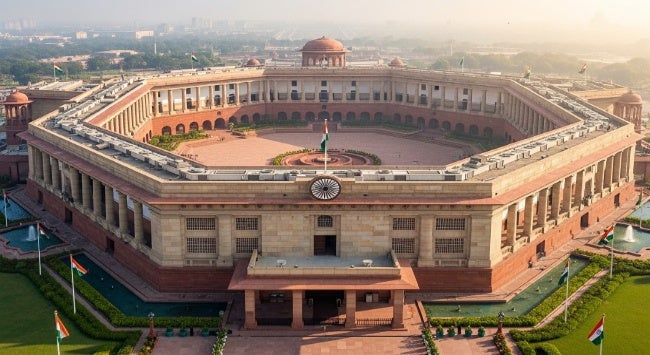
The winter session of the Indian parliament, held from 1 December to 19 December 2025, was a paradoxical one. Unlike some earlier parliamentary sessions that have been marred by disruptions, the 2025 winter session saw both houses of the parliament functioning beyond their scheduled time. The Lok Sabha, or the Lower House of the Parliament, functioned for 103 per cent of its scheduled time and the Upper House or Rajya Sabha, for 104 per cent. In terms of legislative output, nine bills were introduced – some of them of great significance and seven were passed.
These numbers, though, hide the fact that the Indian parliament has failed in its duty of legislative scrutiny not only in the last winter session but over the past few years. In the current 18th Lok Sabha, 11 of the 42 Bills introduced in the parliament or 26 per cent, have been referred to committees. This is higher than the 17th Lok Sabha and almost similar to the 16th Lok Sabha. However, since the Bharatiya Janata Party-led National Democratic Alliance came to power in 2014, the percentage of bills being referred to committees have shown a dramatic decline. In the 14th and 15th Lok Sabhas, when the Congress-led United Progressive Alliance (UPA) was in power, the numbers were 60 and 71 per cent respectively.
This has meant that critical legislations have been rushed through the parliament with scant deliberation and scrutiny. Legislations with far-reaching consequences, such as the Viksit Bharat Guarantee for Rozgar and Ajeevika Mission (Gramin) Bill, or what is now referred to as VN-G RAM G, which replaced the UPA-era Mahatma Gandhi National Rural Employment Guarantee Scheme (MNREGS), was passed in the winter session. It was not only a name change that occurred – dropping Mahatma Gandhi’s name for the Viksit Bharat slogan that is identified with the Narendra Modi government — but also substantive changes in the functioning of the scheme. One of the major changes is that earlier, for the MNREGS, the central government absorbed the entire cost of wage payment, whereas, in the new scheme, the states would have to bear 40 per cent of the cost. Despite vociferous opposition protests, the bill cleared the parliament in 48 hours. In fact, such was the hurry that the Rajya Sabha passed the bill shortly after midnight on the last day of the winter session on 19 December 2025.
Two other important pieces of legislation were passed in a similar fashion. The first is the Insurance Amendment Bill, which permits 100 per cent foreign direct investment in the insurance sector. The second is the Sustainable Harnessing and Advancement of Nuclear Energy for Transforming India Bill, which replaces the Atomic Energy Act, 1964 and the Civil Liability for Nuclear Damage Act, 2010, and allows private companies to build and operate nuclear plants. It also removes provisions related to the supplier’s liability. Both bills were passed amid opposition protests and walkouts.
The last winter session was no different from the earlier sessions. Since 2014, controversial legislations such as the Jammu and Kashmir Reorganisation Bill, 2019, which effectively abrogated of Article 370 of the Indian Constitution and bifurcated the state into two Union Territories, was not referred to a committee. Similarly, the Farmers’ Produce Trade and Commerce (Promotion and Facilitation) Bill, 2020, the Farmers’ (Empowerment and Protection) Agreement on Price Assurance and Farm Services Bill, 2020, and Essential Commodities (Amendment) Bill, 2020 – collectively known as the farm Bills – which triggered widespread protests across India from end-2020, were first promulgated as ordinances and then passed in the parliament without committee scrutiny.
That all these legislations were passed without any scrutiny by parliament committees undermines the committee system that has been built and expanded over the years. Unlike the proceedings on the floor of the House, the committee system, with some exceptions, has worked reasonably well, particularly with regard to bipartisanship. Whereas the public proceedings of the parliament have often been marred by disruptions, committees have provided for legislative scrutiny. With the setting up of the department-related standing committees and their expansion in 1993, there had been a significant shift in activity from the chamber or the floor of the House to committees. However, the sharp decline in the number of Bills being referred to committees does not bode well for the committee system.
Part of the decline can be attributed to a single-party majority in the Lower House, which has allowed the government to bypass committees. This is consistent with the argument that strong governing parties are “likely to resist the development of specialised knowledge in committee arenas because such expertise may threaten their control of the legislature.”
The circumvention of committees has led to demands by some for a mandatory scrutiny of legislation. These suggestions are unlikely to be implemented since improvements to the committee system have not been the highest priority of the government or the parliament in recent times. However, if the current trends continue, the gains made by the committee system risk being irrevocably squandered.
. . . . .
Dr Ronojoy Sen is a Senior Research Fellow and Research Lead (Politics, Society and Governance) at the Institute of South Asian Studies (ISAS), an autonomous research institute at the National University of Singapore (NUS). He can be contacted at isasrs@nus.edu.sg. The author bears full responsibility for the facts cited and opinions expressed in this paper.
Image: ISAS
-
 More From :
-
 Tags :
-
 Download PDF