


Summary
The passing of Khaleda Zia and the political eclipse of Sheikh Hasina mark the end of an era in Bangladeshi politics and open the door to a generational transition with important domestic and regional consequences. As Bangladesh approaches elections amid deep domestic churn, New Delhi hopes to reset a relationship that has sharply deteriorated since the ouster of Hasina in 2024.
The death of Khaleda Zia on 30 December 2025 brought to a close one of the more consequential political careers in modern South Asia. Her political life captured Bangladesh’s unresolved tensions between democratic aspiration and institutional fragility, between nationalism and regional integration, and between autonomy and interdependence with India. These tensions defined her rivalry with Sheikh Hasina. They also structured the political choices available to Bangladesh for more than three decades.
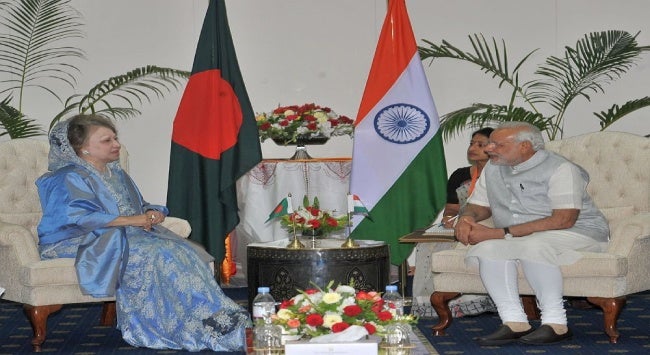
For India, Khaleda’s passing is a challenge as well as an opportunity. Historically, New Delhi enjoyed a close partnership with Hasina and the Awami League while managing prickly engagement with Khaleda’s Bangladesh Nationalist Party (BNP). The abrupt political transition in Dhaka after 2024 has cast a dark shadow over a strong bilateral partnership in trade, connectivity and security built during Hasina’s rule from 2009 to 2024. India is now cautiously preparing for engagement with a likely BNP-led government under Tarique Rahman, Khaleda’s son. However, hostile public sentiment on both sides of the border complicates diplomatic manoeuvres.
Khaleda’s entry into politics was an accidental one. After the assassination of her husband, then President Ziaur Rahman, in 1981, she took charge of the BNP in 1982. She found her political footing in opposition to the military regime of General Hussain Muhammad Ershad. Between 1983 and 1990, she led sustained mass protests against authoritarian rule, at times in a tactical partnership with Hasina. That cooperation succeeded in toppling Ershad but it also marked the beginning of a rivalry that would dominate Bangladeshi politics for the next three decades.
Reduced to the shorthand of the “battle of the begums” in the public discourse, the Khaleda-Hasina rivalry was more than personal. It reflected competing ideas about Bangladesh’s history, identity, political order and its place in the region. Both leaders anchored their legitimacy in the events of 1971, yet they disagreed fundamentally over its meaning and ownership. Hasina privileged the legacy of Sheikh Mujibur Rahman and framed the Liberation War as a secular, Bengali nationalist struggle in which India played a decisive and celebrated role. Khaleda and the BNP, shaped by Ziaur Rahman’s articulation of ‘Bangladeshi nationalism’, resisted what they saw as the Awami League’s monopolisation of 1971, Islamic cultural identity and greater autonomy from India.
The unresolved contest over history prevented Bangladesh from forging a shared national narrative. It also spilled directly into foreign policy. Nowhere was the contrast sharper than in relations with India and Pakistan. Hasina pursued an explicitly cooperative, quasi-strategic partnership with New Delhi, expanding transit arrangements, deepening security coordination and advancing cross-border connectivity. She saw India as an indispensable partner for economic growth and in countering extremism.
Khaleda, by contrast, framed India through a more sceptical lens. The BNP’s rhetoric frequently depicted Indian initiatives as hegemonic and unequal, opposing transit arrangements and highlighting unresolved disputes over water and trade. Her governments were repeatedly accused of turning a blind eye to anti-India insurgent groups operating from Bangladeshi soil although basic bilateral engagement was never abandoned.
The divergence extended to Pakistan. Hasina kept relations with Islamabad deliberately cool, linking normalisation to historical accountability for 1971. Khaleda was more open to political engagement with Pakistan, reinforcing the BNP’s ‘Pakistan-friendly’ image at home and abroad. Globally, her strategy emphasised diversified external ties, most notably with China and the West.
Khaleda also inherited and sustained her husband’s vision for strong regional institutions. Ziaur Rahman had been the principal architect of the South Asian Association for Regional Cooperation (SAARC), initiating the idea in 1980. The idea came to fruition with the founding of the organisation in 1985 in Dhaka. Khaleda treated the SAARC as a forum of sovereign equals, designed to insulate regional cooperation from bilateral disputes and to enhance the leverage of smaller states vis-à-vis India and Pakistan. In contrast, Hasina steadily reduced the prominence of SAARC in favour of India-led and subregional frameworks such as the Bangladesh-Bhutan-India-Nepal (BBIN) Initiative and the Bay of Bengal Initiative for Multi-Sectoral Technical and Economic Cooperation
Despite sharp rhetoric, Khaleda never pursued permanent estrangement from India. Geography and economic interdependence imposed limits on confrontation, and both leaders recognised the impossibility of durable hostility between Dhaka and New Delhi. For India, Khaleda was a difficult but manageable interlocutor. New Delhi neither embraced her nor sought to marginalise her, opting instead for cautious engagement. Although the Indian political class has nurtured a special attachment to Hasina, the foreign policy establishment in New Delhi recognises that neighbourhood diplomacy cannot be anchored exclusively in ties with a single political formation. Intensified engagement with Khaleda’s BNP has now become a major priority for India in Dhaka.
As Bangladesh navigates a new political transition, Khaleda’s life offers enduring insights into the intersection of nationalism, democracy and regional order. For India, the challenge is not merely to work with a new leadership in Dhaka but to ensure that the relationship with Bangladesh is durable and rooted in shared interests. The visit of India’s External Affairs Minister S Jaishankar to Dhaka for Khaleda’s funeral and his meeting with Tarique signalled New Delhi’s recognition of this new moment. Whether India can translate that recognition into a stable reset with Bangladesh will depend on diplomatic finesse – and the political will to separate an important strategic goal from the passions of domestic politics.
. . . . .
Professor C Raja Mohan is an Honorary Senior Fellow at the Institute of South Asian Studies (ISAS), an autonomous research institute at the National University of Singapore (NUS). He can be contacted at crmohan53@gmail.com. The author bears full responsibility for the facts cited and opinions expressed in this paper.
Pic Credit: Twitter
-
 More From :
-
 Tags :
-
 Download PDF