

Summary
Pakistan’s 2026-27 Shanghai Cooperation Organisation chairmanship offers Islamabad a valuable platform to expand its regional influence, strengthen ties with China, Russia and Central Asia, promote connectivity and economic cooperation, and maintain dialogue with India. It reflects Pakistan’s broader strategy of using multilateralism to advance its diplomatic interests and navigate an increasingly multipolar world.
Pakistan’s assumption of the Shanghai Cooperation Organisation (SCO) chairmanship for 2026-27 marks a significant moment for Islamabad’s regional diplomacy. Formally taking over the chairmanship on 1 September 2026 following the Bishkek summit, Pakistan will, for the first time, lead the SCO’s Council of Heads of State. This paper examines what this role means for Pakistan’s regional ambitions, diplomatic leverage and ability to shape the SCO agenda.
Multilateralism has been a persistent feature of Pakistan’s foreign policy since independence in 1947. Rather than relying solely on bilateral alliances or major-power relationships, Pakistan has used regional and international organisations to advance its security, economic and diplomatic interests. Although lacking the capabilities to shape the international system unilaterally, Pakistan can enhance its influence through multilateral diplomacy. Its commitment is evident in its founding role in several organisations. It is also a founding member of the Organization of Islamic Cooperation (OIC), established in 1969. Through the OIC, Islamabad has promoted solidarity among Muslim states and advanced issues, including Kashmir, Palestine and Islamophobia. Pakistan was a founding member of the South Asian Association for Regional Cooperation (SAARC) in 1985 and one of the three founding members of the Economic Cooperation Organization (ECO), established in the same year with Iran and Türkiye.
These organisations serve several purposes for Pakistan. They amplify its diplomatic voice, facilitate coalition-building and provide platforms to project its status as a middle power with regional and international relevance. Pakistan’s combination of demographic weight, military capabilities and nuclear status gives it a distinctive position in international and Muslim-world politics. Multilateralism also supports Pakistan’s strategy of hedging amid great-power competition. While maintaining ties with the United States, Islamabad has deepened its strategic partnership with China and expanded relations with Russia, Central Asia and other non-Western powers. This approach aligns with the National Security Policy 2022-2026, which places economic security and geo-economics alongside traditional geostrategic priorities. China is central to this strategy. The China-Pakistan Economic Corridor (CPEC) has expanded bilateral cooperation into connectivity, investment, energy and industrial development. Pakistan’s growing focus on Central Asia similarly seeks to leverage its geography to connect South Asian markets with Central Asia.
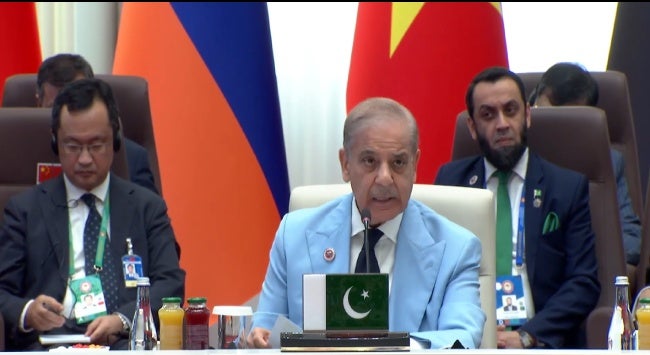
The SCO has consequently become an important institutional component of this strategy. Pakistan became a full member of the SCO in 2017, alongside India, at a time when the organisation was expanding beyond its original Central Asian and Sino-Russian core. The SCO provides Islamabad with a rare multilateral setting in which it can simultaneously engage China, Russia, the Central Asian republics and India. Pakistan’s officials have also explicitly characterised the SCO itself as a vehicle for multilateralism. At the 23rd SCO Council of Heads of Government meeting, Pakistan’s Prime Minister Shehbaz Sharif described the organisation as “a beacon of multilateralism”. In a 2026 message marking the SCO’s 25th anniversary, Pakistan’s Deputy Prime Minister and Foreign Minister Mohammad Ishaq Dar stated that Pakistan’s progression “from observer to a proactive full member since 2017, reflects our unwavering commitment to multilateralism”.
Pakistan’s increasing institutional role within the SCO reinforces this argument. During 2023-24, Pakistan chaired the SCO Council of Heads of Government and hosted the meeting in Islamabad in October 2024. In 2025-26, it chaired the SCO Regional Anti-Terrorist Structure (RATS). Most significantly, at the SCO summit in Bishkek on 1 September 2026, the chairmanship of the SCO Council of Heads of State passed from Kyrgyzstan to Pakistan for 2026-27. Pakistan announced the theme of its chairmanship as ‘Turning Vision into Action: Connectivity, Innovation and Shared Prosperity’. This evolution shows Pakistan’s proactive role within the organisation.
The SCO is also strategically important because it provides Pakistan with a channel for direct institutional engagement with India. This has particular significance given the paralysis of SAARC, where India-Pakistan tensions have severely constrained regional cooperation and contributed to the cancellation of the 2016 Islamabad summit. Unlike SAARC, the SCO continues to bring senior Indian and Pakistani officials together within a wider Eurasian framework. Already through the SCO, India and Pakistan have engaged in joint military exercises, such as the ‘Peace Mission-2018’ in Russia. The organisation, therefore, provides opportunities for engagement on shared concerns, such as terrorism, Afghanistan, connectivity and regional stability, even when bilateral tensions remain high.
The SCO additionally strengthens Pakistan’s engagement with Kazakhstan, Kyrgyzstan, Tajikistan and Uzbekistan. These Central Asian states are important to Pakistan’s long-term ambitions for regional connectivity, energy cooperation, trade and access to Eurasian markets. Pakistan’s participation in both the SCO and ECO, therefore, complements its geo-economic strategy by embedding its relations with Central Asia within established multilateral institutions. Hence, Pakistan has often projected the significance of the CPEC in SCO meetings, for example at the May 2024 meeting of the SCO Council of Foreign Ministers in Astana. Finally, Pakistan’s multilateralism cannot be separated entirely from its Islamic identity. Six of the SCO’s 10 members, namely, Pakistan, Iran, Kazakhstan, Kyrgyzstan, Tajikistan and Uzbekistan, are Muslim-majority states. The SCO, therefore, provides Islamabad with another platform where its pan-Islamic approach meets with its geopolitical motives.
Ever since its establishment, multilateralism remains a potent strategic instrument of statecraft for Pakistan. Through the United Nations, OIC, SAARC, ECO, SCO and other institutions, Pakistan seeks to expand its diplomatic influence, diversify its external relationships, manage great-power competition and avoid excessive dependence on any single external partner. Its growing engagement with the SCO proves this logic in foreign policy decision-making that Pakistan can deepen its relationship with China and Russia, engage Central Asia, maintain an institutional channel of engagement with India, pursue geo-economic connectivity and reinforce its role in the Muslim world. For Pakistan, multilateralism is closely connected to its broader strategy of hedging in an increasingly multipolar international system.
. . . . .
Dr Zahid Shahab Ahmed is an Associate Professor at the National Defense College of the United Arab Emirates in Abu Dhabi in the United Arab Emirates and a Non-Resident Fellow at the at the Institute of South Asian Studies (ISAS), an autonomous research institute at the National University of Singapore (NUS). He can be contacted at zahid.ahmed@deakin.edu.au. The author bears full responsibility for the facts cited and opinions expressed in this paper.
Pic Credit: X
-
 More From :
-
 Tags :
-
 Download PDF