


Summary
Bangladesh’s first female prime minister, Khaleda Zia, died on 30 December 2025. A pivotal figure in the country’s political life since the early 1980s, she played a significant role in shaping Bangladesh’s two-party system and the trajectory of opposition politics. Her legacy, however, is inseparable from the deep polarisation that has defined Bangladeshi politics for decades. It was forged as much through prolonged confrontation with the Awami League and Sheikh Hasina as through her efforts to consolidate the Bangladesh Nationalist Party as a durable national opposition force.
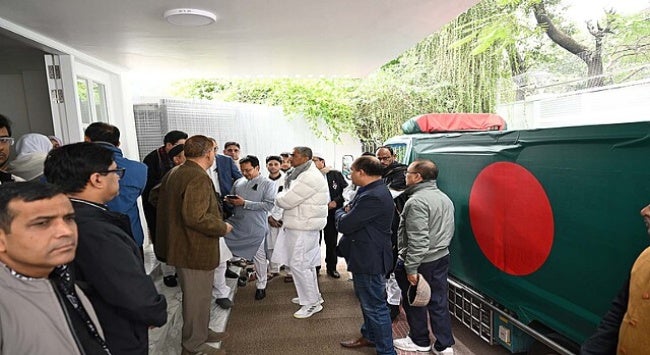
The passing of Bangladesh’s former prime minister, Khaleda Zia, in the early hours of 30 December 2025 marked the end of a defining political career in Bangladesh. As a three-time prime minister and long-time chairperson of the Bangladesh Nationalist Party (BNP), she was widely regarded by supporters as Deshnetri (Leader of the Nation). Her death was marked by three days of state mourning and a nationwide holiday, with national flags flown at half-mast and special prayers held across the country.
Khaleda’s position within Bangladesh’s political landscape was neither inevitable nor fully formed in the years following her husband Ziaur Rahman’s assassination in 1981. She entered politics identified primarily as his widow at a time of military rule under General Hossain Muhammad Ershad (1982-90). Her early political authority remained closely tethered to her late husband’s legacy.
Martial law under Ershad limited how opposition leaders could organise, mobilise or claim legitimacy, as a direct consequence of political engineering and state repression aimed at fragmenting and suppressing opposition forces. Khaleda is long remembered for her principled opposition to the 1986 elections on the grounds that polls held under martial law could not confer democratic legitimacy upon Ershad’s authoritarian rule. That stance exposed the fragility of opposition unity and politics once Sheikh Hasina and the Awami League chose to participate in the elections rather than sustain a collective boycott. This rupture did not merely divide the opposition tactically; it exposed a deeper, entrenched antagonism.
Like Hasina, Khaleda articulated her opposition through personal grievance. She blamed Ershad for her husband’s killing, just as Hasina continued to associate Ziaur Rahman with her father’s death. However, this unusual symmetry did not mitigate political distance between the two political dynasties. Instead, it beset the course for a dysfunctional, unstable relationship between the Awami League and the BNP, defined by a long-running and intense rivalry that is characterised by deep mistrust, frequent confrontation between supporters and recurring political violence.
Despite shifts in power and democratic openings, this dynamic endured as the foremost feature of national politics. Neither Khaleda nor Hasina ultimately succeeded in transcending it. Cooperation between the two parties often remained episodic, self-serving, and strategic. These dynamics often worked to paralyse democratic processes, with personal hostility between the two leaders shaping political outcomes as much as, if not more than, ideological differences. As political analyst Arifur Rahaman explains, Bangladesh is “a country where politics often treats opposition as an enemy rather than a competitor”.
Nevertheless, Khaleda left a substantive institutional legacy. As prime minister, she was instrumental in both restoring parliamentary democracy after years of military rule as well as the introduction of a caretaker government system. The reforms shaped the conduct of electoral politics in Bangladesh, and her focus on accessible education and women’s empowerment and welfare contributed to social policy initiatives that sought to strengthen human development. In his condolence message, Chief Adviser Muhammad Yunus described her as “a great guardian”, acknowledging the indelible mark she had left on the nation’s history.
However, Khaleda was also accused of presiding over periods marked by the growth of Islamist militancy, rising religious intolerance, widespread allegations of corruption and controversies over electoral manipulation. The decision to ban Ahmadiyya publications in 2004 was seen by critics as reflecting the growing influence of Islamist actors in her government and as discriminatory and inconsistent with constitutional guarantees of religious freedom.
These criticisms formed part of a broader pattern of governance failures. However, these failures cannot be understood in isolation from the structural pressures of polarised politics, weak institutions and the adversarial logic that shaped governance across successive administrations. Moreover, Khaleda’s life in politics presents the paradox of Bangladesh’s democratic experience in which electoral politics and institutional reforms advanced (and retracted) alongside enduring, if not increasing, polarisation and the erosion of the country’s democratic political culture.
Where democratic competition hardened into zero-sum rivalry, institutional reform proved insufficient to cultivate the political trust and restraint necessary for long-term democratic consolidation, Khaleda’s legacy embodies the achievements, contradictions and limitations of Bangladesh’s contested and incomplete democratic project. She will be remembered as a leader whose achievements and failures mirrored the unresolved tensions of Bangladesh’s democratic project.
. . . . .
Dr Imran Ahmed is a Research Fellow at the Institute of South Asian Studies (ISAS), an autonomous research institute at the National University of Singapore (NUS). He can be contacted at iahmed@nus.edu.sg. The author bears full responsibility for the facts cited and opinions expressed in this paper.
Pic Credit:Wikimedia Commons
-
 More From :
-
 Tags :
-
 Download PDF