


Summary
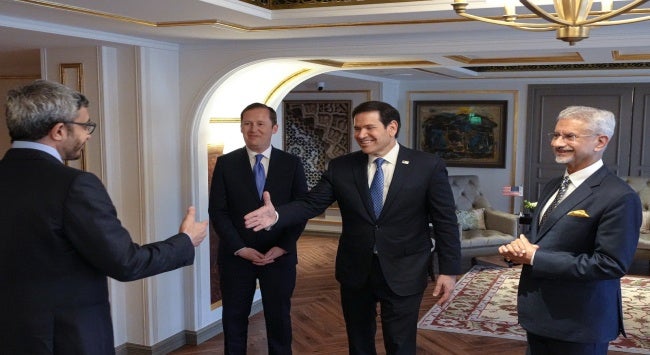
The visit of United States Secretary of State Marco Rubio to India in October 2026 has helped stabilise bilateral relations after a turbulent period in President Donald Trump’s second term. The visit raised expectations of an early trade agreement, opened possibilities for deeper energy cooperation and reaffirmed Washington’s commitment to the Quadrilateral Security Dialogue. For New Delhi, the challenge is to turn this political opening into durable arrangements.
United States (US) Secretary of State Marco Rubio’s visit to Mumbai and Jamnagar this week has helped calm India’s nerves over the future of relations with America. President Donald Trump’s threat of tariffs on the Indian import of Russian oil, Washington’s renewed warmth towards Islamabad and uncertainty over the future of the Quadrilateral Security Dialogue (Quad), had generated considerable political anxiety in India. Rubio’s visit has signalled the US with the intent to put the relationship back on track and revitalise it during the remainder of Trump’s term.
Despite the turbulence triggered by Trump, the Indian government has sought to stay engaged with the US. New Delhi had good reasons to welcome Rubio’s second visit to India in six months. Rubio combines the offices of Secretary of State and National Security Adviser, a concentration of diplomatic authority last seen under Henry Kissinger in the 1970s. As a senator from Florida, Rubio consistently supported closer ties with India. As a potential Republican presidential candidate in 2028, Rubio could remain an important figure in American politics. New Delhi’s investment in the relationship with him is, therefore, a prudent long-term bet.
The most immediate positive signal from Rubio’s visit was on the question of the long-pending bilateral trade agreement. Rubio told the Indian media that the two sides were “weeks, not months” away from concluding the negotiations and that “99 per cent of the work” was complete. Although the two governments had announced progress earlier this year, the agreement remained unsigned. Rubio’s intervention suggests that Washington is ready to move towards a settlement. The US is the largest destination for India’s exports and stability on the trade front is a crucial concern in New Delhi.
The second issue concerns India’s purchases of Russian oil. US tariffs imposed on this score had caused considerable resentment in New Delhi. Trump’s signing of the Sanctioning Russia and Iran Act in September 2026 with its sweeping provisions on reimposing sanctions up to 100 per cent on Russian oil purchases have reinforced this resentment. India had cautioned the US that the imposition of new sanctions could significantly affect the bilateral relationship. Just before Rubio’s visit, the White House paused the imposition of these tariffs. In Mumbai, Rubio suggested that Washington does not want its sanctions policy to undermine the strategic partnership with India.
Rubio’s visit to Reliance Industries’ Jamnagar refinery highlights the expanding possibilities for energy cooperation. Describing India as a “refining superpower”, Rubio suggested that the US could become an important partner in India’s energy security. Jamnagar is the world’s largest single-site refining complex, with the ability to process different grades of crude oil markets. Reliance has already emerged as a favoured refiner of the heavy crude of Venezuela now controlled by the US. Over the last few years, India has emerged as a major importer of American hydrocarbons. Rubio’s visit has sought to elevate this cooperation to the refining arena and a collaborative effort to stabilise the global oil markets amid the continuing conflicts in Ukraine and the Strait of Hormuz.
On the future of the Quad, Rubio had positive signals to offer. Although the annual Quad leaders’ summit did not take place in 2025, the grouping has continued its work at the ministerial level. Rubio described the Quad as moving from broad ideas towards practical cooperation. He hinted at a Quad ministerial meeting in Atlanta, on the margins of the G-20 foreign ministers meeting next month. Rubio also talked up the prospect for a leaders’ summit in Manila on the margins of the East Asia Summit. Rubio was reassuring India that the management of US competition with China will not be at the expense of America’s alliances and partnerships in Asia.
On immigration, New Delhi has wisely avoided making the H-1B controversy a central issue in bilateral diplomacy. The debate is primarily between American companies seeking international talent and domestic political groups demanding tighter immigration controls. Once the current restructuring of American immigration rules is completed, the demand for skilled workers is likely to remain an important consideration. Indian professionals are well placed to benefit from that demand.
Trump’s engagement with Islamabad, particularly the Pakistani military leadership, has revived familiar Indian concerns about Washington’s regional priorities. Yet the history of India-US relations offers a useful perspective. Some of the most important advances in bilateral relations, including the civil nuclear initiative, took place during the 2000s, when Washington maintained a close military partnership with General Pervez Musharraf’s Pakistan.
Realists in New Delhi suggest that the India-US partnership must be judged on its own merits rather than through the prism of Pakistan. In Mumbai, Rubio visited the memorial for the victims of the terror attacks of 26/11 in 2008 and pointed to the shared interests with India on countering terrorism. Defending the engagement with Pakistan, Rubio argued that continued engagement with Islamabad could give Washington greater influence over its decisions on a range of issues. Rubio’s visit has not resolved every disagreement between New Delhi and Washington. However, it has demonstrated the US commitment to sustain the strategic partnership with India. The US remains central to India’s access to markets, technology and capital. It is also an important partner in ensuring a multipolar Asia. For New Delhi, the immediate priority is to convert the improved political atmosphere into concrete agreements and institutional arrangements. The larger task is to preserve the partnership through the uncertainties of American domestic politics.
. . . . .
Professor C Raja Mohan is an Honorary Senior Fellow at the Institute of South Asian Studies (ISAS), an autonomous research institute at the National University of Singapore (NUS). He can be contacted at crmohan53@gmail.com. The author bears full responsibility for the facts cited and opinions expressed in this paper.
Pic Credit: (21) rubio india – Search / X
-
 More From :
-
 Tags :
-
 Download PDF