


Summary
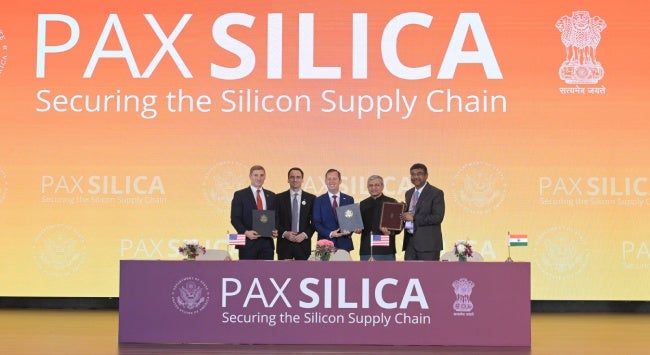
India’s entry into the United States (US)-led Pax Silica Initiative and the India-US Artificial Intelligence (AI) Opportunity Partnership help renew the bilateral technology relationship after the turbulence of 2025. The deepening of India-US integration across silicon supply chains and AI computing structures access is bound to have ripple effects on Asian geopolitics and the evolving international architecture of AI.
India’s decision to join the Pax Silica Initiative and sign the Artificial Intelligence (AI) Opportunity Partnership is an important turning point in the long, uneven, yet steadily deepening technological partnership between India and the United States (US). The announcements in February 2026, on the margins of the AI Impact Summit in New Delhi, have come after a year marked by tariff friction and deep dissonance over President Donald Trump’s involvement in the India-Pakistan conflict of May 2025. They mark a moment when both countries rediscovered each other’s importance in shaping the geopolitics of technological power in the coming decades.
Forward movement in sensitive technological areas is particularly striking given how frayed the India-US relationship appeared in 2025. Tariff clashes dampened political goodwill; and Trump’s intervention in the sensitive dynamics of India-Pakistan relations revived longstanding suspicion in New Delhi of the US ‘tilt’ to Pakistan, a perception that had cast a long shadow over India-US ties in the 1970s.
Yet one factor remained unchanged – the slow but definitive momentum of mutually beneficial technological cooperation. The new framework for semiconductor supply chains and the AI partnership underlines the continuing convergence of the technology interests of India and the US.
Both Pax Silica and the AI partnership highlight the reality that India and the US increasingly depend on each other to navigate the frontier where computing power, semiconductors, and AI models define national power. For India, no partner offers the scale of compute, the depth of scientific research or the speed of private-sector innovation that the US does. For Washington, India’s engineering workforce, a data-rich environment and an expansive market make it indispensable.
This sense of necessity was reinforced by the Trump administration’s broader AI strategy. In July 2025, Trump issued an executive order establishing the American AI Exports Programme, mandating federal agencies to accelerate the global export of what Washington terms the ‘American AI stack’ – from AI-optimised chips and servers to data architectures, foundation models, cybersecurity layers and sector-specific applications.
Rejecting multilateral, treaty-based approaches to ‘global AI governance’, White House officials articulated a vision of ‘AI sovereignty’, which, as Office of Science and Technology Policy Director Michael Kratsios put it, empowers partners to fuse US technology with local data, languages, and national champions. This framing created the political and conceptual space for Washington’s intensified courtship of India as the anchor democratic partner in Asia. India, meanwhile, has complemented its rhetoric and diplomacy on global governance of AI at the New Delhi Summit, with a hard-nosed focus on boosting national capabilities by advancing the technological partnership with the US.
It is in this wider strategic context that India’s entry into Pax Silica must be understood. Pax Silica is not an exercise in supranational governance. It is a practical coalition aimed at securing the upstream materials – quartz, polysilicon and critical minerals – on which the semiconductor industry depends. The 2025 shortages exposed the scale of global dependence on China’s near-monopoly on refining and mineral processing. Bringing India into Pax Silica is, therefore, a calculated American bet: India’s semiconductor ambitions, expanding industrial base and critical minerals initiatives offer important options for diversification.
For New Delhi, Pax Silica aligns closely with its ambition to build domestic capabilities in AI. Ensuring stable access to upstream inputs – and, crucially, to the US AI stack – is now essential for India’s plan to take the new technology to the people and integrate AI into the wider economy.
Private-sector momentum reinforces the alignment between New Delhi and Washington. Google’s US$15 billion (S$18.98 billion) investment plan to create a gigawatt-scale AI hub in Visakhapatnam reflects the commitment to anchor India in the global semiconductor and AI manufacturing map. According to Micron, Indian engineers have contributed nearly 2,000 patents since 2019. These investments reflect a deeper structural shift: leading American technology companies increasingly view India as a central node in their global operations.
If Pax Silica secures the hardware backbone, the India-US AI Opportunity Partnership reboots the compute layer. Under the tiered AI diffusion regime issued in the final weeks of the Joe Biden administration in January 2025, India’s Tier 2 designation capped Graphics Processing Unit imports and obstructed its ability to scale foundation-model training. Trump is now reversing that framework by effectively upgrading India through more intensive cooperation. The US also plans to integrate Indian companies into the broader American AI ecosystem and address India’s long-standing compute deficit, strengthening the Indian government’s ambition for rapid AI diffusion across the Indian economy.
Although framed as bilateral initiatives, the geopolitical consequences of these agreements are unmistakable. The India-US AI initiatives help build technology networks that are less dependent on China. As US Under Secretary of State Jacob Helberg noted, the Pax Silica coalition and the AI partnership together represent a collective rejection of “weaponised dependency”.
For Washington, India’s inclusion brings the scale of a large market and the engineering depth to its global AI strategy. For India, the partnership offers access to more advanced AI tools and industrial partnerships. India and the US have entered a new technological compact, grounded in convergent strategic assessments and complementary capabilities. This is not merely a moment of diplomatic recovery in the India-US relations; it marks the effort to construct a consequential partnership that will contribute to the geopolitical evolution of the global AI landscape in the coming decades.
. . . . .
Professor C Raja Mohan is an Honorary Senior Fellow at the Institute of South Asian Studies (ISAS), an autonomous research institute at the National University of Singapore (NUS). He can be contacted at crmohan53@gmail.com. The author bears full responsibility for the facts cited and opinions expressed in this paper.
Pic Credit: X
-
 More From :
-
 Tags :
-
 Download PDF