


Summary
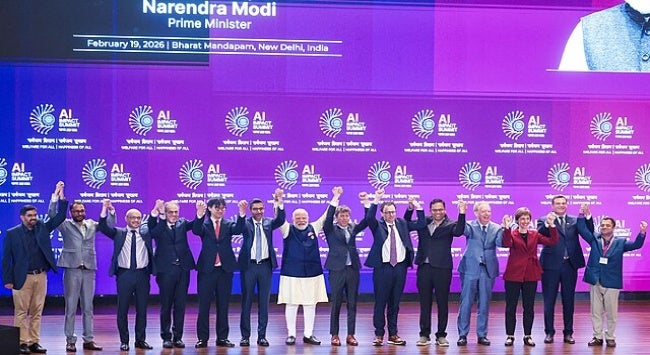
The India AI Impact Summit 2026, organised under the IndiaAI Mission by the Indian government of and the Ministry of Electronics and Information Technology, was the first summit in the series hosted by a Global South nation. The event drew delegations from over 80 countries, including about 20 heads of state and about 300,000 participants. With the theme of ‘AI for All’, the summit reflected India’s broader development philosophy and affirmed its resolve in becoming a leading country in shaping the artificial intelligence revolution.
India hosted one of the most consequential global gatherings on artificial intelligence (AI) from 16 to 21 February 2026 at Bharat Mandapam, the iconic venue that has increasingly become the venue for India’s major international engagements. The India AI Impact Summit 2026 marked a significant milestone not only in the country’s technological ambitions but also in the evolving global discourse on the governance, ethics and equitable development of AI. Being held at a time when AI systems are transforming economies, labour markets, security doctrines and social interactions, the summit positioned India as a central actor in shaping the next phase of the AI revolution.
The summit was notable for its scale and diversity. It drew participation from governments, international organisations, global technology companies, start-ups, academia and civil society from over 80 countries. For India, the event was not merely ceremonial; it was an opportunity to articulate a distinctive vision – one rooted in inclusivity, digital public infrastructure, multilingualism and responsible innovation. The deliberations, announcements and agreements that emerged from the summit collectively signal a decisive shift: India is no longer content with being a large market for AI technologies developed elsewhere; it seeks to be a developer, rule-shaper and norm-setter in its own right.
India’s Vision: ‘AI for All’
A central theme of the summit was ‘AI for All’, reflecting India’s broader developmental philosophy. Unlike some advanced economies where AI discussions are dominated by frontier model capabilities or strategic competition, India emphasised the developmental dimension of how AI can enhance public service delivery, agricultural productivity, healthcare access, financial inclusion and educational quality. These areas are of critical social and economic significance for India to achieve the status of a developed nation by 2047, a goal that the government has set for itself.
This framing aligns with India’s experience in building large-scale digital public goods, such as digital identity, payments and data platforms. At the summit, policymakers stressed that AI must complement these digital public infrastructures rather than exist in isolation. By embedding AI within public systems, whether in telemedicine platforms, crop advisory systems, or grievance redress portals, India aims to harness AI not just for corporate productivity but for social transformation too.
The summit underscored three interconnected principles: inclusivity, responsibility and sovereignty. Inclusivity meant that AI tools should be accessible in multiple Indian languages and usable by citizens across socio-economic strata. Responsibility referred to ethical standards, transparency and safety in AI systems. Sovereignty involved the capacity to build and deploy AI models using domestic data and compute infrastructure, reducing overdependence on external actors.
The New Delhi Declaration: Towards Global Consensus
One of the most significant outcomes of the summit was the adoption of a multilateral declaration endorsed by a broad group of participating countries. Though non-binding, the declaration articulated shared commitments to safe, secure and trustworthy AI; equitable access to AI benefits; and strengthened international cooperation.
For India, the declaration served multiple purposes. First, it elevated the country’s standing in global AI governance debates. While earlier summits in other parts of the world had focused heavily on AI safety or frontier risks, the New Delhi gathering widened the lens to include development and inclusion. Second, it demonstrated India’s ability to convene diverse stakeholders and bridge divides between advanced and developing economies. By foregrounding the concerns of the Global South such as capacity building, technology transfer and equitable participation, India carved out a distinctive diplomatic niche.
The declaration also emphasised collaboration between governments and industry. Recognising that frontier AI models are largely developed by private companies, the summit encouraged voluntary commitments by firms to uphold transparency, invest in safety research and participate in multilingual evaluation initiatives. This multi-stakeholder approach reflects the complex ecosystem within which AI evolves.
Investment Commitments and Infrastructure Expansion
Another headline achievement of the summit was the scale of investment commitments announced. Large pledges were made for AI infrastructure, including high-performance computing facilities, data centres and semiconductor manufacturing initiatives. Venture capital funds signalled increased allocations for Indian deep-technology start-ups.
For India, these investments are critical. AI development requires immense computational resources, advanced chips and robust cloud infrastructure. Historically, such capabilities have been concentrated in a handful of countries. By attracting capital into AI infrastructure, India moves closer to building a domestic ecosystem capable of training and deploying large models. It can thus be an asset for other South Asian countries seeking to broaden the base of their AI infrastructure.
The economic implications are far-reaching. Expanded AI infrastructure can stimulate job creation in engineering, research, data science and hardware manufacturing. It can also enhance productivity across sectors such as manufacturing, logistics and financial services. Moreover, infrastructure investments send a powerful signal to global markets: India is committed to being a long-term player in AI, not a peripheral adopter. This message had also been sent out in the Indian budget which was presented on 1 February 2026 by announcing a tax holiday through 2047 for foreign companies providing global cloud services using Indian data centres.
The summit brought forth large Indian corporates displaying their readiness and capacity for capital investment in the sector. Reliance Industries announced its readiness to invest US$110 billion (S$148.5 billion) to build India’s sovereign AI infrastructure.[1] The investment is planned over seven years and also includes data centres and a nationwide edge compute network.
Another conglomerate, among many others who have concluded similar collaborations, is the Tata Group, which has entered into a strategic partnership with OpenAI. In the first phase, Tata Consultancy Services is expected to build an AI infrastructure with 100-megawatt capacity, scalable up to one gigawatt.[2] The platform is intended to support next-generation AI training and inference workloads while advancing India’s ambition to become a global AI hub. As part of the global Stargate initiative, OpenAI and Tata Group will develop local, AI-ready data centre capacity focused on data residency, security and long-term domestic capacity.
Indigenous AI Models and Multilingual Innovation
A particularly symbolic dimension of the summit was the showcasing of indigenous AI models developed by Indian firms and research institutions. These included large language models (LLMs) trained on Indian datasets and optimised for multiple Indian languages. Such models are essential in a country where hundreds of millions of citizens communicate primarily in regional languages.
A significant case in point is the showcasing of the indigenously developed Sarvam model – the largest model trained from scratch in India. While it purports to be a global model, it is built with Indian contexts in mind. Being smaller in scale, in comparison with Gemini and ChatGPT, the model is projected to be more efficient and cost-effective. The home-grown start-up launched a 105-billion-parameter foundational LLM along with a suite of tools designed for commercial use.[3]
The development of multilingual AI has both social and strategic significance. Socially, it democratises access to AI-driven tools such as chatbots, digital assistants, educational tutors, thereby ensuring that they are not limited to English-speaking elites. Strategically, it enhances digital sovereignty. When foundational AI systems are trained on local data and fine-tuned for domestic contexts, countries gain greater control over how those systems operate and evolve.
By showcasing home-grown models, India signalled its ambition to move up the value chain, from being a provider of information technology (IT) services and back-end support to becoming a creator of foundational AI technologies. This transition is central to the country’s aspiration to become a developed economy in the coming decades.
Sectoral Impacts: Governance, Agriculture, Healthcare and Education
The summit placed strong emphasis on real-world applications. In governance, AI tools are being integrated into public grievance systems, predictive analytics for welfare targeting and urban planning. State governments announced collaborations to deploy AI assistants in public services, reflecting decentralised innovation within India’s federal structure.
In agriculture, AI-powered advisories can provide farmers with crop recommendations, pest alerts and weather forecasts. Given that agriculture employs a substantial share of India’s workforce, even modest productivity gains could have large developmental impacts. Similarly, in healthcare, AI can assist in diagnostics, radiology and disease surveillance, particularly in underserved rural areas where medical specialists are scarce.
Education is another domain of transformation. Adaptive learning platforms, AI-driven assessment tools and virtual tutors can personalise instruction for millions of students. The summit highlighted skill development initiatives aimed at training India’s youth in AI-related competencies. With one of the world’s largest young populations, India’s demographic dividend can become an AI dividend if skills development keeps pace with technological change.
AI Safety, Ethics and Cybersecurity
While celebrating AI’s promise, the summit also acknowledged its risks. Discussions covered issues such as algorithmic bias, misinformation, deepfakes, data privacy and autonomous systems. A significant announcement was the establishment of collaborative research initiatives focused on AI safety and cybersecurity.
As AI systems become more capable, they can also be misused for sophisticated cyberattacks or disinformation campaigns. Strengthening cyber resilience is therefore essential. By promoting partnerships between telecom firms, cybersecurity companies and research institutions, India seeks to build capacity to defend critical infrastructure against AI-enabled threats.
It was also of significance that ethical considerations were woven into the summit’s narrative. Emphasis was placed on transparency, accountability and explainability in AI systems. These principles align with India’s broader legal and regulatory framework, including data protection norms and digital governance policies.
International Partnerships and South-South Cooperation
A noteworthy feature of the summit was its focus on collaboration with other developing nations. India explored partnerships with countries in Africa and Asia to share AI expertise and support sovereign AI initiatives. Such cooperation enhances India’s diplomatic influence and reinforces its image as a champion of the Global South. Among the global leaders who attended the summit was Mrs Josephine Teo, Singapore’s Minister for Digital Development and Information. Speaking at the summit, she emphasised sustained investment in responsible AI research and highlighted Singapore’s commitment to AI that benefits the public good and is scientifically grounded.[4] Her participation underscored Singapore’s engagement in global conversations on AI governance and ethical development. Singapore and India closely collaborate on digital public infrastructure and fintech cooperation among many other strategic partnerships.
Recognising the skewed power structure wherein Big Tech and Silicon Valley dominate the global AI ecosystem, there are compelling considerations to seek more diversified pathways. The Indian prime minister offered an alternative vision, in which AI will not emerge as a strategic asset but rather the framework would centre around open code and shared development. By positioning itself as a bridge between advanced economies and developing nations, India enhances its strategic leverage. In a world where AI capabilities are increasingly linked to geopolitical power, partnerships can shape alliances and supply chains. Collaborative initiatives on semiconductor manufacturing, data governance and research exchange strengthen India’s role in emerging technology networks.
Economic Transformation and Future Growth
AI is projected to contribute significantly to global Gross Domestic Product (GDP) in the coming decades. For India, integrating AI into manufacturing, logistics, fintech and services can drive productivity gains and innovation. Start-ups leveraging AI in financial technology, health technology, agriculture technology and education technology can attract global capital and create high-value employment.
The summit’s emphasis on venture funding and start-up incubation indicates recognition that innovation often emerges from agile enterprises. By connecting entrepreneurs with investors and policymakers, the summit created pathways for scaling AI solutions. Over time, such ecosystems can transform India from a service-oriented IT hub into a deep-tech powerhouse.
Challenges and the Road Ahead
Despite the optimism, challenges remain. Infrastructure expansion must be matched by regulatory clarity. Skill development initiatives must reach beyond metropolitan centres. Ethical guidelines must be translated into enforceable standards. Furthermore, ensuring equitable access to AI benefits requires sustained public investment.
There were also practical lessons from the summit’s scale, managing large crowds, coordinating multiple sessions and balancing high-level diplomacy with grassroots engagement. These are growing pains of a country stepping into a leadership role.
Conclusion: A Strategic Inflection Point
The summit may well be remembered as a strategic inflection point in India’s technological journey. It consolidated India’s aspiration to be not just a participant but a shaper of the global AI order. By foregrounding inclusivity, responsibility and sovereignty, the summit articulated a model of AI development aligned with India’s democratic and developmental ethos.
The achievements, ranging from international endorsements and investment commitments to indigenous model launches and sectoral partnerships, provide tangible momentum. More importantly, the summit reframed the global conversation to include the priorities of emerging economies.
If sustained through policy continuity, infrastructure investment, skill development and ethical oversight, the outcomes of the summit could catalyse a new phase of economic and social transformation. In that sense, the summit was not merely an event; it was a declaration of intent, an assertion that India intends to help shape the future of AI in a manner that is inclusive, secure and development-oriented.
. . . . .
Mr Vinod Rai is an Honorary Senior Fellow at the Institute of South Asian Studies (ISAS), an autonomous research institute at the National University of Singapore (NUS). He is also a former Comptroller and Auditor General of India. He can be contacted at raivinod@hotmail.com. The author bears full responsibility for the facts cited and opinions expressed in this paper.
[1] “Mukesh Ambani announces $110bn push for AI sovereign infra”, MSN, 19 February 2026, https://www.msn.com/en-in/money/news/mukesh-ambani-announces-110bn-push-for-ai-sovereign-infra/ar-AA1WHtCD?ocid=BingNewsSerp.
[2] “Tata Group ties up with OpenAI”, The Times of India, 20 February 2026, http://timesofindia.indiatimes.com/articleshow/128583076.cms?utm_source=contentofinterest&utm_medium=text&utm_campaign=cppst.
[3] Shilpa Phadnis & Supriya Roy, “Sarvam’s 105-bn model puts India on the frontier AI map”, The Times of India, 20 February 2026, http://timesofindia.indiatimes.com/articleshow/128592898.cms?utm_source=contentofinterest&utm_medium=text&utm_campaign=cppst.
[4] Press Information Bureau, AI Governance Must Be Firmly Rooted in Scientific Evidence and Human Rights, Says António Guterres at India AI Impact Summit 2026, Press Release, (New Delhi: Press Information Bureau, 20 February 2026), https://www.pib.gov.in/PressReleasePage.aspx?PRID=2230757&utm.
Pic Credit: Wikimedia Commons
-
 More From :
-
 Tags :
-
 Download PDF