


Summary
India and the European Union (EU) have signed a historic free trade agreement after nearly two decades of negotiation. The deal is significant as it covers a market of over two billion people and a large share of global gross domestic product and trade. For India, it offers expanded exports, cheaper inputs and deeper integration into global value chains. For the EU, it secures market access in a fast-growing economy and strengthens strategic ties amid shifting global trade alignments.
Speaking at the World Economic Forum in Davos on 20 January 2026, the European Commission’s President, Ursula von der Leyen, signalled that negotiations between India and the European Union (EU) were approaching a significant phase, and that the two sides were on the cusp of a historic trade agreement that could reshape global commerce and supply chains. She framed the prospective India-EU free trade agreement (FTA) as part of Europe’s broader strategy to champion fair trade over tariffs, partnership over isolation, sustainability over exploitation. She went on to say that “some call it the mother of all deals”. This statement set a buzz among all nations across the globe as it would affect as many as two billion people.
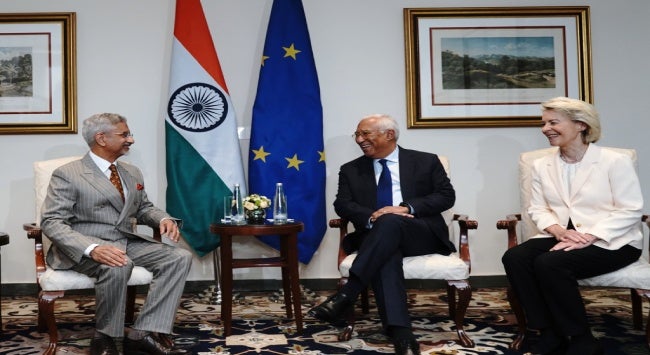
On 27 January 2026, India and the EU reached an FTA to deepen economic and strategic ties after nearly two decades of negotiations. The Foreign Trade Agreement (FTA) is a comprehensive trade and economic partnership designed to liberalise trade in goods and services, enhance investment flows and deepen regulatory cooperation between India and the EU.
The accord will see free trade on almost all goods (96.6 per cent), between the EU’s 27 members and India covering everything from textiles to medicines and bringing down high import taxes for European wine and cars. The EU is expected to announce similar reductions in phases that will eventually cover nearly 99 per cent of India’s shipments by trade value. India and the EU also agreed on a framework for deeper defence and security cooperation, and a separate pact aimed at easing mobility for skilled workers and students, signalling that their partnership extends beyond commerce.
India has excluded dairy products such as milk and cheese from the deal, along with cereals, due to certain domestic sensitivities about those products. On the other hand, the EU will not allow concessional tariffs on imports of Indian sugar, meat, poultry and beef products.
A formal signing of the deal could come later this year after officials go through the legal details of the text and the European Parliament ratifies it.
The deal once signed would help India diversify its export destinations as part of a strategy to offset the impact of higher United States (US) tariffs, including an extra 25 per cent levy on Indian goods for its unabated purchases of discounted Russian oil, bringing the combined tariffs imposed by the US on its Asian ally to 50 per cent. For the EU, the deal offers the EU expanded access to the world’s fastest growing major economies and helps European exporters and investors reduce their reliance on more volatile markets.
It is widely concluded that the negotiations for the deal received an impetus after the US decided to impose punitive tariffs on India for importing Russian oil as well as Washington’s disappointment with the European nations for opposing its attempts to establish sovereignty over Greenland.
While the full text of the treaty is still being finalised, the substantive terms agreed in principle, leading to tariff elimination and market access for Indian exports, provide that the EU will give zero-duty or preferential access for over 99 per cent of Indian exports by value, including textiles, leather, gems and jewellery, marine products, chemicals and engineering goods. This is expected to significantly boost sectors in which India has comparative advantage.
On its part, India will cut tariffs substantially on most European goods; for example, automobiles where tariffs will be cut from about 110 per cent to around 10 per cent over a phased period. Duties will also be reduced on EU agricultural processed foods, wines, spirits such as wine tariffs cut from extremely high rates to roughly 20-30 per cent.
In terms of services and mobility, the deal includes strong commitments on services trade liberalisation, covering information technology, professional services, and financial and business services. It also establishes a mobility framework facilitating movement of skilled professionals, though this is subject to national visa policies. To boost investment facilitation and business climate between the two groups, the FTA contains provisions to boost investment flows and improve regulatory cooperation, offering clarity and transparency on investment rules. Notably, it focuses on investment facilitation rather than full investor-state dispute settlement mechanisms, which is a political compromise to allay Indian regulatory autonomy concerns. A significant feature of the FTA is that it includes strategic elements to enhance supply chain resilience, including cooperation on trade corridors like the India-Middle East-Europe Economic Corridor, an Indian initiative.
The FTA has, however, kept certain measures out of the immediate scope of tariff elimination and facilitation process. In particular EU’s Carbon Border Adjustment Mechanism remains in force within the deal, with ongoing discussions on technical modalities. Also, certain quotas, phased reductions and sensitive product carve-outs remain part of the agreed structure.
Though the deal has been announced, there are several procedural steps remaining before implementation can begin.
The negotiated text must undergo ‘legal scrubbing’ which is a detailed review to clean up ambiguities, ensure legal consistency and prepare a final consolidated text which will be translated in all European languages. The final treaty text will then be formally signed by representatives of India and the EU. It will then have to be approved by the European Parliament. Depending on the legal classification of the treaty text (mixed agreement or exclusive EU competence), national parliaments of EU member states may also need to ratify it national scrutiny.
In India, the agreement must be approved by the Union cabinet and parliament through appropriate legislative measures before it can enter into force domestically.
The FTA signals a changing world order for trade and commerce as nations seek to widen their market access. It is also an attempt of the Indian government to diversify its trade and strategic partners.
. . . . .
Mr Vinod Rai is an Honorary Senior Fellow at the Institute of South Asian Studies (ISAS), an autonomous research institute at the National University of Singapore (NUS). He is also a former Comptroller and Auditor General of India. He can be contacted at raivinod@hotmail.com. The author bears full responsibility for the facts cited and opinions expressed in this paper.
Image: Twitter account
-
 More From :
-
 Tags :
-
 Download PDF